Zinc can interfere with some urine drug screens in a laboratory, but only when it is added directly to the sample in very large amounts. Taking a zinc supplement is a different matter: the best controlled data we found shows that oral zinc did not push urine zinc into the range that interfered with the test. Dropping zinc sulfate into a specimen is also adulteration, and labs and review officers treat it that way.
This guide walks through what the studies measured, what that means for a THC screen, how labs check a sample’s integrity, and what a zinc supplement can and cannot do before a pre-employment or random test.
TL;DR
- Lab studies from 2011 to 2015 found that zinc sulfate added to urine can cause false-negative results on immunoassay screens, including for THC metabolite.
- In the 2013 EMIT study, the interfering concentrations were about 5,000 times a typical random-urine zinc level, and oral zinc did not reach that range.
- Adding zinc to a specimen is adulteration. A flagged or invalid sample usually leads to a recollection or a report to the employer, not a quiet pass.
- An ordinary zinc supplement is not established to make a test negative. THC detection depends on your use pattern and the test type, not on a mineral.
Table of Contents
- Where the zinc idea comes from
- What the studies actually found
- What this means for a THC test specifically
- Does a zinc supplement change a drug test?
- Why putting zinc in a sample is a bad idea
- Zinc and other test types: where the evidence stops
- Zinc and the 12-panel question
- Our perspective
- For nurses and health professionals
- FAQ
- Sources
Where the zinc idea comes from
Supplement-style claims about zinc usually trace back to a few real papers. The idea took off after researchers noticed that zinc sulfate, a cheap and widely available compound, could interfere with the antibody-based chemistry used in first-step urine screens. Online forums then stretched a narrow lab finding into a general rule: take zinc and you will test clean.
The studies do not say that. They describe what happens in a test tube or a controlled experiment under specific conditions. Reading them closely is the only way to separate the documented result from the rumor, so that is what the next sections do.
What the studies actually found
The 2011 ELISA study
A 2011 study in the United States used Immunalysis ELISA kits and found that both zinc sulfate and zinc supplements interfered with the detection of cocaine, methamphetamine, and THC. That paper is the origin of most “zinc beats the test” claims online.
Two cautions apply. First, it tested one family of screening kits. Second, a screening result is only the first step. A lab or review officer can run a different method on the same specimen, which is the subject of the validity section below.
The 2013 EMIT study
A 2013 study of EMIT testing took a more careful approach. Researchers fortified negative urine with methamphetamine, benzoylecgonine (the cocaine metabolite), morphine, and 11-nor-9-carboxy-THC, the main THC metabolite. They also tested samples collected before and after volunteers took zinc.
Their findings:
- Zinc added directly to urine could produce false-negative EMIT results for all four drug classes, including the THC metabolite.
- That only happened at concentrations about 5,000 times a typical total zinc concentration in random urine.
- Oral zinc did not produce urine concentrations high enough for direct interference.
The last point matters most to the reader asking about supplements. The study does not establish that swallowing zinc makes a test negative. The interfering amounts are also so far from normal body levels that a lab would have no trouble telling a natural sample from a spiked one.
The 2015 cotinine study
A 2015 study looked at zinc sulfate in urine tested for cotinine, the nicotine metabolite. Zinc sulfate caused false-negative immunoassay results. When the same samples were run by LC-MS/MS, a more specific confirmation method, the measured cotinine fell by roughly 2.1% to 38.4%. The drug was still there.
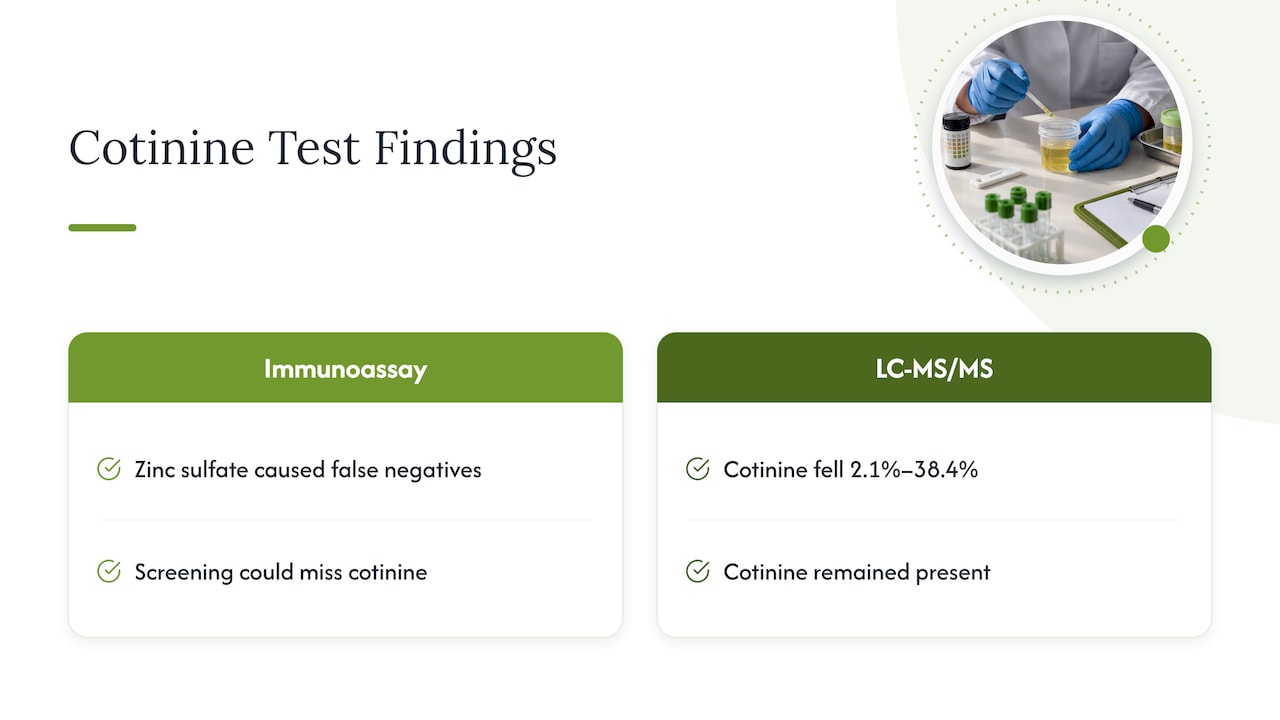
That is a useful pattern. Zinc can fool a screening immunoassay far more easily than it can erase a drug from a specimen measured by mass spectrometry.
How the three studies compare
| Study | Test method | What zinc did | Key limit |
|---|---|---|---|
| 2011, United States | Immunalysis ELISA | Reduced detection of cocaine, methamphetamine, THC | One kit family, zinc added to urine |
| 2013 | EMIT immunoassay | False negatives for methamphetamine, cocaine, morphine, THC metabolite | Needed about 5,000 times typical urine zinc; oral zinc fell short |
| 2015 | Immunoassay and LC-MS/MS (cotinine) | False negatives on immunoassay; LC-MS/MS values dropped 2.1% to 38.4% | Cotinine, not THC; confirmation still detected it |
What this means for a THC test specifically
THC urine screens look for a metabolite, not for THC itself. How long that metabolite shows up depends on how often you use, how much, your body composition, and the cutoff the lab applies. Our guide to THC metabolites explains why a positive shows past exposure rather than current impairment, and our THC detox timeline covers how windows stretch from hours for a single use to as long as 90 days in hair.
Zinc does not change any of that biology. The only documented effect is on the chemistry of a screening assay when zinc is mixed into the sample at an extreme concentration. If you are a heavy, regular user, the amount of metabolite stored and released from fat is the issue, and we cover that in how THC stores in fat.
For day-by-day expectations, see how long weed stays in urine and how specimen type, cutoffs, and program rules change detection times.
Does a zinc supplement change a drug test?
The evidence says an ordinary supplement is not a reliable or documented way to alter a result. The 2013 study found oral zinc did not raise urine zinc enough for direct interference, so nothing in it supports the idea that capsules from the pharmacy make a test negative.
It also helps to know that zinc is tightly regulated by your body. The NIH Office of Dietary Supplements describes zinc homeostasis as a balance of dietary absorption, excretion into the gastrointestinal tract, and reabsorption. Your system does not simply flood the urine with whatever you swallow.
How long does zinc itself stay around? In a study of people taking 10 or 20 mg of zinc sulfate daily for 21 days, blood zinc returned to baseline two weeks after they stopped. That is a nutrition question, though, not a drug-testing one. What matters for a test is how long the drug or its metabolite lasts, and MedlinePlus says that depends on the drug, the amount, how long you used it, and how your body reacts.
Taking high-dose zinc also carries its own risk, and anyone on medication or with a health condition should ask a pharmacist or physician before using it for any reason.
Why putting zinc in a sample is a bad idea
The studies describe adding zinc to urine. In a real collection, that is tampering, and collection sites are designed to catch it.
What a collection site does
In a standard collection you empty your pockets, wash your hands, and give a sample that the collector checks for temperature and appearance. Our guide to urine drug test temperature explains the 90 to 100°F window and the four-minute check. In observed settings, which we describe in supervised urine collection, a collector watches the sample leave your body. Carrying a vial of anything into the room is a serious problem if it is found.
What the lab checks
Federal programs test the specimen itself. SAMHSA’s 2024 guidance says federal urine specimens undergo validity testing at minimum for creatinine and pH, with specific gravity when creatinine is low, plus oxidizing adulterants. The same guidance notes that labs may perform additional testing when a specimen has abnormal characteristics or interferes with analysis.
A 2023 review is more candid about the limits. It states that validity testing detects dilution well, while chemical adulteration and substitution remain harder for commercial validity systems. The same review describes routine checks (creatinine, specific gravity, pH, oxidizers) and newer approaches, including chromatographic detection of endogenous biomolecules and adulterant-specific compounds.
So the honest picture is mixed. Not every adulterant is caught by every routine panel. But the field is moving toward finding them, labs can escalate when a sample behaves strangely, and a result that cannot be read can lead to a recollection. Whether a particular lab flags zinc is not something any forum post can promise you.
The practical consequences
An invalid, substituted, or adulterated result is not the same as a negative. Depending on the program, it can mean an immediate recollection under observation, a report to the employer, or a refusal-to-test finding. If you want to understand how labs treat other shortcuts, our pieces on synthetic urine detection, dilute urine tests, and why single-marker claims fail show the same pattern: the specimen is checked, not just the drug.
Zinc and other test types: where the evidence stops
Every study above is about urine. We found no checked research showing zinc changes results in hair, saliva, or blood tests. That is an absence of evidence, not a guarantee in either direction, and we will not claim more than we know.
The mechanics differ, which is a reason to be skeptical of carrying the urine story over:
- Hair tests measure drug compounds incorporated into the hair shaft over weeks to months. They do not rely on a urine immunoassay at all. Our guide on hair dye and drug tests shows why even treatments that lower measured levels do not guarantee a pass.
- Saliva tests look for recent use in an oral fluid sample collected under supervision, so there is little opportunity to add anything.
- Blood tests are rare for employment screening and measure what is circulating at the time of draw.
If you are preparing for a hair or a mouth swab, zinc is not the variable to focus on.
Zinc and the 12-panel question
People searching this topic often ask what a 12-panel test covers. Panels differ by lab and specimen. The National Jewish Health 12-panel urine screen lists amphetamine, barbiturates, benzodiazepines, cocaine, methadone, methamphetamine, opiates, oxycodone, PCP, propoxyphene, THC, and tricyclic antidepressants or their metabolites. Labcorp’s serum Drug Screen 12 differs: it includes fentanyl and tramadol and a different mix of other classes.
Zinc does not change what a panel tests for. It is not a drug on the panel, and the panel design is set by the lab. The only open question is whether a given assay could be disturbed by an adulterant, which is what the studies above addressed. For employment panels, see U.S. pre-employment drug tests, and for court-ordered testing, what to expect on a probation drug test.
Our perspective
We publish drug-testing guides because the same few myths keep costing people money and jobs. The zinc story is a textbook case: a real, narrow laboratory result gets repackaged as a household trick. When we read the papers, three things stand out.
First, the research is about adulteration, not nutrition. The numbers that produced false negatives were thousands of times beyond anything a body produces after a supplement. Second, every study is measuring a screening step, and screening is built to be followed by a more specific test when something looks wrong. Third, no one at a collection site is grading you on your mineral intake. They are checking whether the specimen looks like it came from you, at the time you gave it.
Our advice is plain. Do not put anything in a sample. If you use cannabis, the factors that matter are how often you use, how long you have until the test, and which test you will face. If a result looks wrong, ask whether the lab will confirm by GC/MS or LC-MS/MS, and read about false-positive drug tests so you know your options. If you take a prescription drug, tell the medical review officer, who exists to sort out those cases.
— MIchael
For nurses and health professionals
NursingScience.org is also a professional community for nurse scientists, educators, and students. If you work in or study healthcare and want access to research resources, conferences, and networking, take a look at our membership options. Student individual membership is 40 USD per year, and NSNA members pay 36 USD per year.

Employers and recruiters can also reach nursing candidates through our job board advertiser options.
FAQ
Can zinc make you pass a drug test?
There is no documented evidence that taking zinc by mouth makes a test negative. Lab studies showed false negatives on some urine immunoassays only when zinc was added directly to the sample at extreme concentrations. Even then, a confirmation method or validity checks may reveal a problem.
Does zinc show up on a drug test?
Zinc is not on standard drug panels such as the 12-panel urine screens, which target drugs like THC, cocaine, opiates, and amphetamines. A lab can look for adulterants in a specimen, though, and a sample that interferes with analysis can trigger additional testing.
How long does zinc stay in your system?
That depends on dose and diet, because the body regulates zinc closely. In one study of daily 10 or 20 mg zinc sulfate for 21 days, blood zinc returned to baseline two weeks after stopping. How long a drug stays in your system is a separate question that depends on the drug, your use, and the test.
Does zinc affect saliva or hair drug tests?
We found no checked research showing that it does. The published studies concern urine immunoassays, and hair and saliva tests work differently. Do not assume the urine findings carry over.
What happens if a lab thinks a sample was adulterated?
The result can be reported as invalid, adulterated, or substituted, not as negative. Depending on the program, you may be asked to provide another sample, often under observation, or the employer may be notified. A medical review officer can discuss legitimate explanations with you.
Sources
- Zinc Reduces the Detection of Cocaine, Methamphetamine, and THC by ELISA Urine Testing (2011)
- Elevated Urine Zinc Concentration Reduces the Detection of Methamphetamine, Cocaine, THC and Opiates in Urine by EMIT (2013)
- Zinc Sulfate, a Recently Introduced Urinary Adulterant, and urine cotinine testing (2015)
- SAMHSA Medical Review Officer Guidance Manual for Federal Workplace Drug Testing Programs (2024)
- Advances in testing for sample manipulation in clinical and forensic toxicology (2023)
- NIH Office of Dietary Supplements: Zinc Health Professional Fact Sheet
- MedlinePlus: Drug Testing
- Verywell Health: How Long Does Zinc Stay in Your System?
- National Jewish Health: 12-Panel Urine Screen
- Labcorp: Drug Screen 12 With Reflex Confirmation
Recommended
- 1,000 to 8,000 mg Niacin Won’t Beat a Urine Drug Test, CDC Says
- CBD and THC Drug Tests: What Actually Triggers a Positive
- Hours to 90 Days: THC Detox Timeline and 2026 Federal Cutoffs
- Specimen, Cutoffs, and Program Rules Change Drug Detection Times
|
The Council for the Advancement of Nursing Science |
   |