Typical detection windows run from a few hours in saliva to about three months in hair, with urine detection lasting longer than saliva but shorter than hair, depending on the frequency of use. Detection is not the same as impairment, and no detox product has documented evidence of reliably clearing THC metabolites on a fixed schedule. Some detox attempts backfire by producing a diluted or invalid sample instead of a clean one.
TL;DR:
- Urine testing for THC-COOH can detect occasional use for a few days and regular use for several weeks, depending on body fat and usage frequency.
- Oral fluid tests target recent use within hours to a few days, while hair testing reflects a 90-day history but misses recent use by one to two weeks.
- Hydration and exercise do not reliably speed up THC clearance and can produce invalid results, which are flagged by specimen validity testing.
- Detox products mainly cause dilution or adulteration, which labs are equipped to detect, making reliance on them risky and often ineffective.
- The detection window varies significantly with usage pattern, with occasional users clearing faster than chronic users, especially in urine testing.
Table of Contents
- Detection windows by specimen: urine, oral fluid, and hair
- What changes your personal detection timeline
- Why detox products rarely deliver what they promise
- Preparing for a test the right way
- How THC moves through your body in phases
- Does hydration or exercise actually speed things up
- What the evidence says about niacin and detox kits
- How much your usage pattern changes the realistic timeline
- Our perspective on evidence-based testing information
- Where to go for deeper, specimen-specific guidance
- FAQ
- Sources
Detection windows by specimen: urine, oral fluid, and hair
Each sample type measures something different, which is why the same person can test differently on a urine screen, a saliva swab, and a hair panel taken the same week.
Urine testing targets Δ9-THC-COOH, a metabolite the body produces after breaking down THC rather than THC itself. The federal guidelines for workplace drug testing set an initial screening cutoff of 50 ng/mL and a confirmatory cutoff of 15 ng/mL for this metabolite. Because THC-COOH stores in fat and releases slowly, occasional users often clear it within a few days, while regular and heavy users can test positive for several weeks.
Urine detection commonly spans a few days for occasional use up to several weeks for daily, heavy use, according to federal cutoff standards, which define the thresholds labs use to call a result positive.
Oral fluid, or saliva, testing looks for parent Δ9-THC rather than a metabolite, which makes it a better marker of very recent use. The same federal guidelines set an initial cutoff of 4 ng/mL and a confirmatory cutoff of 2 ng/mL for oral fluid. Detection generally lasts hours to a couple of days, though heavy users can sometimes show positive results closer to 48 to 72 hours out. Smoking or vaping shortly before a test can also contaminate the mouth and skew an immediate reading, which is part of why observed collection and waiting periods matter for this sample type.
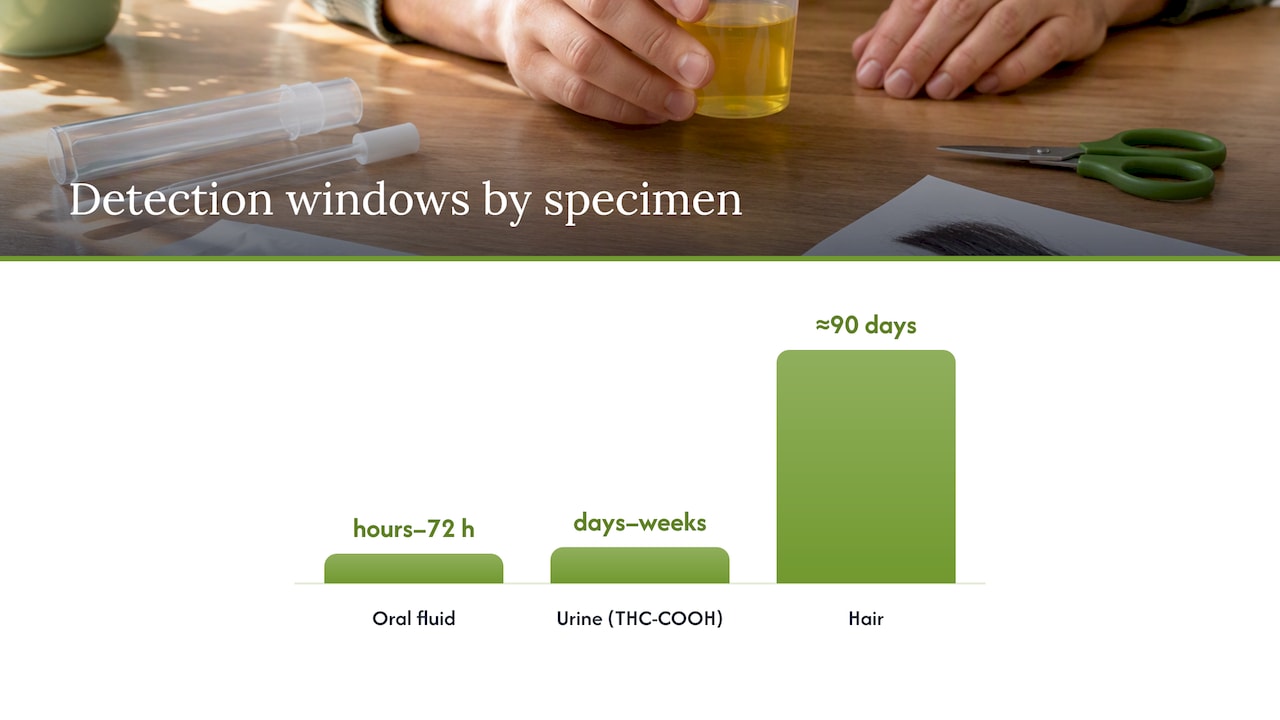
Hair testing works on a completely different timescale. A peer-reviewed review of hair drug testing describes an approximate 90-day retrospective window, depending on hair length, with a blind spot of roughly one to two weeks for very recent use because new growth has to emerge above the scalp before it can be sampled. That lag reflects how hair incorporates compounds over time, a point echoed in research on translating lab results to real-world use, which puts the emergence window at about 10 to 14 days. Hair is well suited to flagging a pattern of repeated use and poorly suited to catching a single recent episode.
The three specimens answer different questions:
- Urine asks whether someone used in the recent-to-intermediate past, based on stored metabolites.
- Oral fluid asks whether use happened very recently, based on parent THC.
- Hair asks whether there is a longer history of repeated use, based on retrospective incorporation.
None of them measure current impairment. The JAOAC review is explicit that analytical detection and behavioral impairment are separate questions, and a positive result on any of these tests says only that the substance or its metabolite was present above a cutoff, not that the person was affected at the time of testing.
What changes your personal detection timeline
Two people with the same test on the same day can get different results because so many variables stack on top of each other.
- Frequency of use: daily or near-daily use builds up fat-stored metabolites that take longer to clear than a single or occasional episode.
- Body composition: higher body fat can extend storage and release of THC metabolites over a longer period.
- Dose and potency: a stronger product or a larger amount extends the window compared with a lighter dose.
- Route of administration: smoking or vaping produces a fast peak and quicker drop in blood levels, while edibles peak later and can extend the detectable window for effects.
- Metabolic rate and biology: age, sex, and individual metabolism all shift how quickly THC and its metabolites are processed.
- Test method: a lab using GC-MS or LC-MS/MS detects lower concentrations than a lateral-flow immunoassay, and a review of portable THC sensing devices found meaningful variability in cutoffs and sensitivity across on-site screening tools.
- Collection setting: observed collection limits tampering opportunities compared with unobserved sample drop-off.
- Hydration and hygiene: heavy water intake can dilute urine, and oral hygiene habits affect how quickly mouth contamination clears before a saliva test.
Hair cosmetics and environmental exposure add another layer of variability for hair testing specifically, since bleaching or heavy treatment can alter how much drug residue remains in the shaft.
Why detox products rarely deliver what they promise
Labs are built to catch exactly the shortcuts that detox marketing suggests. Specimen validity testing exists for this reason, and it catches far more than most people expect.
- Dilution: drinking large amounts of water before a urine test can lower creatinine and specific gravity below normal ranges, which specimen validity testing guidance flags as a dilute result rather than a clean negative.
- Ingestible cleansers: detox drinks and kits marketed to flush THC lack consistent evidence of reliably clearing metabolites, and some simply trigger the same dilution flags as drinking plain water.
- Chemical adulterants: substances added directly to a sample to interfere with testing chemistry are specifically what validity panels screen for, measuring oxidants and pH alongside the drug result.
- Substitution: swapping in synthetic or someone else’s urine remains a known subversion attempt, and a GAO review of masking products found that formulas marketed for this purpose shift over time specifically to try to stay ahead of detection methods, with uneven success.
Labs confirm screening results with GC-MS or LC-MS/MS, methods sensitive enough to flag the chemical fingerprints that dilution or adulteration leave behind. A flagged or invalid specimen typically leads to recollection, review by a Medical Review Officer, and in workplace settings, documentation that can carry its own consequences separate from the original drug question.
Pro Tip: Treat any product promising a guaranteed negative result with skepticism. If a method works mainly by diluting or altering the sample, a validity check is built to catch it.
Preparing for a test the right way
The most reliable approach is abstinence long enough for your own usage pattern to clear naturally, since occasional users clear faster than daily or heavy users. Beyond that, a few steps help you prepare without relying on unproven shortcuts.
- Give yourself a realistic window based on how often and how much you have used, rather than a generic number borrowed from someone else’s situation.
- Use a validated laboratory for any pre-test confirmation instead of relying solely on an at-home strip, since the FDA notes that consumer screening devices are meant to flag possible results, not deliver a final answer.
- Understand the difference between an initial screen and a confirmatory test: a screen can produce a false positive that a confirmatory GC-MS or LC-MS/MS result would correct.
- If you have a legal or prescribed reason for THC or CBD use, document it and raise it with your employer or the Medical Review Officer before the test, not after a flagged result.
- If your result comes back dilute or invalid, expect a request for recollection rather than an automatic negative or positive. Our guide on how to pass a drug test walks through what that process looks like in practice.
How THC moves through your body in phases
THC detox is really a sequence of biological steps, not a single countdown. After use, THC enters the bloodstream quickly, especially when smoked or vaped, and distributes into fatty tissue because it is highly lipophilic. The liver then converts THC into several metabolites, the main one tracked in testing being THC-COOH, through enzymatic processes that happen largely independent of how intoxicated someone feels.
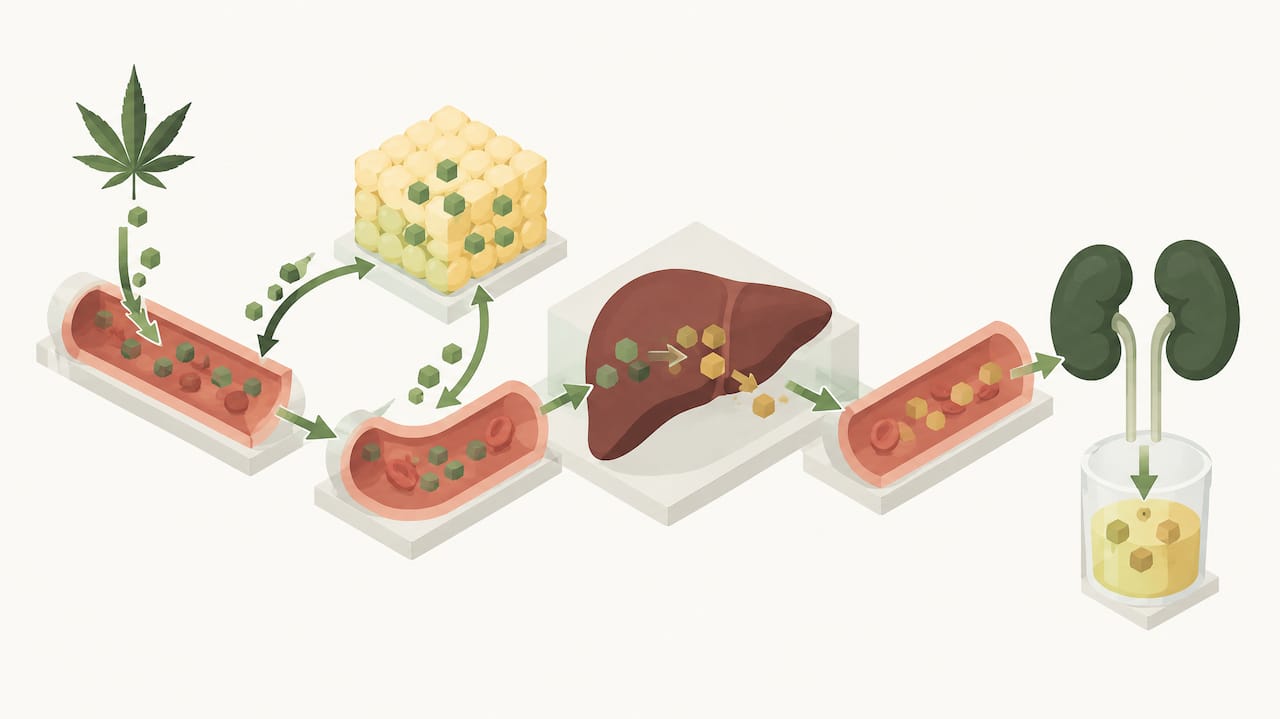
From there, THC-COOH re-enters circulation gradually as fat stores release it, which is why heavier or more frequent users keep testing positive well after they stop feeling any effects. This slow release phase is the main reason urine windows stretch into weeks for regular users while blood and saliva levels of parent THC drop much faster. Eventually the kidneys filter the metabolites into urine for excretion, with smaller amounts leaving through sweat and other routes.
Each phase runs on its own timeline, and they do not move in lockstep. Someone can test negative for parent THC in saliva within a couple of days of their last use while still testing positive for THC-COOH metabolites in urine weeks later, because the two specimens are tracking different points in this chain. Hair testing captures a separate process entirely: incorporation into the hair shaft as it grows, which is why it reflects a history of exposure rather than a recent event. Understanding which phase a given test is actually measuring explains a lot of the confusion around conflicting results from different sample types.
Does hydration or exercise actually speed things up
Drinking extra water does not clear THC metabolites faster. It dilutes the urine sample, which specimen validity testing is specifically designed to catch through creatinine and specific gravity checks described in forensic laboratory guidance. A dilute result does not read as a clean negative. It reads as a flag that often triggers a recollection request, which can be more disruptive than simply waiting out a natural timeline.
Exercise carries a more complicated story. Because THC stores in fat tissue, intense exercise can theoretically mobilize some stored THC into the bloodstream temporarily, but this does not reliably translate into a faster overall clearance timeline, and it can momentarily raise blood concentrations rather than lower them. There is no documented evidence that a workout regimen in the days before a test produces a dependable drop in urine or hair metabolite levels.
The practical takeaway is that neither hydration tricks nor exercise substitute for time. The body processes and excretes THC metabolites on its own schedule, shaped mainly by how much and how often someone used, not by how much water they drink the night before a test or how hard they exercise that week. Anyone trying to speed up a timeline is better served by understanding their own usage pattern than by chasing a shortcut that specimen validity testing is built to catch.
What the evidence says about niacin and detox kits
Niacin is one of the most persistent detox myths, often promoted as a way to “flush” fat cells and release stored THC faster. There is no solid evidence supporting this use, and niacin taken in large doses carries real risks, including skin flushing, liver stress, and in extreme cases more serious toxicity. It is not a documented or recommended method for altering a detection timeline.
Commercial detox drinks and kits generally work, when they work at all, by encouraging fluid intake and sometimes adding substances meant to mask dilution on a validity panel. Our evaluation of detox drinks looks at these products against their marketing claims, and the pattern across available evidence is consistent: none of them have documented, reliable evidence of clearing THC-COOH metabolites outright, and many simply push a sample toward the dilute or invalid range that specimen validity testing is designed to flag.
Pectin-based approaches, sometimes discussed under brand names, follow a similar logic to detox drinks rather than offering a separate mechanism. The honest summary across niacin, detox kits, and related products is that none have strong, reproducible evidence of reliably beating a confirmatory lab test, and several carry a real risk of producing a flagged specimen instead of a clean one.
How much your usage pattern changes the realistic timeline
Someone who used THC once or twice and someone who uses daily are not working from the same clock, even if they take an identical test on the same day.
Occasional users, meaning a single use or infrequent use over a short period, tend to clear urine THC-COOH within roughly a few days to about a week, since there is little fat-stored metabolite to release gradually. Saliva clears even faster for this group, often within a day or two, since parent THC does not linger once active use stops.
Regular users, using multiple times a week, build up more stored metabolite and can see urine detection windows stretch to several weeks rather than days. Heavy or daily users face the longest realistic timelines, sometimes extending to multiple weeks in urine, because fat-stored THC-COOH keeps releasing back into circulation long after the last use. Hair testing does not shift much by usage frequency in the same way since it reflects exposure incorporated during hair growth over roughly 90 days, which is why it can flag chronic use even when urine and saliva have both cleared.
Anyone estimating their own timeline should start from their actual usage pattern rather than a number they saw attached to someone else’s situation, since the gap between occasional and heavy use can span weeks.
Our perspective on evidence-based testing information
We built our drug-testing content area around a simple standard: explain what labs actually measure and let readers separate documented testing practice from product marketing. Our guides on hair testing methods and saliva swab tests walk through specimen-specific procedures rather than generic promises, because the biggest disservice to a reader preparing for a test is a confident-sounding shortcut with no evidence behind it.
— MIchael
Where to go for deeper, specimen-specific guidance
We publish detailed, specimen-specific guides so you are not left guessing which rules apply to your situation, and for readers who want ongoing access to evidence-based nursing and health research resources, membership with us is the most direct path to that depth.

- Read our breakdown of detox drinks and their actual evidence base before relying on one for an upcoming test.
- Review documented hair test preparation methods if you are facing a hair panel specifically.
- Check our saliva swab test guide for oral fluid procedures and timing considerations.
- Explore membership options for continued access to our evidence-based testing and nursing research content.
FAQ
How long does THC stay detectable in urine?
Occasional users often clear urine THC-COOH within a few days to about a week, while regular or heavy users can test positive for several weeks. The federal cutoffs of 50 ng/mL initial and 15 ng/mL confirmatory determine when a urine result counts as positive.
Can a detox drink guarantee a negative THC test?
No product has documented, reliable evidence of guaranteeing a clean result. Many detox drinks mainly add fluid volume, which risks producing a dilute result that specimen validity testing flags for recollection rather than clearing you.
Does a saliva test detect THC as long as a urine test?
No, saliva testing targets parent Δ9-THC and typically detects use for hours up to a couple of days, sometimes longer in heavy users, which is a much shorter window than urine. The federal oral fluid cutoffs are 4 ng/mL initial and 2 ng/mL confirmatory, reflecting its focus on recent use.
Why does hair testing detect THC for so much longer?
Hair incorporates THC and its metabolites as it grows, giving it a retrospective window of about 90 days rather than tracking recent elimination like urine or saliva. A peer-reviewed hair testing review notes a one to two week blind spot before very recent use becomes visible above the scalp.
What happens if my test comes back diluted or invalid?
A dilute or invalid result typically does not count as a negative. It generally triggers a recollection request and review by a Medical Review Officer, following the specimen validity procedures labs use to catch tampering or over-dilution.
Sources
- Mandatory Guidelines for Federal Workplace Drug Testing Programs—Authorized testing panels (Federal Register)
- Drugs of abuse tests | FDA
- Complexity of Translating Analytics to Recent Cannabis Use and Impairment | Journal of AOAC INTERNATIONAL
- Hair drug testing review (PMC)
- An Introduction to Specimen Validity Testing in Workplace Drug Testing
Recommended
- Best Detox Drinks for THC Drug Tests: A Comprehensive Guide
- Certo Detox To Pass A Drug Test: What you should know
- Methods to Pass a Hair Drug Test
|
The Council for the Advancement of Nursing Science |
   |