Blood typically shows recent drug use for about 1 to 2 days, urine for 1 to 3 days (longer with chronic use), oral fluid for a few hours up to 48 hours, and hair for up to about 90 days with a standard 1.5-inch sample. These are ranges, not guarantees. They shift with dose, frequency, metabolism, and the specific assay used. So the first real step is confirming the exact specimen and panel with the testing organization.
TL;DR:
- Chronic cannabis use can keep urine tests positive for several weeks, while occasional use may clear within a week; hydration affects measured concentration.
- Standard panels may miss fentanyl and newer substances, so confirm that the requested panel includes a targeted assay for the specific drug of concern.
- An initial immunoassay can produce false positives when unrelated compounds trigger it; request confirmatory mass spectrometry if results conflict with known use or prescriptions.
- Urine dilution can trigger a repeat collection, and federal programs apply standardized procedures; ask the testing organization which specimen, panel, and laboratory rules govern.
Table of Contents
- Quick Reference: Detection Windows by Specimen Type
- Why Detection Windows Vary: Half-Lives, Metabolites, and Lab Cutoffs
- Detection Windows and Collection Notes by Specimen
- Estimated Detection Windows for Common Drugs
- What Changes Your Personal Detection Window
- How Workplace Testing Programs Shape the Result
- What a Positive or Negative Result Actually Means
- Detection Challenges With Synthetic and Novel Psychoactive Substances
- How Detection Windows Differ Across Age, Sex, and Health Status
- Reading Detection Charts the Way a Clinician Would
- Related Resources for Understanding Drug Testing
- FAQ
- Sources
Quick Reference: Detection Windows by Specimen Type
Before getting into the pharmacology, here’s the practical snapshot most readers are searching for.
| Specimen | Typical detection window | Best used for |
|---|---|---|
| Blood/serum/plasma | About 1 to 2 days | Confirming very recent exposure or impairment |
| Urine | Commonly 1 to 3 days, longer in chronic users | Standard screening and workplace programs |
| Oral fluid/saliva | A few hours up to 48 hours | Very recent use, observed collection |
| Hair (1.5-inch sample) | Up to about 90 days | Longer-term use history |
| Sweat patch | Several days to about a week while worn | Continuous monitoring over time |
| Breath (alcohol) | A few hours | Immediate alcohol presence, not long-term use |
These ranges come from ARUP Consult’s drug testing guidance, which frames blood as the matrix for recent exposure, urine as the standard screening matrix, and hair as the option for longer-term history.
A few things stand out immediately:
- For recent use or impairment, blood or oral fluid gives the tightest, most current picture.
- For longer-term history, hair extends the window dramatically beyond what urine or blood can show.
- THC is the outlier. Frequent cannabis users can test positive in urine well beyond the typical window because the drug stores in fat tissue and releases slowly, an exception confirmed across ARUP’s half-life and urine detection data.
The 90-day hair window is one of the most cited figures in drug testing, because it reflects how hair grows out from the follicle over roughly three months, capturing a much longer history than any fluid-based test, according to ARUP Consult.
A few practical notes worth keeping in mind: urine samples can be flagged as dilute if a person drinks excessive fluids before collection, hair samples can be affected by bleaching or chemical treatments that strip the shaft, and oral fluid collections are typically observed directly, which limits substitution attempts compared with unobserved urine collection.
Why Detection Windows Vary: Half-Lives, Metabolites, and Lab Cutoffs
Detection windows aren’t fixed numbers. They’re estimates built on pharmacokinetics, which is the study of how a body absorbs, distributes, and eliminates a substance.
Every drug has an elimination half-life, the time it takes for the body to clear half of the drug from the bloodstream. As a rough rule, it takes about 4 to 5 half-lives for a drug to be mostly eliminated from blood. But elimination from blood doesn’t mean a test can’t still detect it elsewhere. Urine, hair, and fat tissue can hold traces long after blood has cleared, which is why half-life alone cannot predict a detection window, a point made clearly in StatPearls’ pharmacokinetics overview.
Labs often don’t test for the parent drug at all. They test for metabolites, the byproducts created when the body breaks a substance down. Cocaine use is detected through benzoylecgonine, its primary metabolite, and cannabis use is detected through 11-nor-9-carboxy-THC rather than THC itself. Metabolites often persist longer than the parent compound, which is part of why urine windows differ so much from blood windows.
Most drug screens start with immunoassay testing, a fast chemical method that flags whether a substance is likely present above a set cutoff concentration. A positive immunoassay result is typically sent for confirmatory testing using gas chromatography or liquid chromatography combined with mass spectrometry (GC/LC-MS/MS), which identifies the exact compound with much higher specificity. The clinical review on objective drug testing notes that immunoassays are useful for speed and cost but carry a real risk of cross-reactivity, meaning unrelated compounds can trigger a false positive screen.
Urine results are also adjusted using normalization: measuring creatinine concentration or specific gravity to judge whether a sample was diluted. Research summarized by the CDC’s analysis of urinary cannabinoid data shows that normalization helps account for hydration-driven swings in measured concentration, which matters most for cannabinoids since their levels can vary widely based on fluid intake.
- Half-life explains elimination speed, not detectability in every specimen.
- Metabolites often outlast the parent drug in testable concentration.
- Immunoassay screens are fast but prone to cross-reactivity; confirmatory testing resolves ambiguity.
- Creatinine and specific gravity checks flag diluted urine samples before cannabinoid results are interpreted.
Pro Tip: If a result seems inconsistent with known use, ask whether the lab ran a confirmatory GC/LC-MS/MS test rather than relying on the initial immunoassay screen alone.
Detection Windows and Collection Notes by Specimen
Each specimen type answers a different question, and picking the wrong one is a common source of confusion.
Urine remains the most widely used specimen for standard screening. ARUP Consult places the typical window at 1 to 3 days for many substances, though chronic, heavy use of fat-soluble drugs like THC can extend detectability well past a week. Urine collection also carries normalization checks: a sample reported as dilute or out of the expected temperature range can trigger a repeat collection. Urine testing is inexpensive, widely available, and backed by the largest body of reference data, but it’s also the specimen most associated with adulteration attempts, which is why observed collections exist for higher-stakes programs. Readers researching how collection procedures work in supervised settings can review our guide on supervised drug tests for more detail on what observed collection actually involves.
Blood, serum, and plasma testing covers a much shorter window, generally around 1 to 2 days, according to ARUP’s specimen guidance. Clinicians order blood tests when they need to confirm current impairment or recent exposure, such as in emergency medicine or certain legal contexts, rather than for general screening.
Oral fluid (saliva) testing captures very recent use, typically a few hours up to 48 hours. Because collection is usually directly observed, it reduces some of the substitution concerns tied to urine. SAMHSA’s drug-free workplace guidance notes that oral fluid was authorized as a federal specimen type with guidelines effective October 10, 2023, giving employers a faster, more directly supervised option. Readers considering an oral fluid test can find procedural detail in our saliva swab testing guide.
Hair testing extends the lookback window to roughly 90 days for a standard 1.5-inch head-hair segment, since hair grows out gradually and incorporates drug traces as it forms. This makes hair the matrix of choice when an employer or clinician needs a longer-term use history rather than a snapshot. External contamination (secondhand smoke exposure, contact with surfaces) and cosmetic treatments like bleaching or heavy coloring can complicate interpretation, which is why confirmatory testing and careful sample washing protocols matter. Our hair drug test methods guide goes deeper into how these samples are processed.

Sweat patches are less common but used for continuous monitoring, often in probation or treatment-compliance settings. A patch worn for several days to about a week can capture cumulative exposure across that period rather than a single point in time.
Breath testing is specific to alcohol and only reflects very recent consumption, generally within a few hours, since alcohol metabolizes quickly and doesn’t leave the kind of metabolite trail that supports longer detection in breath. A related biomarker, ethyl glucuronide (EtG), extends alcohol detection further in urine, sometimes up to a few days, but it has known limitations around incidental exposure from products like hand sanitizer or mouthwash.
| Specimen | Collection style | Typical concern |
|---|---|---|
| Urine | Usually unobserved unless specified | Dilution, substitution |
| Blood | Clinical draw | Invasiveness, cost |
| Oral fluid | Directly observed | Recent food or drink interference |
| Hair | Cut from scalp | External contamination, cosmetic treatment |
| Sweat patch | Worn over days | Patch tampering or removal |
Estimated Detection Windows for Common Drugs
Detection figures below reflect urine windows compiled from ARUP’s drug half-life and detection window data and FDA home-use test guidance. Always confirm the exact panel, since not every test screens for every substance.
| Drug/class | Typical urine detection window | Notes |
|---|---|---|
| Marijuana (THC) | Hours up to 1 to 7 days for occasional use; longer for chronic users | Fat-soluble metabolite extends window with heavy use |
| Cocaine | About 2 to 3 days | Detected via benzoylecgonine metabolite |
| Heroin/opiates | About 1 to 3 days | Heroin’s parent compound is rarely detected directly; morphine metabolite is the usual marker |
| Amphetamine/methamphetamine | About 2 to 3 days | Standard immunoassay panels typically include both |
| Benzodiazepines | About 1 to 4 days | Longer-acting agents can extend this window |
| Barbiturates | Up to about 1 to 3 weeks for some agents | Varies significantly by specific drug |
| Methadone | Several days, per ARUP’s half-life data | Requires a specific assay, not always on standard panels |
A few notes worth flagging directly:
- Heroin itself is almost never detected. Its parent compound breaks down so quickly that labs rely on morphine or 6-acetylmorphine as markers instead.
- Fentanyl and other synthetic opioids often require a targeted assay. Standard opiate immunoassays are built around morphine-class compounds and frequently miss fentanyl entirely unless the panel specifically screens for it.
- MDMA typically falls in a window similar to amphetamines, roughly a few days in urine, though it isn’t always included on basic panels.
- Standard five-panel and even expanded panels can miss newer or less common substances. Confirming exactly what a panel screens for matters more than memorizing a generic chart.
This is the single most practical takeaway from drug-specific timelines: the chart only tells you what the test is actually designed to find.
What Changes Your Personal Detection Window
Charts give averages. Individual results depend on a handful of variables that can move the window significantly in either direction.
- Frequency and duration of use matter more than almost anything else. Someone using a drug once will clear it faster than someone using the same drug daily for months, because chronic use allows the substance to accumulate in tissue.
- Metabolism, age, body composition, and organ function all affect elimination speed. Reduced liver or kidney function slows clearance, and lower body fat changes how fat-soluble drugs like THC are stored and released.
- Route of administration and formulation influence how quickly a drug peaks and clears; injected or smoked substances tend to act and clear faster than oral formulations with extended-release properties.
- Hydration and urine concentration affect measured results without necessarily changing total drug content, which is exactly why creatinine and specific gravity checks exist, as described in CDC-referenced cannabinoid research.
A concrete contrast: an occasional cannabis user might clear THC from urine within a week, while a daily, long-term user can test positive for several weeks after their last use because stored THC in fat tissue continues releasing slowly over time.
How Workplace Testing Programs Shape the Result
Not all drug tests follow the same rules, and the program behind a test often matters as much as the biology.
Federal workplace programs operate under SAMHSA’s Mandatory Guidelines, which authorize specific specimen types. Oral fluid testing guidelines became effective October 10, 2023, and authorized oral fluid panels were published January 16, 2025, with an effective date of July 7, 2025, expanding federal programs beyond urine-only collection.
Federal collections require certified laboratories and controlled procedures that private testing doesn’t always match. Collection sites operating under SAMHSA’s framework follow strict procedural rules, including reading specimen temperature within four minutes of collection, enforcing minimum volume requirements, and flagging samples as dilute or invalid when they fall outside expected ranges, according to the SAMHSA urine collection site manual.
- Federal, HHS-certified labs follow standardized chain-of-custody and confirmatory testing rules; private or clinical labs may use different cutoffs or skip confirmatory steps on negative screens.
- Observed collections are reserved for specific circumstances, such as a prior dilute result, rather than used routinely.
- A dilute result doesn’t automatically mean a negative test; depending on the program, it can trigger a re-collection requirement.
- Panel composition varies by employer and program, so a “standard panel” at one workplace may not screen for the same substances as another.
Because these rules differ by program, the most reliable step is asking the testing organization directly which specimen, panel, and lab certification apply to a specific test rather than assuming a generic chart applies.
What a Positive or Negative Result Actually Means
A single screening result is not the final word, and treating it as one leads to avoidable confusion.
False positives can occur through cross-reactivity, where an unrelated compound (certain over-the-counter medications, for example) triggers a positive immunoassay screen. False negatives can occur when a drug falls below the assay’s cutoff concentration or when the panel simply doesn’t test for that specific substance, which is common with newer synthetic opioids.
For federally regulated specimens, a Medical Review Officer (MRO) reviews any non-negative result before it’s reported, checking for legitimate medical explanations and confirming that proper confirmatory testing was performed.
- Ask specifically which panel was run and whether cutoffs are published for each substance.
- Request confirmatory GC/LC-MS/MS testing if an initial immunoassay result seems inconsistent with known use or exposure.
- Bring a clinician or MRO into the conversation for any medical interpretation, especially when prescription medications could explain a result.
Pro Tip: Keep documentation of any prescribed medications on hand before testing, since it speeds up MRO review if a legitimate explanation is needed.
Detection Challenges With Synthetic and Novel Psychoactive Substances
Standard drug panels were built around a relatively small set of well-established substances: cannabinoids, cocaine, opiates, amphetamines, and PCP. Synthetic opioids like fentanyl, synthetic cannabinoids, and newer novel psychoactive substances often fall outside that core list entirely.
Routine immunoassay screens frequently fail to detect these compounds unless a lab runs a targeted assay built specifically for them. Fentanyl is the clearest example: because its chemical structure differs enough from morphine-class opioids, a standard opiate panel can return a negative result even when fentanyl is present, unless the panel explicitly includes a fentanyl-specific test.
This creates a meaningful gap between what a chart says and what a specific test actually screens for. Synthetic cannabinoids present a similar challenge, since their metabolites differ from THC’s and won’t trigger a standard THC immunoassay. Detection windows for these substances are also less standardized across labs, since testing protocols are newer and less uniform than decades-old opiate and cannabinoid assays.
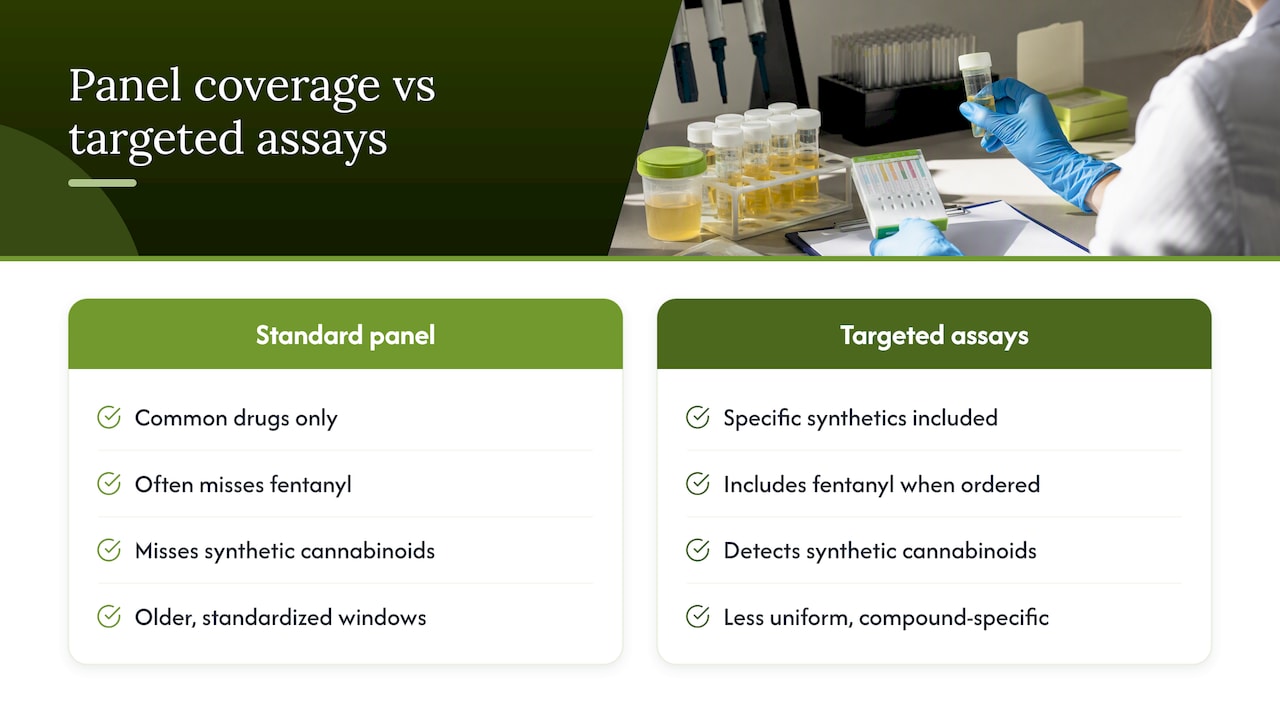
The practical implication is straightforward: if there’s any reason to suspect exposure to a synthetic opioid or a newer psychoactive substance, the only reliable approach is confirming with the testing organization whether the panel includes a targeted assay for that specific compound, rather than assuming a standard panel covers it.
How Detection Windows Differ Across Age, Sex, and Health Status
Detection windows aren’t uniform across every person, and a handful of biological factors shift the numbers in predictable directions.
Age affects metabolism and organ function, both of which influence how quickly a drug clears. Older adults often have slower hepatic and renal clearance, which can extend detection windows compared with younger adults using the same dose.
Body composition plays a particularly large role with fat-soluble drugs like THC. Individuals with higher body fat percentages tend to store more THC in adipose tissue, which can release slowly over time and extend urine detection windows well beyond what a leaner, occasional user would show.
Liver and kidney function directly affect elimination speed for most substances, since these organs do the bulk of metabolizing and excreting drugs and their metabolites. Any condition that impairs liver or kidney function, whether from disease, medication interactions, or age-related decline, can extend how long a substance remains detectable.
Sex-related differences in body fat distribution and metabolic rate can also contribute to variation, though these effects are generally smaller than the impact of frequency of use, dose, and organ function. Pregnancy and certain medical conditions can further alter drug metabolism in ways that are specific to the individual rather than predictable from a general chart.
The takeaway across all of these factors is the same: published detection windows describe an average case, not a guarantee for any specific person’s biology.
Reading Detection Charts the Way a Clinician Would
Detection charts get treated like fixed rules when they’re really just averages built from population data. The number that matters most to any one reader is never the chart’s midpoint. It’s how that person’s frequency of use, body composition, and the testing program’s specific panel interact with each other.
The biggest misunderstanding I see repeated across forums and casual advice is the idea that a detection window is a countdown clock. It isn’t. It’s a probability curve, and chronic use, assay sensitivity, and specimen choice all shift that curve in ways a simple chart can’t capture.
If there’s one practical move that matters more than memorizing any table, it’s this: confirm the exact specimen and panel with the testing organization, and loop in a clinician for anything with real health or legal stakes.
— MIchael
Related Resources for Understanding Drug Testing
We publish a full library of procedural guides for readers who want to go deeper than detection windows alone. If this article answered the “how long” question, our other resources cover the “how does this actually work” side of testing.
- Our guide to how drug tests work and what preparation does and doesn’t change walks through the full testing process start to finish.
- For readers specifically facing a hair test, our hair drug test methods guide covers collection mechanics and common misunderstandings.
- Readers researching oral fluid collection can check our saliva swab testing guide for what to expect during an observed collection.
- For a closer look at commercial detox products and what the evidence actually supports, see our detox drink evaluation guide.
Beyond these guides, we also support nursing professionals and students who want to go deeper into the research side of topics like this one. Membership offers access to a broader library of nursing science resources, conferences, and research collaboration. Current prices are available on the membership page.
This article is general information, not a substitute for advice from a qualified doctor. Consult a qualified healthcare professional about your own circumstances before acting on anything here.
FAQ
How long are drugs detectable in a urine test?
Most drugs are detectable in urine for about 1 to 3 days after use, though this window extends significantly for chronic or heavy users, particularly with THC. The exact range depends on the specific drug, dose, and how often it was used, according to ARUP Consult’s testing guidance.
Is 4 days enough time to pass a drug test?
For many substances with a 1 to 3 day urine detection window, 4 days without use may be enough, but this isn’t reliable for chronic users or for drugs like THC that store in fat tissue and clear more slowly. FDA guidance explicitly warns that published windows are guidelines, not guarantees, so the safest approach is confirming the specific substance and usage pattern rather than assuming a fixed number of days.
How far back can a urine test detect drug use?
For occasional use, most standard urine panels look back about 1 to 3 days, but heavy or long-term use of certain substances, especially cannabis, can extend detectability to several weeks. The clinical review on objective drug testing notes that urine windows vary considerably based on use pattern rather than following one fixed timeline.
How long do I have to be clean for a urine drug test?
There’s no single safe number of days, since detection depends on the specific substance, how often it was used, and individual metabolism. Standard windows run roughly 1 to 3 days for many drugs per ARUP’s guidance, but chronic use of fat-soluble substances like THC can require several weeks of abstinence before levels drop below a lab’s cutoff.
Sources
- Drug Testing | Choose the Right Test — ARUP Consult
- Drug Half-Lives and Urine Detection Windows — ARUP Consult
- Drugs of Abuse: Home-Use Tests — FDA
- Drug-free workplace FAQs — SAMHSA
- Objective testing – urine and other drug tests — NCBI/PMC
Recommended
- Methods to Pass a Hair Drug Test
- How to Pass a Drug Test: A Complete and Detailed Guide
- How to Pass a Hair Drug Test? Tested Method and Products
- How to Pass a Saliva Mouth Swab Drug Test
|
The Council for the Advancement of Nursing Science |
   |