Neither Quick Fix nor Upass offers a guaranteed pass, and treating either as a sure thing misreads how modern testing works. Upass markets itself on basic strip-marker mimicry while Quick Fix leans on market familiarity and a ready liquid formula, but labs rarely rely on one marker. The real story is in how collection sites and laboratories cross-check multiple validity signals, which the sections below break down product by product.
TL;DR:
- Synthetic urine products rely primarily on multiple biomarkers tested at collection sites and labs, not on single-marker claims marketed by brands.
- Proper temperature regulation and timing during collection are critical failure points, with liquid kits generally easier to control than powders or device systems.
- Laboratory testing increasingly uses enzyme markers like GGT and amylase, which are more reliable than uric acid or creatinine alone for detecting synthetic urine.
- Visual signs of tampering and out-of-range temperatures at collection sites are immediate indicators, often leading to a second, supervised collection.
- Promises made by product marketers lack independent, current verification from controlled studies or lab data, so choose products based on documented testing rather than marketing claims.
Table of Contents
- How Quick Fix, Upass, and other synthetic urine products compare
- What the ingredients, form, and temperature controls actually tell you
- How collectors and labs actually catch a substituted sample
- Choosing a product and spotting the red flags that predict failure
- How NursingScience.org weighed the evidence
- Storing and handling these products without degrading them
- Timing: when to use a product relative to the test
- Where I land on all of this
- Where to go deeper on test preparation
- FAQ
- Sources
How Quick Fix, Upass, and other synthetic urine products compare
Synthetic urine products split into three practical classes: ready-to-use liquids, powders that need mixing, and prosthetic or belt-based delivery systems. Each class carries different setup risk, and that risk matters more than brand name once a sample reaches a collection site.
- Quick Fix: a ready-to-use liquid marketed with biomarker claims, popular for having few setup steps.
- Upass: a liquid product whose marketing emphasizes particular biomarker differences, often cited in head-to-head comparisons.
- Quick Luck: another ready liquid formulation positioned as an alternative to Quick Fix in product roundups.
- Test Clear: a brand recognized across mainstream comparison lists, covering both detox and synthetic urine lines.
- X-Stream: a liquid product with broad commercial availability, frequently listed alongside Quick Fix and Upass.
- Magnum Detox: typically positioned at a lower price tier, often compared on cost rather than formulation.
- Dr. Greens Agent X: branded as a lab-friendly alternative, though that framing is marketing language rather than documented lab performance.
- Whizzinator: a prosthetic delivery device with an integrated heating mechanism, built for device-assisted substitution rather than a pourable liquid.
- Whizz Kit (female): a female-specific version of the prosthetic kit, designed around female anatomy.
- Monkey Whizz: another device-based brand referenced in forums and roundups, competing in the same prosthetic category as the Whizzinator.
- The Gotcha Belt: a belt-style concealment system built for discreet delivery rather than a direct liquid pour.
- Incognito Belt: a similar belt option marketed on concealment reliability.
| Product | Form | Heat/temp solution | Device needed | Price tier | Best for |
|---|---|---|---|---|---|
| Quick Fix | Liquid | Included heat pad option | No | Mid | Buyers wanting a simple ready liquid |
| Upass | Liquid | Included heat pad option | No | Mid | Buyers focused on basic strip-marker mimicry |
| Quick Luck | Liquid | Included heat activator | No | Mid | Users wanting an alternative liquid format |
| Test Clear | Liquid | Included heat pad option | No | Mid | Readers comparing mainstream brands |
| X-Stream | Liquid | Included heat pad option | No | Mid | Buyers checking multiple mainstream options |
| Magnum Detox | Liquid | Included heat pad option | No | Low | Users comparing price across brands |
| Dr. Greens Agent X | Liquid | Included heat pad option | No | Mid | Buyers considering branded alternatives |
| Whizzinator | Device (prosthetic) | Integrated heating | Yes | High | Readers considering device-assisted delivery |
| Whizz Kit (female) | Device (prosthetic) | Integrated heating | Yes | High | Female readers seeking a device solution |
| Monkey Whizz | Device (prosthetic) | Integrated heating | Yes | High | Readers comparing device brands |
| The Gotcha Belt | Belt delivery | Depends on inserted liquid | Yes | High | Users wanting concealed delivery |
| Incognito Belt | Belt delivery | Depends on inserted liquid | Yes | High | Buyers researching concealment devices |
The “best for” column reflects marketing positioning, not confirmed lab outcomes. User reports about any of these products are anecdotal: they describe what happened in one person’s test, not a controlled result. The only controlled comparison with published data is the Army laboratory challenge discussed below, and it tested a specific set of products under specific conditions, not this full list.
What the ingredients, form, and temperature controls actually tell you
Marketing copy often leans on a single detail, like “contains uric acid,” as if that settles the question. It does not. SAMHSA’s biomarker-validity guidance warns that uric acid alone is a poor validity indicator: some genuine human urine samples run low on uric acid, and some synthetic products now include it specifically to pass that one check. The same logic applies to creatinine and urea. Presence or absence of any single marker can point either way.
- Uric acid, urea, and creatinine are the markers most synthetic brands advertise, but no single one confirms authenticity.
- Liquid formulations with a built-in heat pad are generally easier to bring to the correct temperature than powders that need mixing with water on-site.
- Powders require precise water measurement and timing, which raises the odds of an off-temperature or inconsistent sample.
- Prosthetic devices and belts introduce their own failure points: tubing, timing, and a heating element that has to hold temperature through the collection window.
A 2026 case analysis in the Journal of Analytical Toxicology found that combined enzyme markers, specifically GGT and amylase, detected synthetic urine more reliably than uric acid or urea alone, which is the clearest evidence yet that single-marker product claims do not hold up under expanded lab screening.
Form and temperature control matter more than the brand’s biomarker story. A liquid kit that reaches the right temperature window causes fewer collection-site questions than a powder mixed in a bathroom stall, and a belt or prosthetic adds mechanical risk that a simple liquid pour does not.
How collectors and labs actually catch a substituted sample
A sample’s first test happens at the collection site, not in a lab. Federal collection procedures require the collector to check temperature within four minutes of the donor handing over the specimen, record volume, and look for visible signs of tampering such as unusual color or foaming. An out-of-range temperature or an obvious anomaly typically triggers a second collection under direct observation.
Samples that clear the collection site still face laboratory specimen validity testing, which looks at creatinine, specific gravity, pH, and, where the lab has the capacity, additional enzyme markers like GGT and amylase. SAMHSA’s collection-site manual lays out the procedural steps labs and collectors follow when a sample’s validity markers fall outside expected ranges.
Labs that adopt expanded enzyme biomarker panels can separate some synthetic products from authentic urine more reliably than uric acid or urea testing alone. Journal of Analytical Toxicology, 2026 case analysis
| Check | Where it happens | What triggers a flag |
|---|---|---|
| Temperature | Collection site | Outside the acceptable range within four minutes |
| Visual inspection | Collection site | Color, foaming, or unusual appearance |
| Creatinine and specific gravity | Laboratory | Values outside normal human urine range |
| Enzyme panels (GGT, amylase) | Laboratory, where available | Absence of enzymes expected in authentic urine |
A 2018 test of several commercial synthetic urine products against Army laboratory procedures found that most screened negative on immunoassay and passed specimen validity testing in that specific test set, but physical observation and on-site synthetic urine strips identified five of the eight products tested. That result is nearly a decade old, and both manufacturers and labs have adjusted their methods since, which is exactly why a single comparison test from any year should not be read as a current guarantee for any product on the market.
Choosing a product and spotting the red flags that predict failure
If you’re weighing any of these products against each other, the same criteria apply regardless of brand.
- Look for documented lab data rather than marketing copy alone, since most “biomarker match” claims are unverified.
- Confirm the form (liquid or powder) and whether a heat solution is included, since mixing errors and temperature misses are common failure points.
- Check that packaging is sealed and instructions are clear; treat scattered user reports as anecdotal, not proof.
- Recognize when a collection is likely to be supervised. Supervised collection removes most product options entirely.
The three biggest predictors of failure are a missing temperature solution, biomarker claims that contradict each other across a product’s own marketing, and anything visibly or olfactorily off about the sample.
Pro Tip: Read the collection procedure your tester actually uses before assuming any product’s claims apply to your situation.
How NursingScience.org weighed the evidence
Claims in this article are ranked by source: federal guidance and peer-reviewed toxicology findings first, controlled lab testing second, and user reports last, labeled as anecdotal throughout.
- SAMHSA’s biomarker-validity guidance and the collection-site manual anchor the federal procedural detail.
- The Journal of Analytical Toxicology case analysis anchors the peer-reviewed biomarker evidence.
- Product-specific performance claims not tied to one of these sources are flagged as marketing or anecdotal rather than confirmed.
- Formulations and lab protocols both change over time, so any comparison reflects a point in time, not a permanent standing.
Storing and handling these products without degrading them
Heat-activated liquids lose reliability if they sit in a hot car or freeze in winter. Most manufacturers recommend room-temperature, dark storage away from direct sunlight, since heat and light can break down the biomarker compounds the formula relies on. A product stored improperly may arrive at the correct temperature on activation but carry a composition that no longer matches its label.
Powders are more stable in storage but still need a sealed, moisture-free container. Humidity exposure can clump the powder or shift its concentration when mixed, which creates inconsistent readings. For device-based kits like the Whizzinator or belt systems, the heating element and tubing are the fragile points. Repeated folding, crushing, or extreme temperature swings in storage can damage seals and cause leaks at the worst possible moment.
Check expiration dates before relying on any kit. Manufacturers typically date these products for a reason: enzyme and biomarker compounds can degrade over months even in good storage conditions, and a product past its stated shelf life is more likely to show an unusual composition if it reaches laboratory specimen validity testing. None of this changes the fundamental uncertainty around whether any of these products passes a given test, but poor storage adds an avoidable failure mode on top of that uncertainty.
Timing: when to use a product relative to the test
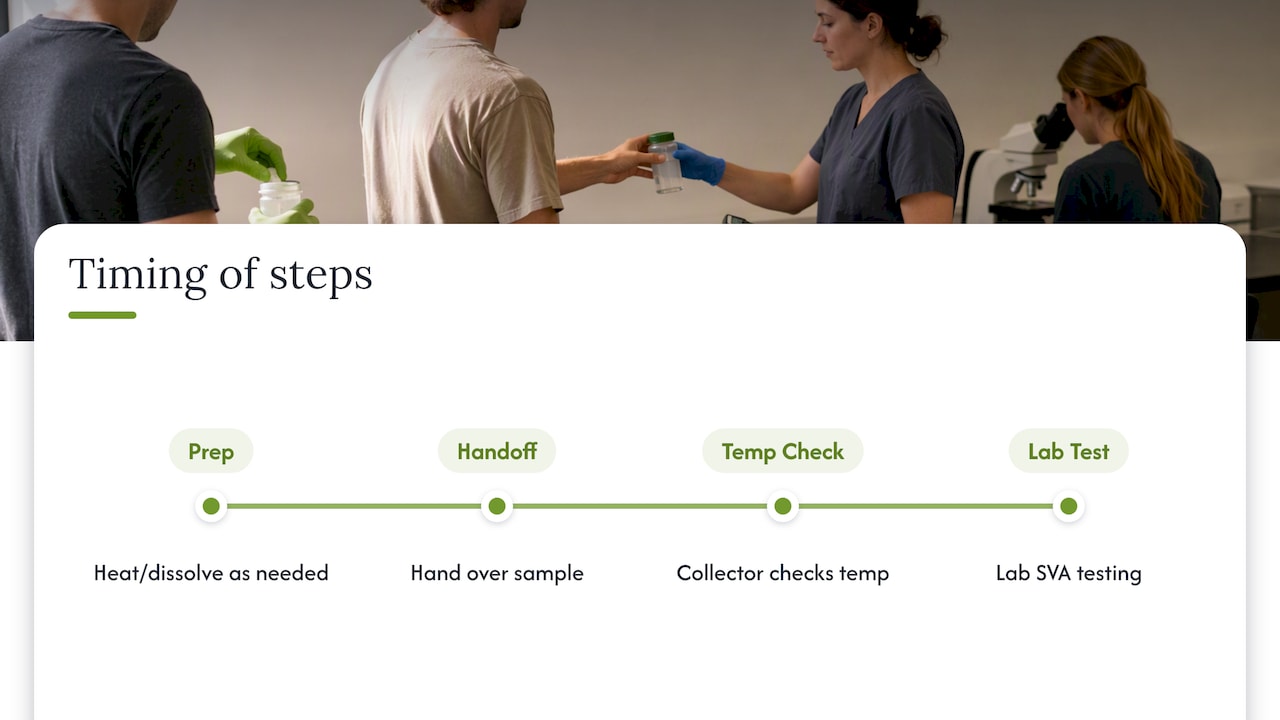
Most liquid synthetic urine kits are designed to be heated and used within a narrow window right before the collection appointment, typically in the final hour or less. Heating too far in advance risks the sample cooling below the acceptable range by the time a collector checks it, while heating too close to the appointment risks not reaching temperature at all.
Powders need enough lead time to fully dissolve and reach a stable temperature, which usually means more preparation time than a liquid kit, not less. Device-based systems like the Whizzinator or belt kits add another timing variable: the heating element needs enough lead time to warm the liquid inside without so much lead time that it cools again before the collection.
None of this timing guidance changes the underlying issue covered throughout this article: collection-site temperature checks happen within minutes of handoff, and laboratory specimen validity testing happens afterward regardless of how well the timing was managed beforehand.
Where I land on all of this
Every product on this list promises something a controlled lab test hasn’t verified at scale. If you’re facing a real test, talk to your employer about their testing policy, or look into lawful preparation methods instead of betting on a formula.
— MIchael
Where to go deeper on test preparation
If you want the fuller picture on detection windows, collection procedures, and lawful preparation strategies beyond synthetic urine, membership programs provide ongoing access to guides written for exactly this kind of research.

- Read the complete guide to passing a drug test for detection windows and preparation timelines.
- Check the supervised collection guide if you expect a monitored test.
- Become a member for ongoing access to testing and preparation resources as they’re published.
FAQ
Can a urine test detect synthetic urine?
Yes. Laboratories run specimen validity testing that checks creatinine, specific gravity, pH, and, where available, enzyme markers like GGT and amylase, and collection sites separately check temperature and visible signs of tampering. A 2026 case analysis found combined markers caught synthetic samples that single-marker checks missed.
Does Quick Fix work on a laboratory test?
There’s no published controlled data confirming Quick Fix passes current laboratory specimen validity testing. The only controlled comparison available, a 2018 Army laboratory challenge, tested a different product set under conditions that don’t reflect current lab protocols.
Is Upass more reliable than Quick Fix?
Neither product has independent, current lab data confirming reliable pass rates against modern specimen validity testing. Marketing differences between the two mostly concern which biomarkers they claim to include, and federal guidance treats single-marker claims as insufficient evidence either way.
What makes a synthetic urine sample fail at the collection site?
The most common failure points are temperature outside the acceptable range within the four-minute check window and visible signs of tampering, both specified under federal collection procedures. Either issue typically triggers a second collection under direct observation.
Are prosthetic devices like the Whizzinator detected differently than liquid kits?
Prosthetic and belt systems carry the same temperature and tampering checks as liquid kits, plus added mechanical risk from tubing, heating elements, and timing. A leak, a wrong temperature reading, or a visible device during collection can flag the attempt before the sample ever reaches laboratory testing.
Sources
- Sample validity lessons learned from challenging cases and proposed biomarkers for synthetic urine detection | Journal of Analytical Toxicology
- Use of urine biomarkers in validity testing: strategies and complexities | SAMHSA
- Collection Site Manual 2024 – Urine | SAMHSA
- § 40.65 – What does the collector check for when the employee presents a urine specimen? | Code of Federal Regulations
- Can synthetic urine replace authentic urine to “beat” workplace drug testing? (Army test challenge)
Recommended
- Supervised Drug Tests for Females – Best Guide
- Certo Detox To Pass A Drug Test: What you should know
- Methods to Pass a Hair Drug Test
|
The Council for the Advancement of Nursing Science |
   |