Most standard employment drug tests come back negative within 24 to 72 hours of the specimen reaching the lab. Rapid tests done at the collection site can show a negative in minutes to a few hours. A non-negative result is different. It goes to lab confirmation and a Medical Review Officer (MRO), and that usually adds several days before anyone calls it a final positive.
This guide covers each step of the clock, what slows it down, and what the wait does and does not tell you. It is written for people waiting on a pre-employment or random screening, and for anyone who wants to understand the process.
TL;DR
- Negative lab-based urine tests: typically 24 to 72 hours from lab receipt. Shipping time to the lab comes on top.
- Rapid or point-of-collection tests: a negative can be available in about four hours or less. Anything non-negative is only preliminary.
- Non-negative results: confirmation testing plus MRO review typically adds 3 to 5 days. A slow answer is not proof of a positive, and a fast one is not proof of a pass.
- Hair and saliva: saliva swabs can read in minutes on site. Hair is sent to a lab, so ask the collector or employer for the expected turnaround.
Table of Contents
- The timeline from collection to a final answer
- Result times by test type
- Why a non-negative result takes longer
- What the waiting time can and cannot tell you
- What to do while you wait
- Our perspective
- For nursing students and professionals
- FAQ
- Sources
The timeline from collection to a final answer
A drug test is a chain of steps, and each one has its own clock.
- Collection. You give a urine, saliva or hair sample. The collector seals it and starts the chain-of-custody form. This takes minutes.
- Transport. Specimens are shipped to a certified lab, commonly the same day or overnight. This is the step people forget when they count the days.
- Initial screen. The lab runs an immunoassay screen. Negatives are reported fast.
- Confirmation. A non-negative specimen is retested with gas chromatography/mass spectrometry (GC/MS), the confirmation method labs use to identify a substance with scientific certainty.
- MRO review. For regulated and many private programs, a physician reviews the lab report and interviews the donor before the employer hears a verified result.
- Reporting. The result reaches the employer or its background screening dashboard. Employers may then take extra time to act on it.
The lab portion is only one piece. A test that is “done” on Monday can still be showing as pending on Thursday because of shipping, weekends, or an MRO who has not yet reached you.
Result times by test type
| Test type | Typical negative result | If non-negative |
|---|---|---|
| Lab-based urine | 24 to 72 hours after lab receipt | Confirmation plus MRO review, typically 3 to 5 additional days |
| Rapid urine (point of collection) | Minutes to about 4 hours | Sent to lab for GC/MS, which can add 48 to 72 hours |
| Saliva (oral fluid) swab | Minutes for an on-site device | Lab confirmation, then MRO review where required |
| Hair | Lab-based; confirm timeline with the collector | Confirmation, then MRO review where required |
These are typical ranges, not guarantees. A program’s own policy, the lab’s workload and the day of the week all move them.
Urine: the most common, and the most predictable
Urine is the usual specimen for pre-employment screens. One national screening provider states that processing is 24 to 72 hours from the time the lab receives the specimen. Employer-facing summaries tend to say one to three days in total, and you will see results in that range cited across the top-ranking pages for this topic.
If you want to know what is on the panel before you wait, our guide to U.S. preemployment drug tests and applicant rights lists the five-panel basics.
Rapid tests: fast for negatives only
Rapid tests at a patient service center or clinic are real, but people misread them. Rapid tests that screen negative typically have results available to the ordering client within four hours. The same page explains that non-negative specimens go to a certified lab for mass spectrometry confirmation.
So “instant” means instant for one outcome. If the cup or device shows anything other than clean, the result is preliminary. Do not treat a long wait after a rapid test as a good sign or a bad one. It means the specimen is in the confirmation queue.
Saliva: minutes on site, but the same rules apply
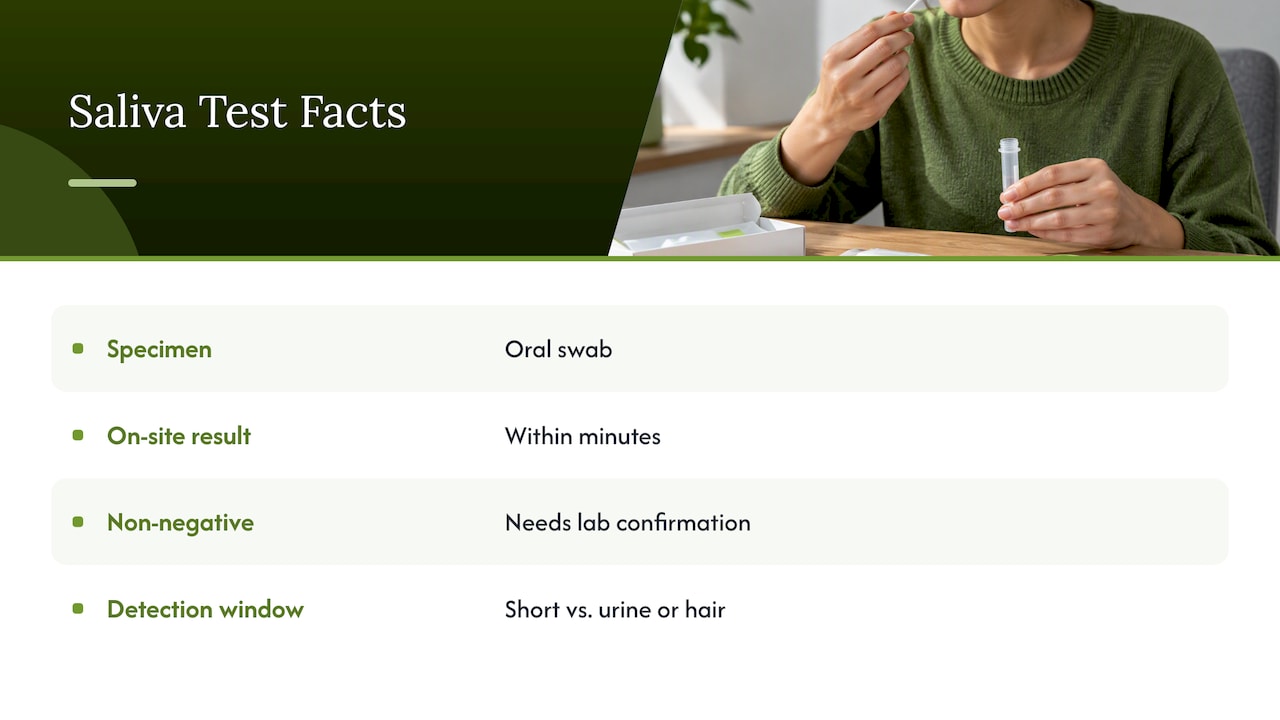
Oral drug tests use a swab. Point-of-collection saliva tests give results within minutes, and a non-negative still needs lab confirmation. Saliva is also tied to recent use, so detection windows are short compared with urine or hair. Our drug detection times guide explains how specimen, cutoffs and program rules change those windows.
One caution about folk tricks. Research on oral fluid notes that stimulating saliva with something sour can lower measured drug concentrations, but this kind of manipulation can also be picked up in specimen validity checks. That can lead to an invalid result or a refusal to test, which many programs treat like a positive. Do not eat or drink anything in the minutes before a swab, and follow the collector’s instructions exactly.
Hair: a lab-only test, so ask before you count days
Hair tests are not run on a device at the collection site. The hair goes to a lab, then follows the same confirmation and review path as other specimens. We have not found a single authoritative national figure for hair turnaround, so we will not give you one. Ask the collection site or the employer’s screening vendor for the expected timeline, and ask whether the lab’s report goes through an MRO.
Hair covers a much longer look-back than urine, which is why people searching for hair test timelines are usually also searching for detection windows. See Hours to 90 Days: THC Detox Timeline and 2026 Federal Cutoffs for that side of the question, and hair dye and drug tests for what treatments do and do not change.
Why a non-negative result takes longer
A non-negative screening result is not a verified positive. It triggers extra steps by design, and each one costs time.
Lab confirmation
The screen is a first pass. Confirmation by GC/MS is the step that identifies the specific substance and checks it against a cutoff. That second analysis is why employers warn that positive results take longer to report than negatives.
The MRO interview
Federal programs and many private ones route confirmed results to a Medical Review Officer. The role is to protect accuracy and fairness: the SAMHSA workplace program materials describe the MRO as the physician who reviews results and gives the donor a chance to discuss a legitimate medical explanation, such as a valid prescription. The 2024 MRO Guidance Manual lays out how federal MROs handle cancelled tests, dilute specimens and reporting.
The practical bottleneck is you. The MRO has to reach you. If you do not answer the phone from an unknown number, the review stalls. Under federal guidance, a donor who cannot be reached after repeated attempts can end up verified as positive without ever having explained a prescription. If you tested recently, keep your phone on and return unfamiliar calls promptly.
For DOT-regulated tests, 49 CFR 40.137 sets the basis on which the MRO verifies confirmed positives for marijuana, cocaine, amphetamines, semi-synthetic opioids and PCP.

Medications and false positives
Some prescriptions can trigger a non-negative screen. That is exactly what the MRO interview is for, and it is also why you should bring a medication list. Our article on how ofloxacin can trigger a false positive and why to request GC/MS walks through one example.
THC and the “medical marijuana” question
For federal workplace programs, state cannabis laws do not change the analysis. SAMHSA’s November 2025 memo to federal drug program coordinators and MROs treats cannabis-derived products under federal rules, and a state-level recommendation is not a legitimate medical explanation in those programs. If you are in a federally regulated job, a THC positive will generally be verified as positive. Private employers set their own policies, so ask HR what applies to you. For what actually triggers a THC result, read CBD and THC drug tests.
What the waiting time can and cannot tell you
People read the clock like a verdict. It is not one.
- A fast negative from a rapid test is a real negative, subject to the lab’s own validity checks.
- A slow result may only mean weekend shipping, a backlog, or a specimen waiting for the MRO.
- A call from the MRO means the review process has begun. It is not the final outcome.
- A dilute or invalid specimen can mean a recollection, which restarts the clock. Learn how urine temperature checks and supervised collection work so a procedural problem does not catch you off guard.
Also keep the test and the answer separate. A urine or hair result shows that a substance or metabolite was present, as we explain in THC metabolites: exposure, not current impairment. It does not by itself show impairment.
What to do while you wait
- Ask the collector for the timeline. Ask when the specimen ships, which lab receives it, and whether an MRO is involved.
- Ask where results go. Some employers receive results in a screening dashboard, some by phone. Find out which.
- Keep your phone available. MRO calls often come from unlisted or unfamiliar numbers.
- Make a list of medications. Include prescriptions, doses and prescriber names. Have documentation ready.
- If the result is non-negative, ask for confirmation by GC/MS if it has not already happened, and ask how to request a retest of the split specimen where the program allows it. Our probation drug test guide explains how that works in a court-supervised setting.
- Be skeptical of quick fixes. Waiting time is the wrong moment to buy a product that promises a pass. We review what the evidence does and does not support in our guides on detox drinks for THC tests and how THC stores in fat. Neither can undo a specimen already collected.
Our perspective
We publish about drug testing because the questions people ask are rarely the questions that matter. “How long until I know?” is really “Should I be worried?” The honest answer is that timing is mostly logistics. Shipping, weekends, lab queues and an unanswered phone call explain far more delays than the result itself does.
What we try to do is separate three things that get blended together online: documented testing practice, product marketing, and personal reports. Turnaround figures from labs and regulators belong in the first group. Claims that a drink or shampoo guarantees a pass belong in the second, and a forum thread about someone’s cousin’s test belongs in the third.
If you take one thing from this page, make it this: once a specimen is collected, the outcome is set by what is in it and by the program’s rules. The most useful things you can still control are being reachable, knowing your rights in the process, and having your medication documentation ready.
— MIchael
For nursing students and professionals
The Council for the Advancement of Nursing Science supports nurse scientists and nursing professionals with research, practice and policy resources. If you are a nursing student, the student membership is 40 USD per year, and NSNA members pay 36 USD per year. You can see all plans on the membership page.
FAQ
How long do drug test results take for a new job?
Most pre-employment urine tests return a negative within one to three days, counted from when the lab receives the specimen. Add shipping time. If the screen is non-negative, expect confirmation and MRO review to add roughly three to five days.
Why is my drug test result taking so long?
Common causes are weekend or holiday shipping, a lab backlog, a recollection after a dilute or invalid specimen, or a pending MRO interview. A missed MRO call can stall a result for days. Ask the collection site or the employer’s screening vendor for the status before assuming anything.
Are saliva test results faster than urine?
On-site saliva devices can read in minutes, which is faster than a lab-based urine test. Rapid urine tests can also screen negative within hours. In both cases a non-negative result is preliminary and goes to a lab for confirmation.
Does a rapid negative mean I have passed?
A rapid negative is usually the end of testing for that specimen, and it can be available within about four hours. Employers can still have their own steps, such as lab validity checks or a full panel sent out. Ask the employer when the process is considered complete.
How long does a hair test take to come back?
Hair is analyzed at a lab, so there is no on-site answer. We cannot give a single reliable number, because turnaround depends on the lab and the program. Ask the collector or employer for the timeline, and whether an MRO reviews non-negative results.
Sources
- DISA: How long does a drug test result take?
- Rapid urine drug tests, national laboratory overview
- Tests and screenings FAQ, occupational health provider
- Cleveland Clinic: Oral drug test (mouth swab)
- Bioanalytical procedures for monitoring in utero drug exposure (PMC)
- SAMHSA: Workplace programs
- SAMHSA: MRO Guidance Manual for Federal Workplace Drug Testing Programs, 2024
- U.S. DOT: 49 CFR Part 40, Section 40.137
- SAMHSA: Synthetic Cannabis-Related Products Memo, November 2025
Recommended
- Specimen, Cutoffs, and Program Rules Change Drug Detection Times
- Hours to 90 Days: THC Detox Timeline and 2026 Federal Cutoffs
- Methods to Pass a Hair Drug Test
- How to Pass a Drug Test: A Complete and Detailed Guide
|
The Council for the Advancement of Nursing Science |
   |