Baking soda does not reliably help you pass a drug test, and it can hurt you. Urine labs check the pH of a sample as a routine validity step, so a sample pushed off normal can be reported as a problem in its own right. Swallowing enough sodium bicarbonate to change your urine can also cause serious medical harm. This guide explains what the trick claims, what the lab actually does, what the poison-center data shows, and what to do instead if a test is coming.
TL;DR
- Baking soda is sodium bicarbonate. It has no documented ability to remove THC or other drug metabolites from urine, blood, saliva or hair.
- Federal-style urine testing includes specimen validity checks for creatinine and pH, so an abnormal sample can be flagged instead of passing quietly.
- Large doses can cause electrolyte problems, metabolic alkalosis and, in case reports, stomach rupture. In one California review, over half of the cases tied to “beating a drug test” needed medical evaluation.
- Baking soda on hair does nothing to the drug trapped inside the hair shaft.
- A better plan is to learn your test type, your timeline and your rights, and to talk to the testing program or a medical review officer about legitimate prescriptions.
Table of Contents
- What people think baking soda does
- What the lab does with your urine sample
- Does baking soda work on other kinds of tests?
- Is baking soda dangerous?
- How accurate is a baking soda pee test?
- What happens if a sample is flagged
- Our perspective
- What to do instead
- For nurses and nursing students
- FAQ
- Sources
What people think baking soda does
The theory goes like this. Drugs and their metabolites are excreted in urine. Urine pH affects how some substances are excreted. So, the argument runs, drinking baking soda dissolved in water will change your urine and “neutralize” or flush out what the lab looks for.
Online versions vary a lot. A poison-center case report notes that internet dose suggestions range from about a teaspoon to several tablespoons in water. That spread alone tells you nobody has tested a safe, effective amount, because none exists.
There is a sliver of chemistry behind the myth. A 2024 web-monitoring study of test subversion in the United States notes that baking soda may raise urine pH and reduce the elimination of amphetamines. That is a statement about how one drug class is excreted. It is not evidence that a test comes back negative, and it says nothing that would help with THC.
Two other versions turn up in searches:
- Baking soda on hair. Forums describe pastes or washes meant to “open” the hair and pull out metabolites.
- The baking soda and vinegar test. People sometimes ask whether mixing the two shows something about a sample. Mixing them just produces fizzing carbon dioxide. It tells you nothing about drugs in urine, and it is not a screening method any lab uses.
What the lab does with your urine sample
A urine drug test is more than a check for THC. In federally regulated testing, the lab also checks whether the sample looks like real human urine.
The 2024 HHS Medical Review Officer Guidance Manual describes mandatory specimen validity testing. At a minimum, labs measure creatinine and pH. They add specific gravity when creatinine is below 20 mg/dL. Results outside expected ranges can lead to a report of invalid, adulterated or substituted, and the medical review officer (MRO) is involved in what happens next.
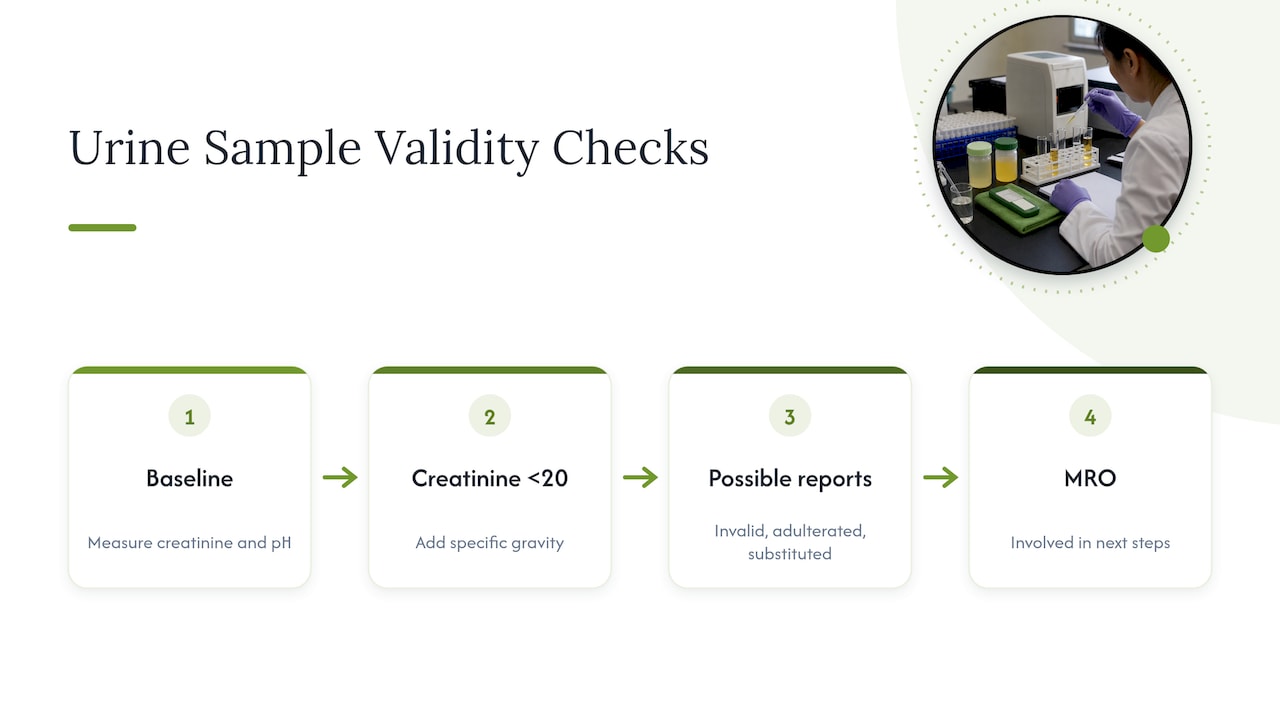
That is the core problem with baking soda. The test does not just ask “is THC there?” It also asks “is this sample normal?” A sample with an abnormal pH is a red flag, and it does not hide the drug marker. The outcome can be worse than a plain positive, because an adulterated result suggests tampering. For many jobs and programs, that reads as a refusal to test.
Many employers use non-federal tests, and their rules differ. Still, labs that run them commonly use the same validity checks. For how dilution fits in, see our guide to dilute urine drug tests, the 20 mg/dL line and specific gravity of 1.003. For how collectors guard against swaps, see urine drug test temperature checks.
Why single-marker tricks fail
Home methods usually try to move one number: pH, creatinine or concentration. Labs look at several markers together, and a fix that nudges one can push another out of range. We explain this in why labs catch quick fixes.
Does baking soda work on other kinds of tests?
It helps to separate sample types, because each works differently.
| Test type | What baking soda claims | What is documented |
|---|---|---|
| Urine | Changes pH to hide metabolites | Abnormal pH is a validity flag; no documented way to erase THC markers |
| Hair | Paste or wash “cleanses” follicles | No scientific evidence it removes drug from hair; scalp and hair damage possible |
| Saliva (oral fluid) | Swallowing or rinsing alters the result | Oral fluid is a validated alternative to urine; see this systematic review |
| Blood | Not usually claimed | Not applicable to home remedies |
On hair, the sample is cut close to the scalp and the drug is incorporated into the hair as it grows. Something rubbed on the outside does not reach it. If you are weighing hair-specific options, read our guides on detox shampoos and hair dye and drug tests, which separate documented effects from product claims.
On saliva, drugs appear in oral fluid mostly from recent use. Time since use matters far more than anything you swallow. Our drug detection times guide shows how specimen type and cutoffs change the window.
Is baking soda dangerous?
Yes, in the amounts people use for this purpose. The popular idea that baking soda is “natural” and therefore harmless is wrong.
Poison Control explains that baking soda is sodium bicarbonate, and both the sodium and the bicarbonate can cause serious toxicity if too much is swallowed. When it reaches the stomach it rapidly produces a large volume of carbon dioxide.
That gas is the reason for the most dramatic case on record. A poison-center case report on gastric perforation describes a stomach rupture after baking soda was taken to beat a drug test. The report explains that the reaction with stomach acid creates gas, and heavy water intake, which online “detox” routines often add, can distend the stomach. Rupture is a life-threatening emergency that needs surgery.
Other harms are more common than rupture. The Missouri Poison Center warns that serious toxicity can occur even with small ingestions, with electrolyte imbalance and metabolic alkalosis among the risks. Its toxicology sources state plainly that failing a screen is a better outcome than internal damage.
A review of California Poison Control System cases put numbers on it. “Beating a urine drug test” was the stated reason in 11.5% of identified baking soda misuse cases, and 55.2% of those cases needed medical evaluation because of significant toxicity.

Symptoms that mean you should get help
The overdose symptoms listed by a medical encyclopedia entry on baking soda overdose include vomiting, diarrhea, muscle spasms, muscle weakness, irritability and convulsions. If you or someone else has taken baking soda in a large amount, call Poison Control at 1-800-222-1222 right away, or call 911 for severe symptoms such as convulsions, severe abdominal pain or trouble breathing. Do not wait to see whether it passes.
People with kidney disease, heart failure, high blood pressure, or anyone on diuretics or other regular medication should be especially wary of sodium loads. Ask your doctor or pharmacist before taking any sodium bicarbonate. Never give it to a child.
How accurate is a baking soda pee test?
A search result sometimes shows a “baking soda pee test” for pregnancy or health. These home tests have no validated accuracy for anything, and they have no connection to drug testing. A drug test relies on immunoassay screening and, for presumptive positives, confirmation by a method such as GC/MS. Our probation drug test guide explains why you can ask for confirmation.
A home kit also has limits. One laboratory science study of a lateral-flow urine device examined how well such devices perform in the presence of adulterants and when used by untrained people. Consumer-level checks are not the same as a certified lab, and you cannot use one to predict how a lab will treat a sample whose pH you have altered.
What happens if a sample is flagged
The path depends on who is testing you.
- Collection. A collector checks the sample, in many programs including temperature within minutes. A sample that looks wrong can trigger a recollection, sometimes under direct observation. See our guide to supervised urine collection.
- Laboratory. The lab runs the drug panel and the validity tests. Out-of-range pH or creatinine can produce an invalid, adulterated or substituted report.
- Review. In federal programs, an MRO reviews the result and speaks to the donor before reporting it to the employer. Medications you take legitimately are discussed here.
- Employer decision. Policies differ. A refusal or adulterated result is often treated as seriously as a positive, and sometimes more so.
For job applicants, our pre-employment drug test guide covers the usual panels and applicant rights. Rules vary by state and by whether the job is federally regulated, so check the written policy you were given.
Our perspective
We publish drug-testing guides because people facing a test usually get advice from forums and product pages, and those are the least careful sources. The baking soda question is a good example. It sounds like kitchen chemistry, so it feels low risk. The documentation says otherwise: a lab that checks sample validity as routine, and poison centers that have seen what happens when people try it.
We also see a pattern worth naming. The methods that spread online usually move one marker and ignore the rest of the lab process. Few come with a source you can read. When we write about any approach, including detox drinks, shampoos and charcoal, we try to separate three things: what testing procedures document, what a product claims, and what people report. Baking soda fails on the first and gets worse on the third.
Our advice is practical. Find out which test you are facing and what the written policy says. Work out your realistic timeline, using what is known about how THC leaves the body. If you take a prescribed medication, tell the collector or MRO at the right moment. And do not put your stomach or kidneys on the line for a trick that the lab is built to catch.
— MIchael
What to do instead
There is no shortcut we can honestly promise. There are decisions that help.
- Identify the test. Urine, saliva, hair and blood have very different windows. Our detection times guide and the THC detox timeline with current federal cutoffs lay these out. A pharmacology review of detection times in blood, urine and oral fluid shows how much they vary with dose and frequency of use.
- Understand how THC is stored. THC is fat soluble, which is why heavy use lingers. Read how cannabis stores in fat and what that means for clearing it.
- Check CBD products. Some products carry trace THC. See what actually triggers a positive on CBD and THC tests.
- Weigh other products critically. If you are comparing options, our guides on detox drinks and activated charcoal explain what they claim and where they fall short. For a wider overview, see our complete guide to drug tests.
- Ask about timing. If you can reschedule legitimately, or you have a medical or legal basis to discuss, do it openly with the program rather than hiding it.
If cannabis or other drug use is becoming hard to control, talk to your doctor or call the SAMHSA National Helpline at 1-800-662-4357. That is a better use of the weeks before a test than any kitchen remedy.
For nurses and nursing students
NursingScience.org is built for nurse scientists and nursing professionals, and drug testing is part of workplace life in health care. If you work or study in the field, our membership options give you access to resources, conferences and community. The student rate for undergraduate, master’s and pre-doctoral members is 40 USD per year, and NSNA members pay 36 USD per year at the discounted tier.
FAQ
Does baking soda help pass a drug test?
No documented evidence says it does. Labs check urine pH and creatinine as part of validity testing, so an altered sample can be flagged rather than cleared. It also carries real medical risk.
Is baking soda dangerous?
Yes, when swallowed in the large amounts suggested for this trick. Poison centers report electrolyte disturbance, metabolic alkalosis and, in a documented case, stomach perforation. Call Poison Control at 1-800-222-1222 if someone has taken too much.
Does the baking soda and vinegar test show anything about drugs?
No. Combining the two produces carbon dioxide and fizzing, and that reaction says nothing about drug metabolites in a sample. No lab uses it as a drug screen.
Does baking soda work on a hair follicle test?
There is no scientific evidence that it removes drug from hair. Labs analyze the hair shaft itself, and surface treatments do not change what is inside it. Scrubbing can irritate your scalp and damage hair.
Sources
- Baking soda misuse as a home remedy: California Poison Control System case experience
- Medical Review Officer Guidance Manual for Federal Workplace Drug Testing Programs, 2024
- Gastric Perforation After Baking Soda Ingestion to Beat a Drug Test, Missouri Poison Center
- Ill Advised Antidotes, Missouri Poison Center
- Baking soda: risks and treatment, Poison Control
- Baking soda overdose, ADAM medical encyclopedia
- Systematic web monitoring of drug test subversion strategies in the United States, Drug Testing and Analysis
- Hair analysis for drug detection, PubMed
- Whether drug detection in urine and oral fluid is similar? A systematic review
- Detection times of drugs of abuse in blood, urine, and oral fluid
- OneScreen drug test devices: adulterant effects and untrained subject use, ASCLS
Recommended
- How to Pass a Drug Test: A Complete and Detailed Guide
- U.S. Probation Drug Test: What to Expect and Ask for GC/MS Confirmation
- Methods to Pass a Hair Drug Test
- CBD and THC Drug Tests: What Actually Triggers a Positive
|
The Council for the Advancement of Nursing Science |
   |