Yes, labs can detect synthetic urine, but not with one universal test. Detection works in layers: a collector checks the sample at the cup, the lab runs specimen validity testing, and a suspicious sample can get targeted biomarker analysis. Basic checks miss well-made products. The layered approach, plus the way the sample is collected, is what catches them. And in federally regulated testing, a substituted result is treated as a refusal to test.
This guide explains what each layer looks for, where each one is weak, and what happens to you if a sample is flagged. It is written for people facing a pre-employment or random screen who want the documented facts, not product marketing.
TL;DR
- Labs detect synthetic urine through collector checks, routine validity tests (creatinine, specific gravity, pH, oxidants) and, when a sample looks off, targeted biomarkers such as uric acid, GGT and amylase.
- Routine validity testing alone is weak against well-formulated synthetic products. Peer-reviewed work says no single test catches every fake, so labs combine methods.
- Under DOT rules, a substituted specimen is a refusal to test, with the same consequences as a positive result.
- Observed collections and supervised procedures cut off the opportunity to substitute a sample in the first place.
- If your real concern is a THC result, the documented timelines and options are safer to understand than a gamble on a fake sample.
Table of Contents
- What counts as synthetic urine, and why labs care
- The layers of synthetic urine detection
- Why the collection process matters more than the chemistry
- What happens when a sample is reported as substituted
- Synthetic urine versus real urine: what a lab sees
- A note on “best brand” and “top kit” lists
- Perspective: what we tell readers who are worried about a test
- If you work in nursing or health research
- What to do instead of gambling on a fake sample
- FAQ
- Sources
What counts as synthetic urine, and why labs care
Synthetic urine is a lab-made liquid built to resemble human urine: water, urea, creatinine, salts, and a pH buffer. Laboratories legitimately use similar fluids as calibrators and controls, which is one reason a collector cannot simply look at a sample and know.
Why labs care: a drug test only means something if the specimen is human urine from the person being tested. So before any drug result is reported, a lab checks that the sample is the real thing. Researchers describe the problem as a moving target. Manufacturers adjust formulas, labs add markers, and no single static test guarantees detection of every product.
The layers of synthetic urine detection
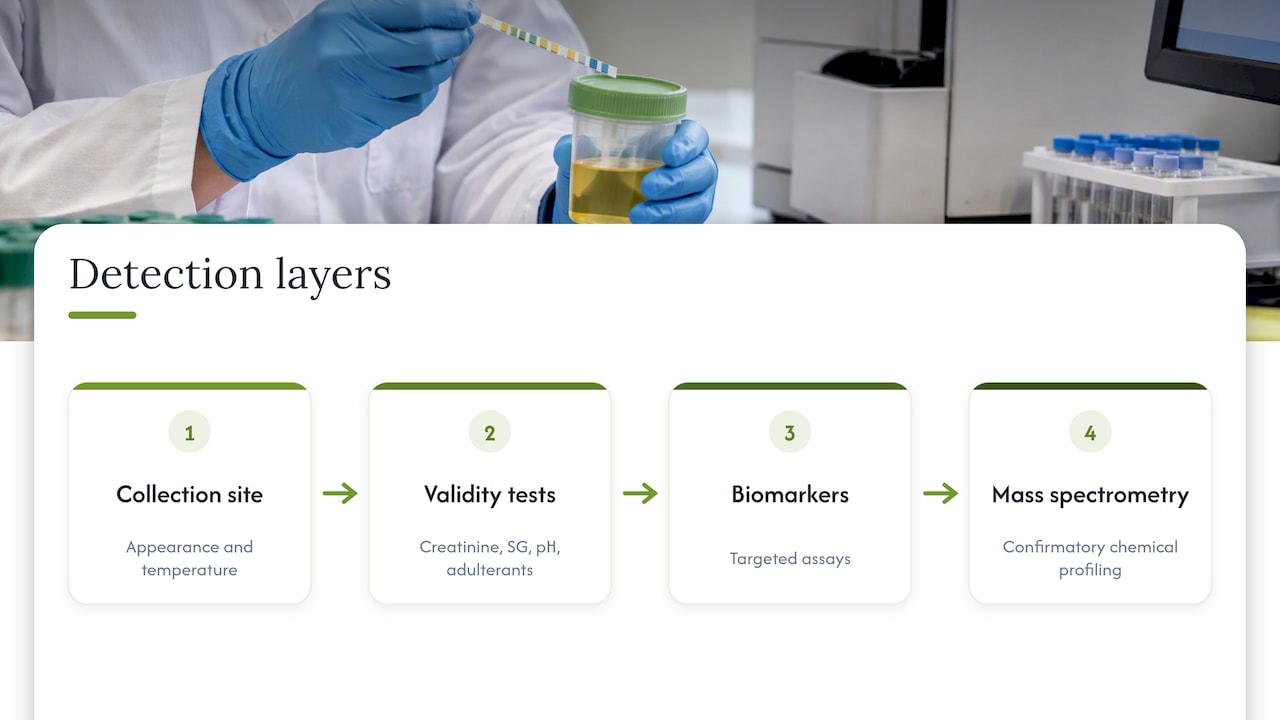
Layer 1: the collection site
The first check happens before the sample leaves the room. Collectors look at color, odor, and clarity, and read the temperature strip on the cup. Federal workplace rules set the procedure for collection, and an unusual temperature or appearance can lead to a second, observed collection.
Temperature alone is a weak safeguard. The toxicology literature warns that relying on a single parameter such as temperature is easily circumvented. That is why collection procedure matters as much as chemistry.
Layer 2: routine specimen validity testing
Under federal rules, labs must test primary urine specimens for validity, and 49 CFR 40.87 spells out the required checks: creatinine, specific gravity, pH, and screening for oxidants and other adulterants. Labs are also authorized to go further when a specimen has an unusual odor, color, or consistency, or reacts atypically during screening.
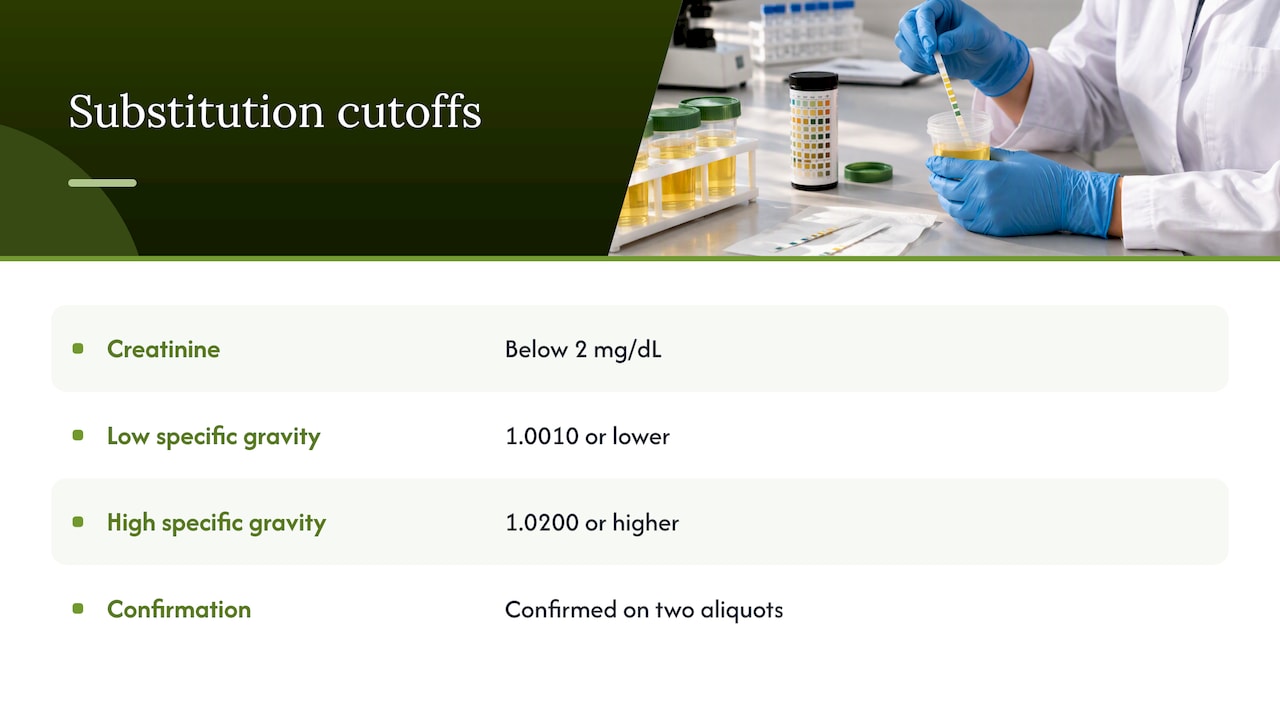
The cutoffs are specific. A specimen is called substituted when creatinine is below 2 mg/dL and specific gravity is 1.0010 or lower, or 1.0200 or higher, confirmed on two aliquots. Real human urine essentially never looks like that, but a good synthetic product is not made to look like that either.
Here is the honest weakness. Products are engineered to sit inside normal ranges for exactly these parameters, so routine validity testing is largely ineffective against high-quality synthetic urine. A sample that is merely “normal” on creatinine, specific gravity, and pH has passed the routine layer. It has not been proven to be human.
Layer 3: targeted biomarkers
This is where detection gets serious. Real urine is a messy biological fluid. It contains compounds that are hard and expensive to reproduce consistently, and labs now look for them in samples that raise a flag.
| Marker | What it is | Why it helps |
|---|---|---|
| Uric acid | Purine metabolism product | Absent in many synthetic formulas; its absence is a known substitution signal |
| GGT (gamma-glutamyltransferase) | Enzyme from the kidney | Typically present in authentic urine, often missing or inconsistent in fakes |
| Amylase | Digestive enzyme | Same logic: endogenous, variable, hard to mimic |
| Urea | Main nitrogen waste | Present in most synthetics, so alone it proves little |
A 2026 paper in the Journal of Analytical Toxicology describes how a laboratory used these proposed biomarkers on challenging cases, and reports that routine labs often do not screen for them unless something looks suspicious. An earlier study evaluated biochemical assays and optimized LC-MS/MS analysis specifically for finding synthetic urine, because the problem had become common enough to need dedicated methods.
Automated assays are arriving too. A 2025 study tested a commercial assay built for indirect synthetic urine identification, noting that synthetic urine mimicking normal urine is difficult to detect with standard validity testing. The direction is clear: what is a gap today is being closed with automation, which makes the targeted layer cheaper to run on more samples.
Layer 4: confirmatory analysis
When a sample is flagged, mass spectrometry can look at the whole chemical profile. Reviews of sample-manipulation testing note that commercial products which pass a basic immunoassay screen generally cannot withstand advanced forensic analysis, because they lack the complex, variable profile of real human fluid. Our guide on why labs catch single-marker claims in popular synthetic products goes deeper on why a product that advertises one passing marker says little about a full lab workup.
Why the collection process matters more than the chemistry
Medical Review Officers (MROs) are the physicians who review lab results before they go to an employer. Their consistent point is that the strongest defense against substitution is procedural. Monitored and observed collections reduce the opportunity to introduce a foreign liquid at all.
Under DOT rules, a directly observed collection can be required in defined situations, including after certain lab results, and the employer must explain the reason to the employee. Observed collection is also a standard feature of many return-to-duty and follow-up tests. If you want to know how these procedures work in practice, see our guide to supervised drug tests for females. Probation programs often use observed collection as well, and our page on the U.S. probation drug test explains what to ask for, including GC/MS confirmation.
The practical upshot: in a supervised setting, a fake sample has to get past a person watching, not just past a lab assay.
What happens when a sample is reported as substituted
In a DOT-regulated test, the consequences are heavy:
- The lab reports the specimen as substituted to the MRO.
- The MRO interviews the donor and treats the report the same way as a positive result, according to 49 CFR 40.145.
- The donor must offer a legitimate medical explanation backed by valid evidence gathered with proper methodology. Anecdotal claims about personal characteristics are not enough.
- Without that, the MRO reports a refusal to test, which carries the same professional consequences as a positive drug test.
For safety-sensitive drivers and others under federal rules, that can mean removal from duty and a return-to-duty process. For a non-DOT employer, policies vary. A flagged sample can end a job offer, and some employers treat tampering more harshly than a plain positive. Many states also have laws that criminalize selling or using substances to defraud a drug test, so check your own state’s statute or ask an employment attorney before assuming it is only a workplace matter.
Compare that to a plain positive THC result, which is often a conversation about timing and policy. Substitution turns a possible problem into a documented act of cheating.
Synthetic urine versus real urine: what a lab sees
| Feature | Real human urine | Typical synthetic product |
|---|---|---|
| Creatinine, specific gravity, pH | Varies by hydration and person | Set to fall in a normal range |
| Uric acid, GGT, amylase | Present, variable | Often absent or inconsistent |
| Natural variation between samples | High | Same every batch |
| Temperature at collection | Body temperature | Must be heated and held, easy to get wrong |
| Effect of observed collection | Not an issue | Very hard to defend |
None of this makes a given fake sample certain to be caught. It means the odds depend on how closely the lab looks, and you cannot know that in advance. Programs with higher stakes, such as DOT, probation, and some safety-sensitive jobs, look harder.
A note on “best brand” and “top kit” lists
If you searched for rankings of the best synthetic urine brands, you will find pages that claim a lab test of products. Be careful with them. Most are published by sellers or affiliates, and passing a quick strip or dipstick says nothing about a lab running uric acid, GGT, or mass spectrometry. Product websites also update formulas often, and the evidence above is that updates chase the screens labs used last year. We do not rank these products, because no honest ranking can promise how your specific lab will treat a sample.
Perspective: what we tell readers who are worried about a test
We publish drug-testing guides, and we also earn affiliate commissions on some product recommendations, so we try to be plain about the difference between documented testing practice and product claims. On synthetic urine, the documented picture is this: the cup is the weak point, and the lab is getting better every year.
When people write to us, the real worry is almost never “how do labs work.” It is “I have a test on Friday and I used last week.” That is a timing question, and it has more honest answers than a fake sample does. Our THC detox timeline lays out how long metabolites can stay detectable and which cutoffs apply. Our guide on THC metabolites explains why a positive shows exposure, not current impairment, which matters if you need to discuss a result with an MRO. If your result might come back dilute instead, read about dilute urine drug tests, since a dilute sample is a different outcome from a substituted one.
If you are applying for a job, learn what your employer actually tests for. Our page on preemployment drug tests and applicant rights is a good starting point, and our complete guide to passing a drug test covers the lawful options in more detail. Our view: a sample you can defend is worth more than a sample that passes today and creates a refusal record tomorrow.
— MIchael
If you work in nursing or health research
Some of our readers come to us from the professional side: nurses, nurse scientists and students who want to understand specimen integrity for their own practice or research. The Council for the Advancement of Nursing Science offers membership for individuals and institutions, with a student rate of 40 USD per year and a rate of 36 USD per year for NSNA members. You can compare plans on the membership page.
What to do instead of gambling on a fake sample
- Find out the test type. Urine, hair and saliva have different windows. Our guide on how specimen, cutoffs and program rules change detection times explains why.
- Ask about prescriptions. If a medication could trigger a result, tell the MRO. That is the legitimate path to a corrected result.
- Know your rights. Federal workplace rules give you an MRO interview before a result is reported to your employer.
- Do not assume a dilute sample is safe either. Drinking large amounts of water can produce a dilute result that may require a retest, which can be observed.
- Consider rescheduling or disclosure if your employer allows it, rather than relying on an untested workaround.
FAQ
Can labs detect synthetic urine?
Often, yes, but not always, and not with one test. Routine validity checks can be passed by well-made products. Targeted markers like uric acid, GGT, and amylase, plus mass spectrometry, are much harder to beat, and observed collections prevent substitution altogether.
What is validity testing for urine?
It is a set of checks that confirm a sample is real, undiluted, human urine before a drug result is reported. Under federal rules, labs measure creatinine, specific gravity and pH and screen for oxidants and other adulterants. They may do more when a specimen looks unusual.
What happens if my sample is reported as substituted?
In DOT testing, an MRO interviews you and, unless you provide a valid medical explanation backed by evidence, reports a refusal to test. That has the same consequences as a positive result. Non-DOT employers set their own policies, so ask yours.
Is synthetic urine the same as real urine in a lab test?
No. It can match basic numbers like creatinine and pH, but real urine contains variable enzymes and metabolites that fakes tend to lack or reproduce inconsistently. That is why labs that look beyond the routine panel can tell them apart.
Sources
- Sample validity lessons learned from challenging cases and proposed biomarkers for synthetic urine detection (J Anal Toxicol, 2026)
- Same article, DOI record
- Evaluation of biochemical assays and optimization of LC-MS-MS analysis for the detection of synthetic urine
- Evaluation of an automatized assay for indirect synthetic urine identification
- Advances in testing for sample manipulation in clinical and forensic toxicology, Part A: urine
- 49 CFR 40.87: validity tests on primary urine specimens
- 49 CFR 40.88: dilute and substituted criteria
- 49 CFR 40.145: MRO verification of adulteration or substitution
- 49 CFR 40.67: directly observed urine collection
Recommended
- Why Labs Catch Quick Fix vs Upass: 3 Reasons Single Marker Claims Fail
- Dilute Urine Drug Tests: 20 mg/dL, 1.003, and What to Do Next
- 90–100°F, Four Minutes: Urine Drug Test Temperature for Donors
|
The Council for the Advancement of Nursing Science |
   |