Nursing research grants in the United States come from three main places: the National Institute of Nursing Research (NINR) and other NIH institutes, federal workforce programs such as HRSA and the Department of Labor, and a long list of nursing foundations and specialty societies. Federal awards are the largest and slowest to win. Society and foundation grants are smaller, often open to master’s-prepared nurses and doctoral students, and are usually the best first step. This guide shows you how each route works, what they pay, who can apply, and how to prepare an application that gets read.
TL;DR
- NIH funds nursing science mainly through investigator-initiated grants (R01, R03, R15, R21) and through training awards (T32, F and K series), with NINR as the lead institute.
- Specialty societies and foundations offer smaller awards, often a few thousand dollars, with eligibility built around licensure, degree level, and membership.
- A research grant pays for a project. Scholarships and education grants pay for a student’s tuition, so check which one you actually need.
- Read the funding opportunity announcement first, talk to a program officer or experienced investigator early, and plan your budget around the science.
- Deadlines change every cycle. Treat any date you see in an article as a pattern and confirm it on the funder’s own page.
Table of Contents
- The main funding sources for nursing research
- NIH and NINR grants for nursing research
- Foundation, society and specialty grants
- Who is eligible and what projects get funded
- Research grants, scholarships, fellowships: do not mix them up
- How much do awards pay, and how long do they last?
- Perspective: build a ladder, not a single leap
- How to prepare and submit an application
- Finding current deadlines
- Common mistakes that sink first applications
- Join a community that helps you get funded
- FAQ
- Sources
The main funding sources for nursing research
It helps to sort funders by who they are, because each type has different rules, award sizes and expectations.
| Funder type | Typical use | Award size | Who usually applies |
|---|---|---|---|
| NIH institutes (NINR and others) | Full research projects, pilots, training, career development | Varies by mechanism; large projects need extra approval above $500,000 in direct costs in any year | Faculty, postdocs, doctoral students, early-career investigators |
| HRSA and Department of Labor | Workforce, education and training programs | HRSA awards may reach $750,000 | Schools, health systems, workforce partners |
| Nursing honor societies and foundations | Pilot studies, specialty topics, dissertation work | Often $3,000 to $30,000 | Licensed nurses, graduate students, new investigators |
| Specialty and regional associations | Studies in one clinical area or region | Often $5,000 to $25,000 | Members, clinicians, educators |
| Hospital and university internal funds | Seed money for pilots | Varies by institution | Employees and faculty |
The federal workforce programs are a different animal from research funding. The Department of Labor’s Nursing Expansion Grant Program, for example, funds nursing workforce training initiatives and is paid for by a user fee on employers who bring foreign workers to the U.S. under the H-1B visa program. It builds training capacity. It does not fund a clinical study you design yourself.
NIH and NINR grants for nursing research
If you searched for NIH nursing grants or NINR grants, this is the section that matters. NINR’s primary mechanism is the investigator-initiated grant: you develop the question, the protocol, the method and the approach, and NIH funds the institution on your behalf.
Four research mechanisms cover most of what nurse scientists apply for:
- R01: the traditional research project grant for a discrete, specified project run by the named investigator or team.
- R03: small grants for pilot and feasibility work.
- R15 (AREA): small-scale research by faculty at educational institutions that have not been major participants in NIH programs. This is a useful route for faculty at teaching-focused schools.
- R21: exploratory and developmental research for new ideas that do not yet have preliminary data.
NINR also funds careers, not only projects. According to NIH’s institute profile, NINR supports research training through T32 institutional training grants, F30, F31 and F32 fellowships, and K-series career development awards. A doctoral student typically looks at an F31, a postdoc at an F32 or a T32 slot, and a junior faculty member at a K award.
Two details trip up first-time applicants. First, awards are made to institutions, except for predoctoral, postdoctoral and senior fellowships, which go to individuals. Your grants office will be a partner in submission. Second, each application gets a dual review, one for scientific merit and one for program relevance, so your aims need to fit the institute’s priorities as well as stand up on method.
NIH is not the only institute that funds nurses. Nursing scientists regularly apply to institutes focused on aging, cancer, mental health or minority health when the topic fits. Your project’s subject, not your professional title, decides which institute is the right home.
Foundation, society and specialty grants
Most nurses who win their first grant do it here. These awards are smaller, the applications are shorter, and reviewers are often nurses in the same field.
Sigma Nursing and co-sponsoring organizations offer grants ranging from pilot studies to specialty-area research and projects. One example shows how modest and how structured these can be. The Sigma and Midwest Nursing Research Society grant lists a maximum of $3,500, one award per year, and an annual 1 April deadline. Eligibility there requires a registered nurse with a current license who holds a master’s or doctoral degree or is enrolled in a doctoral program, and the project must be completed within one year of funding.
Other funders in this category include:
- Specialty nursing foundations tied to a clinical area such as oncology, emergency, critical care, rehabilitation or transplant nursing.
- Regional research societies that fund members within a multi-state area.
- Nursing education organizations that fund studies on teaching and learning.
- Academic nursing associations that fund early-career work.
Amounts across these programs range widely. Federal HRSA grants may range up to $750,000, while organizational awards are usually far smaller. Program announcements in 2026 list figures such as $30,000 for one emergency nursing foundation grant and $25,000 for the Foundation for Academic Nursing’s awards. Do not expect a society grant to cover your salary. It is meant to pay for a defined piece of work: participant incentives, a statistician, instruments, transcription, or a pilot.
Our own Awards & Grants page collects opportunities connected to the Council for the Advancement of Nursing Science, and the Council/STTI Grant page is a good place to see how a collaborative grant has been presented.

Who is eligible and what projects get funded
Eligibility depends on the funder, but a few patterns hold across most programs.
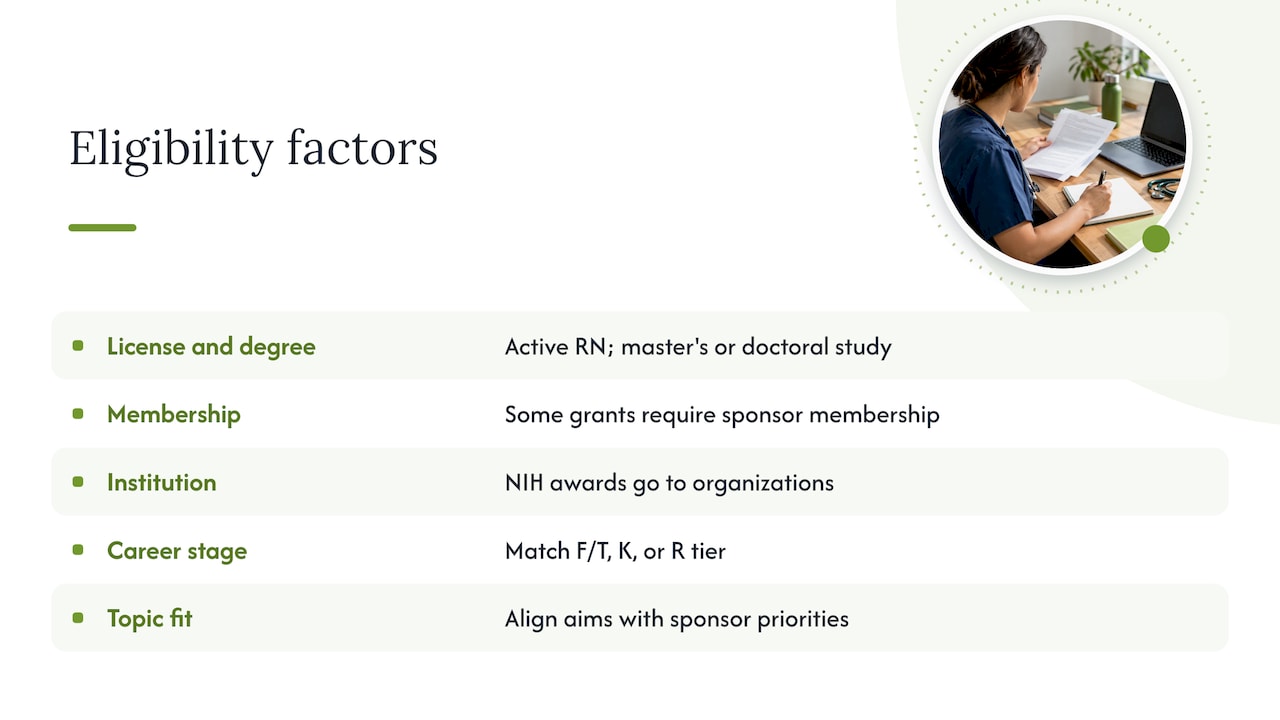
Licensure and degree. Society grants frequently ask for an active RN license and at least a master’s degree, or enrollment in a doctoral program. Some accept doctoral students only for dissertation support.
Membership. Many specialty and regional grants are open only to members of the sponsoring organization, sometimes with a minimum membership period. Read the eligibility list before you spend time on the narrative.
Institution. NIH makes awards to organizations, so you need an affiliation with a university, hospital or research institute that can administer the money. Independent applicants without an institution are rarely competitive for federal funds.
Career stage. NIH distinguishes training awards (F and T), career development (K) and independent research ®. Applying for the wrong tier is a common reason for a weak score.
Topic fit. Funders reward alignment. A critical care foundation wants critical care questions. A technology-focused foundation wants studies on implementation, evaluation or governance of healthcare technology. A nursing education funder wants studies of teaching. Tailor the aims to the sponsor’s own stated priorities.
Types of projects that tend to be funded include pilot and feasibility studies, secondary analyses, intervention trials, qualitative studies, quality improvement research with a clear research design, and dissertation projects. Pilot work matters: it produces the preliminary data that NIH reviewers expect.
Research grants, scholarships, fellowships: do not mix them up
Searchers often land on lists that blend three different things.
- Research grants fund a project: a study with aims, methods and a budget. NINR grants support research and training projects.
- Fellowships fund a person during training. Predoctoral, postdoctoral and senior fellowships go directly to individuals.
- Scholarships and education grants help pay tuition and living costs for nursing school. They are not research money.
If you are a student looking for tuition help rather than money to run a study, go to our financial aid for nursing students guide instead. If you are a doctoral student, you may need both: a fellowship for your stipend and a small society grant for dissertation costs.
How much do awards pay, and how long do they last?
The spread is enormous, so plan by tier:
- Seed and pilot (roughly $3,000 to $30,000): society and foundation grants, usually one year. These match a single study with a small sample.
- Mid-size federal and foundation awards: R03 and R21 projects, which are intended for exploratory or small projects and carry a shorter timeline and lower ceiling than an R01.
- Large projects: R01-level work. NIH requires that applications requesting $500,000 or more in direct costs in any year get NINR approval, requested from the Program Director at least six weeks before submission.
For exact award limits and project periods, always read the current announcement. They differ by program and are revised between cycles.
Perspective: build a ladder, not a single leap
We see many nurses treat the first application as an all-or-nothing bet on an R01. That is rarely the best path. In our view, the strongest portfolios are built in steps: a small society grant for a pilot, then a modest exploratory award, then a larger application backed by real preliminary data and a published paper or two.
We also believe the people around you matter as much as the idea. A mentor who has sat on a review panel, a statistician who joins at the design stage and a grants office that checks your budget early will improve a proposal more than another round of polishing prose. Joining a professional community of nurse scientists gives you access to exactly those people.
Finally, be realistic about timing. A grant cycle from idea to funding often takes many months, so start earlier than feels necessary.
— MIchael
How to prepare and submit an application
The process is similar whether the sponsor is NIH or a small foundation. Scale the effort, not the logic.
- Pick the funder by fit. Match your career stage, topic and degree to a specific program. Read previous award lists to see what gets funded.
- Read the full announcement. For NIH, the funding opportunity announcement sets the receipt date, the forms and the instructions. NINR advises applicants to check its funding opportunities and notices, consult NIH standard due dates, and read the announcement for the receipt date.
- Talk to a person. NINR recommends consulting experienced investigators and an NINR Program Director before you submit. A short call can save you from a mismatched mechanism.
- Draft specific aims or a summary first. One page that states the problem, the gap, the approach and the expected contribution. Share it with a mentor before writing anything longer.
- Assemble the standard pieces. Grant applications typically require biographical sketches, a detailed project narrative, a study budget and a budget justification.
- Build the budget from the science. NINR says budget requests must be science-driven. Every line should trace to an activity in your methods.
- Use the specified forms. Federal applications use electronic forms tied to the grant type, and submission runs through your institution.
- Submit early. Portals and institutional sign-offs take time. Aim to finish days, not hours, before the deadline.
Small grants usually ask for a shorter proposal, a CV, a budget and sometimes a letter of support or IRB documentation. Check whether you must have ethical approval before funds are released, because some sponsors will not pay costs incurred before the funding date.
Finding current deadlines
Deadlines are the part of any grants article that goes out of date fastest. NIH uses standard due dates and a defined review and award schedule, and each announcement lists its own receipt date. Foundations commonly run one cycle a year, with a spring or autumn deadline and a funding date a few months later, but the pattern shifts. Use these habits:
- Bookmark the funding opportunities page of NINR and the grants pages of your specialty organizations.
- Set a calendar reminder for the opening of each cycle you target.
- Confirm the date on the sponsor’s page before you plan around it.
- Ask your institution’s research office for a list of internal deadlines, which usually fall well before the sponsor’s.
Common mistakes that sink first applications
- An aim too large for the money. A $5,000 grant cannot fund a multi-site trial. Narrow the question.
- No link to the sponsor’s mission. Reviewers score fit.
- A vague budget. Items without justification look like padding.
- Ignoring eligibility fine print. License status, membership length and degree level are checked first.
- No preliminary data for a large award. Pilot first.
- Writing alone. Ask someone outside your project to read the draft cold.
Join a community that helps you get funded
Grants are easier to win with colleagues who have done it before. Our membership gives nurse scientists and nursing professionals access to conferences, educational resources and a network of peers working on research, practice and policy. Student membership (undergraduate, master’s and pre-doctoral) is 40 USD per year, and the NSNA member rate is 36 USD per year. You can see all plan options and join on the membership page.
FAQ
Can a nurse without a doctorate get a research grant?
Yes, in many cases. Several society and foundation grants accept nurses with a master’s degree and a current RN license, and doctoral students are often eligible for dissertation support. NIH research grants are awarded to institutions, so you would usually apply as part of a team led by a doctorally prepared investigator, or through a training award.
What does NINR fund?
NINR funds research and research training in nursing science. Its investigator-initiated grants include R01, R03, R15 and R21 awards, and it supports training through T32 grants, F fellowships and K career development awards.
How is a research grant different from a scholarship?
A research grant pays for a study you design, with aims, methods and a budget. A scholarship pays toward your own tuition or living costs while you are in school. Fellowships sit between the two and support an individual during research training.
How much can I expect from a first grant?
A first award from a society or foundation is often in the low thousands to the tens of thousands of dollars, for example $3,500 at the small end for one regional grant. Federal awards can be far larger, but they usually require preliminary data and an institutional partner.
Where do I check whether a grant is still open?
Go to the sponsor’s own page. For NIH, read the funding opportunity announcement and NIH standard due dates. For foundations, check the grant page for the current cycle, because dates change from year to year.
Sources
- Introductory Information for Grantees, NINR
- NINR profile, NIH Grants & Funding
- Frequently Asked Questions for Applicants and Grant Recipients, NINR
- Nursing Expansion Grant Program instructions, U.S. Department of Labor on Grants.gov
- Research & Project Grants, Sigma Nursing
- Midwest Nursing Research Society Research Grant, Sigma Nursing
Recommended
- Our Awards & Grants
- Council/STTI Grant – Council for the Advancement of Nursing Science
- Financial Aid for Nursing Students – Council for the Advancement of Nursing Science
|
The Council for the Advancement of Nursing Science |
   |