A nursing conference abstract is a short proposal, usually 250 to 500 words, that tells reviewers what problem you tackled, what you did, what you found and why it matters to nursing. To get accepted, read the specific call first, build the abstract around one focused question, report your key results with enough method detail to be credible, and finish with a practical implication. Then submit it complete, before the deadline, in the official portal.
The rest of this guide walks through that process with current U.S. examples, so you can see where calls agree and where they differ.
TL;DR
- Word limits vary by conference. AACN’s current call limits submissions to 500 words, and other calls use about 300. Always write to the target call.
- Most U.S. calls expect purpose or background, methods or practice change, results or evaluation, and conclusions or implications.
- Reviewers score fit with the theme, significance to nursing, rigor, novelty and clarity. A good topic without credible methods loses points.
- An incomplete submission after the deadline is not reviewed, so draft offline, check every field and keep the confirmation email.
- If you are accepted as a poster, the abstract is only the selection document. Design the poster separately around one message.
Table of Contents
- What a conference abstract is, and what it is not
- Read the call before you write a word
- How reviewers score an abstract
- A structure that works
- A worked example of a weak line and a strong line
- Our perspective: what we see in abstracts that stand out
- Submission: where abstracts actually get lost
- If your abstract is accepted as a poster
- Podium or poster: which should you choose?
- Before you hit submit: a final read-through
- Where to go next
- Membership for nurse scientists
- FAQ
- Sources
What a conference abstract is, and what it is not
An abstract is the document a review committee uses to decide whether your work gets a podium slot, a poster board or a rejection letter. It is not a literature review, and it is not a miniature manuscript. Reviewers read dozens or hundreds of these in a short window, so a strong one reads like a focused argument.
Current U.S. calls accept several kinds of work. UF Health’s nursing research and innovation conference separates research from evidence-based practice and quality improvement formats, each with its own sample abstracts. The AACN call asks for programs, courses, initiatives and evaluation strategies that fit the conference theme. If your project is a unit-level quality improvement effort rather than a funded study, that is usually welcome. You just have to use the right format.
Read the call before you write a word
Conference rules are not interchangeable, and the target call’s rules decide your draft. Three things to pin down first:
- Project status. AACN permits completed work for poster or podium presentation but limits work in progress to posters. Other calls require reported results. If your data collection is unfinished, this can decide where you apply.
- Word limit and format. The 2026 AACN examples use 500 words, the California Association of Colleges of Nursing also uses 500, and the Northwest regional research conference uses a 300-word body. The Texas Nurses Association notes that many nursing calls fall between roughly 250 and 500 words.
- Extras beyond the abstract. The OADN 2026 podium call allowed up to four presenters, required three to five learning objectives and used blind review by at least two committee members. Blind review means your abstract must not name your school or hospital in the text.
Print the call, highlight every requirement and keep it beside you while you write. Many rejections happen because a field was skipped or a limit was exceeded, not because the science was weak.
How reviewers score an abstract
Scoring sheets differ, but the same criteria keep appearing: fit with the conference theme, significance or contribution to nursing, methodological rigor, novelty, clarity, completeness and usefulness to practice, education, policy or research.
The 2026 American Nurses Enterprise Research Symposium call is a good example of how specific this gets. Its rubric explicitly includes significance, sample size, theoretical framework, valid and reliable tools, innovation and clarity. Its focus areas include nurse well-being, workforce sustainability, new care models, AI and technology integration, and innovative research methods.
The lesson: even in 300 words, state your sample size, name your design, and name the instrument or measure you used. A reviewer who cannot tell how you measured the outcome cannot give you a high score, however interesting the topic.
A structure that works
Most U.S. calls follow some version of the same four parts. Use the headings the call gives you. If it gives none, this order is safe.

Title
Keep it clear and informative. AACN’s writing guidance says 12 or fewer words is optimal. Put the topic and population in it. Skip clever wordplay that hides what the project is.
Purpose or background
Two to four sentences. State the problem, give one piece of evidence that it matters, and then state your purpose or question. AACN’s guidance suggests opening with a hook, defining an evidence-supported problem, describing your work and ending by restating the purpose. Reviewers need a coherent narrative, not a compressed literature review, so cite sparingly.
Methods or practice change
Describe the design, setting, sample and intervention or implementation steps. For research, name the tools and how you analyzed the data. For QI or EBP, name the change, the framework you used (if any), the time frame and how you evaluated it.
Results or evaluation
Give your most important findings with numbers. If the call allows work in progress, report preliminary results or the evaluation plan, and say clearly which one it is. Do not write “results will be discussed.” That reads as an empty promise.
Conclusions and implications
End with what a nurse, educator, leader or policymaker could do differently because of your work. Be honest about limits. A one-site sample with a modest effect is still publishable when you describe it accurately.
A worked example of a weak line and a strong line
Weak: “We implemented a new handoff process and nurses liked it.”
Strong: “A structured bedside handoff tool was piloted on two medical-surgical units over eight weeks. Staff completed a validated satisfaction survey before and after the pilot. Scores rose, and the units reported fewer handoff-related callbacks.”
The second version tells reviewers the setting, the length, the measure and the direction of results. Add your actual numbers, and it is ready. (This example is illustrative, not a real study.)
Our perspective: what we see in abstracts that stand out
At NursingScience.org we think the most common mistake is trying to say everything. A nurse spends months on a project, then crams the background, every subgroup and three recommendations into 300 words. The reviewer finishes without knowing what the project actually showed.
We would rather see you choose one question and one headline finding. Everything else can go in the presentation, where you have time and slides. The second mistake is writing for the topic instead of the call. If the theme is workforce sustainability, say in your first two sentences how your work connects to it, in the call’s own vocabulary.
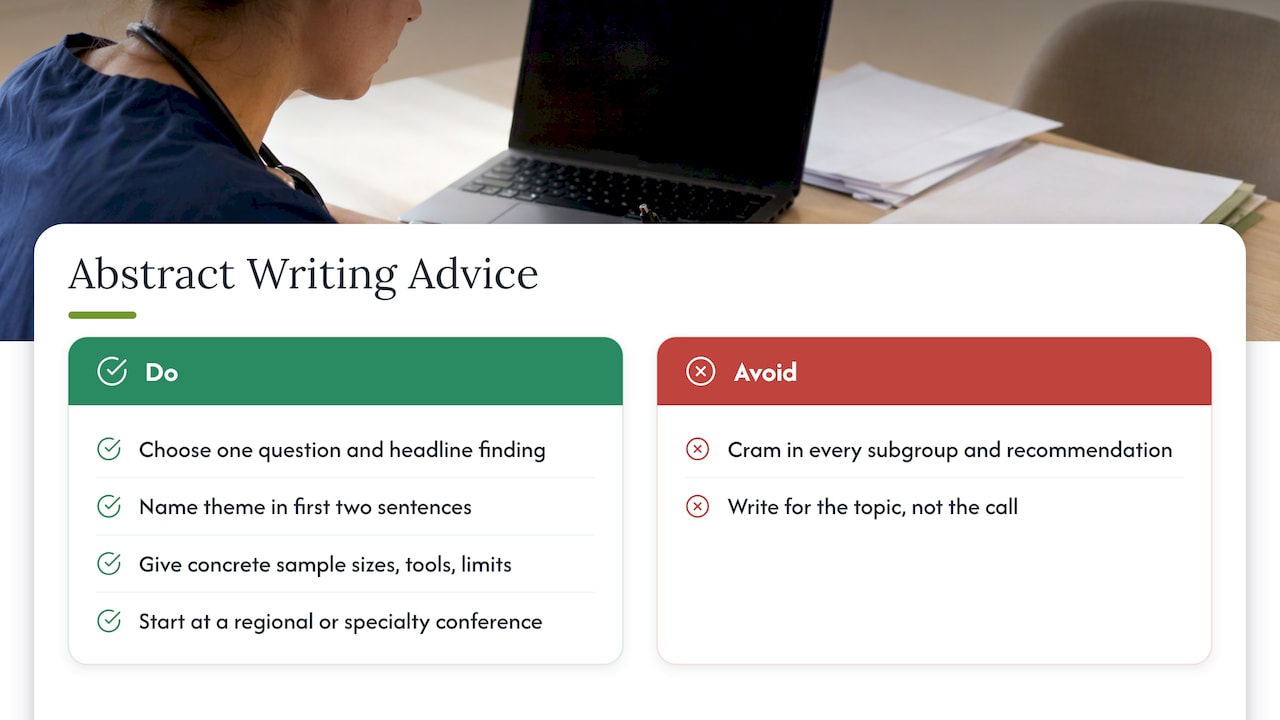
Third, treat the methods paragraph as your credibility. Nursing science advances through evidence that others can trust and build on, and reviewers are trained to look for that. Concrete sample sizes, named tools and plain limitations signal that you know the difference between a finding and a hope.
If you are new to this, choose a regional or specialty-association conference first. The stakes are lower, the feedback is often more personal and you will learn the process before aiming for a national podium.
— MIchael
Submission: where abstracts actually get lost
Logistics can decide eligibility before anyone judges your science. AACN, for example, requires an electronic account, a complete submission and confirmation of final submission, and incomplete submissions after the deadline are not reviewed. Use this checklist.
- Draft in a separate document. Portals time out and formatting disappears. Write in a word processor, check the word count there, then paste.
- Create the portal account early. Do not do it on deadline day.
- Choose the category and presentation type. Pick the conference-aligned track and your preference (podium or poster). AACN asks the primary author to state a preferred format.
- Enter authors and affiliations. Agree on author order before you submit. Some calls name one primary author as the point of contact for all communication.
- Complete the disclosures. Requirements and look-back periods differ. The Endocrine Nurses Society requires financial-relationship disclosures for the prior 24 months and resolution before presenting. AACN states that presentations may not be used to sell a product or service. Use the target call’s own form rather than assuming a universal rule.
- Submit and save the confirmation. If no confirmation email arrives, assume the submission failed and contact the organizers.
Deadlines move, so check the date
Deadlines are set per conference and sometimes extended. The 2026 ANE symposium deadline was February 23, 2026, for an October 28, 2026 event. UF Health’s deadline was September 11, 2026. California’s call was extended to October 15. The Endocrine Nurses Society lists January 1 for its March conference and August 1 for its October one. Those dates have mostly passed as of late October 2026, but they show the pattern: abstract deadlines often fall four to nine months before the event, so for a conference next year you may already be close to the window.
What happens after acceptance
Acceptance usually carries obligations. AACN says primary authors are responsible for registration and presentation, and presenters cover registration, travel, lodging and other expenses. Before you submit, ask your unit, school or employer whether professional development funds can cover it.
If your abstract is accepted as a poster
The abstract got you in. The poster now has a different job: communicating quickly. A PMC guide to preparing and presenting a poster notes that attendees may view a poster from about 10 feet for roughly 10 seconds before deciding whether to engage. That shapes everything.
- Design around one research question and a few key findings. A PMC overview of poster structure and content focuses on layout and form for exactly this reason.
- Use a short, informative title and a clear visual hierarchy. Keep text minimal and figures legible.
- Check the required orientation and dimensions in the conference instructions before you open design software.
- Preserve whitespace. A crowded board is skipped.
- Practice a short spoken pitch. MIT’s Communication Lab suggests that a practiced 20-second explanation turns passive viewing into conversation.
One size guide: UC Berkeley’s suggestions, cited in the research above, are about 90-point title text, 32 to 36-point section headings and 22 to 28-point body text for a single-sheet poster. These are design suggestions, not conference requirements, so the call’s instructions come first.
Podium or poster: which should you choose?
| Situation | Likely better fit |
|---|---|
| Work in progress, preliminary data | Poster (AACN limits work in progress to posters) |
| Completed study with clear, strong findings | Podium or poster |
| You want one-to-one feedback and networking | Poster |
| A QI or program model others could copy | Either, check the call’s categories |
| Call requires reported results | Whichever format the call allows |
A poster is not a consolation prize. For a first-time presenter it is often the better way to meet people with similar research interests and receive feedback.
Before you hit submit: a final read-through
Read the abstract aloud once. Then check these points.
- Does the first sentence connect to the conference theme?
- Can a stranger name your question, your sample and your main result after one reading?
- Is every number in the abstract the same as in your data file?
- Are you under the word limit, counting what the portal counts (some exclude the title and references)?
- If review is blind, have you removed names of institutions and units?
- Have all co-authors approved the final version and the disclosures?
Ask a colleague outside your specialty to read it. If they understand it, a mixed review panel will too.
Where to go next
If you want to see how a large nursing science meeting frames its program, our guide to the 2026 State of the Science Congress on Nursing Research covers its themes, including AI, and is a useful way to get a feel for the topics that draw attention in the field. For the community behind it, you can also visit the Council for the Advancement of Nursing Science home page.
Membership for nurse scientists
If you plan to present regularly, membership gives you a professional home for it. Individual student membership (undergraduate, master’s and pre-doctoral) is 40 USD per year, and NSNA members on the discounted individual plan pay 36 USD per year. Regular, discounted individual and institutional plans are also listed. See the options on our membership page.
FAQ
How long should a nursing conference abstract be?
Follow the call. Many U.S. nursing calls fall between about 250 and 500 words, with AACN at 500 and a Northwest regional conference at a 300-word body. If the call gives a limit for the title or a separate limit for learning objectives, treat those as separate requirements.
Can I submit an abstract if my study is not finished?
Sometimes. AACN permits completed work for poster or podium presentation but limits work in progress to posters. Other calls require results, so check the project-status rule before you invest time in the draft.
Who reviews nursing abstracts, and how?
Committees of nurse researchers, educators and clinicians score them against a rubric. OADN, for instance, uses blind review by at least two committee members. Rubrics often cover theme fit, significance, rigor, innovation and clarity.
Do I have to disclose financial relationships?
Most calls ask. AACN requires disclosure of potential conflicts and does not allow presentations to sell a product or service. The Endocrine Nurses Society looks back 24 months. Use the disclosure form in your target call.
What should I do right after submitting?
Check that the confirmation email arrived and save it. Note the notification date, and find out what registration and travel costs you would carry if accepted, since presenters generally cover their own expenses.
Sources
- AACN Call for Abstracts
- AACN: Tips for Writing an Excellent Conference Abstract
- Texas Nurses Association: Mastering the Abstract
- 2026 ANE Research Symposium Call for Abstracts
- OADN 2026 Convention Call for Podium Abstracts
- California Association of Colleges of Nursing Call for Abstracts
- UF Health Nursing Research and Innovation Conference Abstract Submission
- Endocrine Nurses Society Abstract Submission
- How to prepare and present a poster at a conference (PMC)
- Creating conference posters: Structure, form and content (PMC)
- MIT Communication Lab: Posters
|
The Council for the Advancement of Nursing Science |
   |