Bleaching often lowers the amount of drug or metabolite a lab can measure in hair, but it does not reliably produce a clean result. Labs that follow validated procedures can flag chemically damaged or treated hair, which may trigger an invalid finding or a request for an alternate specimen instead of a simple pass.
TL;DR:
- Studies report reductions of 40 to 80% after bleaching or dyeing, but results vary by drug and treatment intensity, and some drugs may remain detectable.
- Cocaine and some opiates can show large losses, while amphetamine results vary and THC outcomes also depend on metabolite stability and laboratory cutoffs.
- Collectors document visible treatments, and validated lab checks may flag damage or contamination; an invalid result can prompt another specimen rather than close the case.
- Labs can identify peroxide damage through chemical markers, so a low drug concentration alone does not establish abstinence or guarantee a negative result.
- If scalp hair is too damaged or sparse, collectors may seek another specimen; disclose recent treatment and retain records if disputing results.
Table of Contents
- How Bleaching Changes Hair Structure and Pulls Analytes Out
- How Labs Document and Interpret Bleached Hair Samples
- Which Drugs Bleach Affects Most, and Which Resist It
- How Labs Catch Bleaching and Sample Manipulation
- What Happens at Collection If Your Hair Is Bleached
- Our Take on Bleach Claims and Test Preparation
- FAQ
- Sources
How Bleaching Changes Hair Structure and Pulls Analytes Out
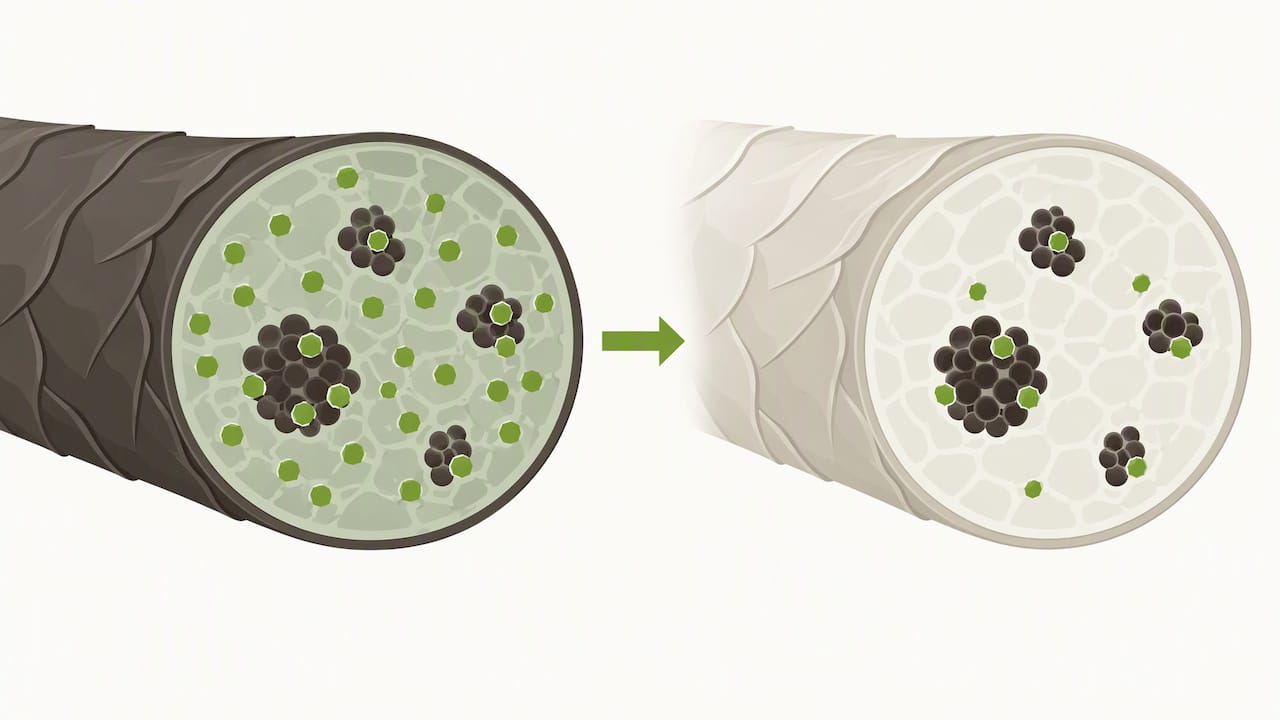
Hair bleach works by forcing hydrogen peroxide and other oxidizers into the hair shaft, where they break down melanin pigment and attack the keratin protein that holds the shaft together. That process cracks the cuticle, the hair’s outer protective layer, and leaves the shaft more porous. A more porous shaft lets drug molecules and their metabolites leach out along with the pigment, which is why bleached hair often tests lower than untreated hair from the same person.
Published research backs this up, though the size of the effect varies by drug and by how aggressively the hair was bleached. Several studies report substantial decreases for some drugs after strong bleaching, with repeated sessions pushing the loss even higher.
- Hydrogen peroxide degrades melanin and keratin, cracking the cuticle and raising porosity.
- Higher porosity lets drugs and metabolites diffuse out of the shaft over time.
- Repeated bleaching sessions compound the loss rather than simply adding to it.
- Permanent oxidative dye has a milder effect than full bleaching, and temporary dye has the least impact of the three.
Multiple peer-reviewed studies indexed on PubMed document reductions of 40 to 80% or more after bleaching or dyeing, though the exact figure depends heavily on the drug and the treatment protocol used.
One detail readers often miss: melanin affinity still matters even after bleaching. Basic, lipophilic drugs bind strongly to melanin and tend to start at higher concentrations in hair, so some can still register as detectable even after a substantial reduction.
How Labs Document and Interpret Bleached Hair Samples
Collection staff are trained to note visible cosmetic treatments on the chain-of-custody paperwork before the sample ever reaches a lab. That documentation becomes part of the record the lab and any reviewing physician will consult later.
The Mandatory Guidelines for Federal Workplace Drug Testing Programs address this directly: cosmetic treatments, including bleaching, can lower measured drug concentrations and make hair more susceptible to external contamination, so labs are expected to use validated methods for identifying damaged hair and to request an alternate specimen when needed. SAMHSA’s technical guidance on hair testing echoes this, noting that external contamination is a persistent concern and that metabolite-specific testing helps distinguish ingestion from surface exposure.
In practice, a bleached sample moves through a few predictable steps:
- Collectors record the visible treatment and assess whether enough hair is available for testing.
- The lab applies a validated decontamination wash, then screens for both parent drugs and specific metabolites.
- If the lab cannot rule out contamination or structural damage, it reports the specimen as invalid rather than negative.
- A Medical Review Officer reviews the result, may request an alternate specimen, and considers any statement from the donor before a regulated employer sees a final report.
Pro Tip: An invalid result is not the same as a negative one, and in a regulated testing program it usually means another sample gets collected rather than the matter being closed.
Which Drugs Bleach Affects Most, and Which Resist It
Not every drug class responds to bleaching the same way, which matters when sizing up how much a given situation is actually at risk.
- Cocaine and certain opiate metabolites show some of the largest losses, with some studies reporting substantial reductions for specific opiates after bleaching.
- Amphetamines and methamphetamine show more variable results, commonly substantial reductions in experimental settings, depending on treatment strength.
- THC and its metabolite THC-COOH are more lipophilic, so bleaching can still lower levels, but metabolite stability and the lab’s cutoff threshold both influence whether a reduction is enough to change the outcome.
- Benzodiazepines show mixed effects overall, since their chemical structure and metabolite stability vary widely across the drug class.
Peer-reviewed work summarized through PubMed shows that cosmetic treatment effects are consistent in direction across drug classes, with lower concentrations after oxidative treatment, but inconsistent in magnitude, which is exactly why a reduction on paper does not translate into a guaranteed negative. Readers comparing THC detection windows against cutoff levels can find more detail in our THC detox timeline and federal cutoffs guide.
How Labs Catch Bleaching and Sample Manipulation
Reduced concentrations alone used to be hard for a lab to explain. Newer analytical methods are closing that gap by identifying chemical signatures that bleaching itself leaves behind, separate from whatever drug was or wasn’t present.
Proteomics work using liquid chromatography mass spectrometry has identified oxidation-dependent peptide markers in hair exposed to hydrogen peroxide, and these markers cluster by peroxide concentration in ways that can distinguish treated hair from untreated hair, according to proof-of-concept research in Analytical Chemistry. Separately, a review in Analytical and Bioanalytical Chemistry describes ATR-FTIR spectroscopy and PTCA or cysteic acid detection as established oxidative damage markers that labs can use to screen for chemically altered samples.
| Detection method | What it identifies |
|---|---|
| Proteomics LC-MS | Oxidation-dependent peptide markers tied to peroxide exposure level |
| ATR-FTIR spectroscopy | Spectral signatures of oxidative damage to the hair shaft |
| PTCA / cysteic acid assay | Chemical byproducts specific to melanin and keratin oxidation |
Together, these tools mean a reduced analyte concentration is no longer, by itself, convincing evidence of abstinence. A lab that also finds strong oxidative damage markers has a basis for questioning the sample rather than accepting a low reading at face value.
What Happens at Collection If Your Hair Is Bleached
If a test is coming up soon and your hair is visibly bleached, expect the collector to note the treatment and check whether there is enough untreated growth near the scalp to collect a valid sample.
- The collector documents the visible treatment and evaluates sample adequacy before cutting.
- If scalp hair is insufficient or appears too damaged, an alternate specimen, body hair, urine, or oral fluid, may be requested; body hair in particular carries a longer and more diffuse detection window, so it is not a safer fallback.
- Be straightforward with the collector and the Medical Review Officer about any recent treatment rather than letting it surface later as a discrepancy.
- If a result is disputed, request confirmatory testing by GC-MS, and keep salon receipts or records if the timing of a treatment is relevant to your case.
- For a regulated or employment-critical test, loop in occupational health, HR, or legal counsel before the collection if there is any uncertainty about what to expect.
Our Take on Bleach Claims and Test Preparation
Most claims that bleaching “removes drugs” rely on lab conditions that do not match how hair actually grows, sheds, and gets tested in practice. We approach this topic the way we approach every testing question on our site: follow the published chemistry and lab procedure, not the marketing claim. For a procedural comparison of methods people discuss, see our guide to methods used to try to pass a hair drug test.
— MIchael
This article is general information, not a substitute for advice from a qualified lawyer. Consult a qualified legal professional about your own circumstances before acting on anything here.
FAQ
Does bleach affect the hair follicle itself?
Bleach affects the hair shaft, not the follicle beneath the skin, by breaking down melanin and keratin and increasing porosity. New growth from the follicle after bleaching is unaffected by the earlier treatment, which is one reason timing matters for detection.
How can I detox my hair follicles?
There is no scientifically validated method that reliably removes drug metabolites from hair once they are incorporated into the shaft; commercial detox shampoos and bleaching both have limited, inconsistent effects documented in peer-reviewed research. Our detailed guide to hair drug test methods breaks down what has evidence behind it and what does not.
Can bleaching hair fully remove drugs from a sample?
No, bleaching reduces measured concentrations in many cases but does not eliminate analytes entirely, and the reduction varies by drug class and treatment intensity. Labs can also flag the oxidative damage itself, which may lead to an invalid result rather than a clean negative.
Is a bleached hair sample treated differently by the lab?
Yes, labs document visible cosmetic treatment and may apply additional specimen-validity checks under federal guidelines. If the lab cannot rule out damage or contamination effects, it can report the sample as invalid and request an alternate specimen.
Does hair dye have the same effect as bleaching?
Dye has a milder effect than full bleaching, with permanent oxidative dye reducing concentrations somewhat and temporary dye having the least impact. Our hair dye and drug test guide covers the documented concentration drops for dye specifically.
Sources
- Mandatory Guidelines for Federal Workplace Drug Testing Programs (Federal Register)
- Drug metabolites and hair testing (SAMHSA)
- Influence of the cosmetic treatment of hair on drug testing (PubMed)
- New approaches to identify urine and hair adulteration attempts in forensic toxicology (ACS Analytical Chemistry)
- Advances in testing for sample manipulation in clinical and forensic toxicology—part B: hair samples (Springer Nature)
Recommended
- 52–65% Drops Don’t Guarantee a Pass: Hair Dye and Drug Tests
- Methods to Pass a Hair Drug Test
- How to Pass a Hair Drug Test? Tested Method and Products
- How to Pass a Drug Test: A Complete and Detailed Guide
|
The Council for the Advancement of Nursing Science |
   |