There are two common urine collection procedures in the U.S., and they are not the same. A workplace drug test follows a chain-of-custody process built to prove the sample is yours and untampered with. A medical clean-catch collection aims to keep bacteria out of the sample for diagnosis. If you are heading to a drug screen, expect to show photo ID, wash your hands, urinate in privacy, hand the cup to the collector, and watch while the specimen is checked, split, sealed and documented.
This guide walks through both procedures, shows which steps belong to you and which to the collector, explains how the temperature strip is read, and covers what happens when something goes wrong.
TL;DR
- A federally regulated workplace collection needs photo ID, at least 45 mL of urine, privacy, and no flushing until the specimen is handed over.
- The collector checks the temperature within four minutes. The acceptable range is 32–38°C (90–100°F).
- An out-of-range reading triggers a new collection under direct observation or an oral fluid collection, and both specimens go to labs.
- The donor watches the specimen being split, sealed and labeled, then initials the seals.
- A medical clean catch is a different method: midstream urine in a sterile cup, meant for diagnosis rather than custody.
Table of Contents
- Two procedures, two purposes
- Step by step: a workplace urine collection
- Who does what: donor versus collector
- How the temperature strip is read
- When the temperature is out of range or the sample fails
- What the collector looks for in the specimen
- Medical clean-catch collection, for comparison
- Preparing for a collection
- Our perspective
- Support the work behind these guides
- FAQ
- Sources
Two procedures, two purposes
Search results for this topic are dominated by clinical instructions: wash your hands, wipe, start urinating into the toilet, then catch the middle of the stream. That is the clean-catch method, and it serves a doctor who wants to find an infection. A drug test serves an employer, a court or a regulator who needs to be certain that the sample belongs to one specific person and has not been altered.
The difference shapes everything: who is in the room, what you carry in, what the collector writes down and how the sample travels afterward. If you are preparing for an employment screen, the workplace procedure is the one to learn. If you are giving a sample at a clinic, skip to the clean-catch section below.
The rest of this article focuses on federally regulated workplace collections, because their rules are published and detailed. Many private employers use similar steps, but their programs can differ. Our guide to what actually differs between DOT and non-DOT tests explains where private programs may depart from the federal model.
Step by step: a workplace urine collection
The sequence below follows the federal collection documents: the IBC drug test collection process, the 2024 SAMHSA Urine Specimen Collection Handbook and the instructions for the federal custody and control form.
1. The collector prepares the site before you arrive
According to the SAMHSA handbook, which took effect on February 1, 2024, a federally regulated collection begins with securing the collection site. Water sources are turned off or secured, toilet water is blued or removed, and anything that could be used to adulterate a sample or hide something is removed or controlled. This is why the restroom can feel stripped down: no soap dispensers by the sink in some sites, colored water in the bowl, and cabinets emptied or locked.
2. You identify yourself
When you arrive, you present photo identification and stay at the site until the collection is complete. Leaving early can be treated as a refusal to test, so do not walk out because the wait is long. The collector verifies who you are, explains the procedure and uses a Federal Custody and Control Form, usually called the CCF, to track the specimen from collection through shipment.
3. You remove outer clothing and empty your pockets
You are asked to remove outer garments such as a coat or jacket and to empty your pockets. You then wash your hands. The point is to keep anything that could alter the sample out of the collection area. The IBC process describes these same steps for donors.
4. You provide the specimen in privacy
In a standard collection you go into the restroom alone, with the collector outside. You need to provide at least 45 mL of urine. You must not flush the toilet until after you have handed the specimen to the collector. Keep the cup in your hand until you leave the stall, since the process expects you to retain visual contact with your specimen until it is sealed.
Two details trip people up. First, the collector cannot combine urine from separate voids to make up a specimen; 49 CFR Part 40.65 prohibits it. Second, if you cannot produce enough, the collection is not simply finished with a small sample. The collector follows a procedure for insufficient volume, which generally means starting over with new paperwork rather than topping up.
5. The collector checks temperature and appearance
You hand over the cup. The collector checks the specimen’s temperature using the strip attached to the container, no later than four minutes after receiving it, and inspects the specimen for unusual color, foreign objects or material, odor, or other signs of tampering. More on both below.
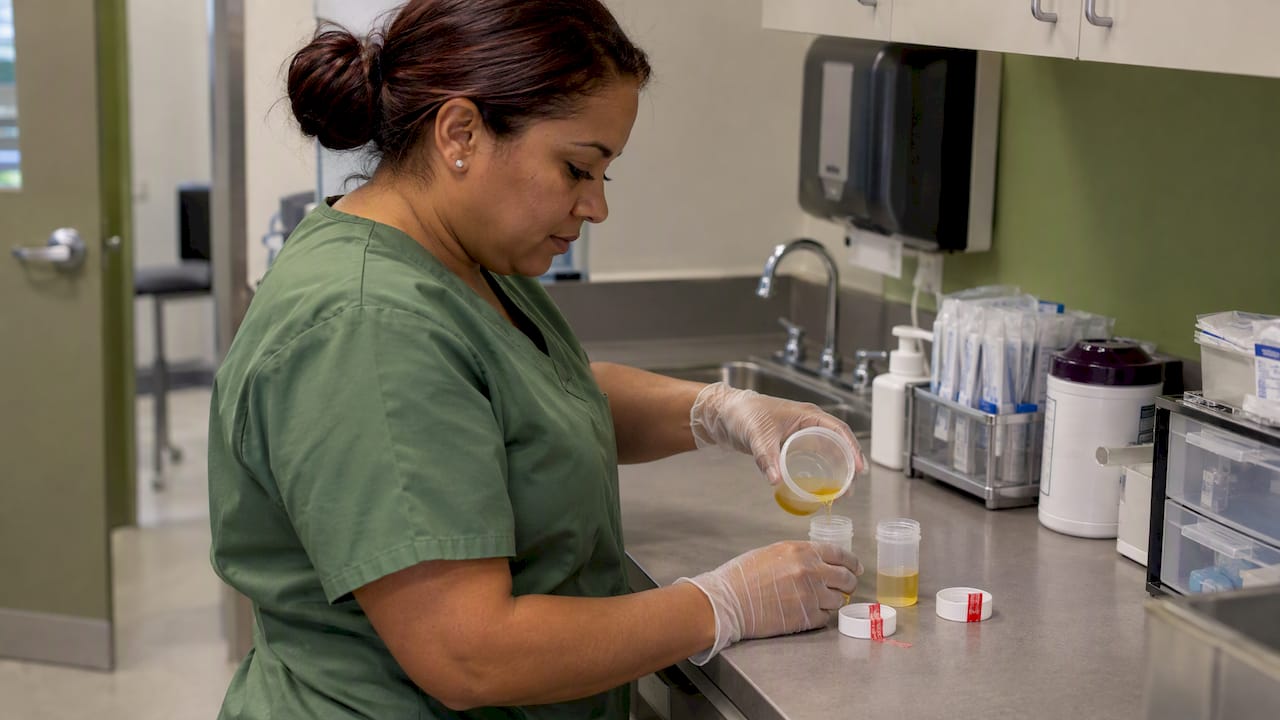
6. The specimen is split, sealed and labeled in front of you
You watch the collector pour the urine into the specimen bottles, cap them and place tamper-evident seals over the caps. The collector dates the seals and you initial them. The collector also matches the specimen identification number across the form and the bottles. Initialing the seals matters: it is your record that the bottles you watched being sealed are the ones that left the site.
7. The paperwork is completed
The collector completes the CCF, and you are asked to review and sign the relevant sections. Read what you are signing. If the form lists a medication you take, or something looks wrong, say so at the site, not later. The specimen then goes to a laboratory under documented custody.
Who does what: donor versus collector
| Step | Donor | Collector |
|---|---|---|
| Site preparation | Nothing | Secures water sources, bluing or removing toilet water, removes adulterants |
| Identification | Shows photo ID, stays until finished | Verifies identity, explains the procedure |
| Before collecting | Removes outer garments, empties pockets, washes hands | Observes that the instructions are followed |
| Giving the sample | Provides at least 45 mL in privacy, does not flush | Waits outside in a standard collection |
| Temperature and inspection | Hands over the cup | Reads the strip within four minutes, inspects the specimen |
| Sealing | Watches, then initials the seals | Pours into two bottles, caps, seals, dates the seals |
| Documentation | Reviews and signs the CCF | Completes the CCF and matches ID numbers |
How the temperature strip is read
A fresh specimen is warm. Under 49 CFR Part 40.65, the collector checks the temperature no later than four minutes after receiving the specimen, and the acceptable range is 32–38°C (90–100°F). The 2024 HHS/SAMHSA urine collection site manual gives the same range.
The strip is attached to the collection container and changes as it warms. The collector reads the displayed temperature against the range and marks the CCF accordingly: the “Yes” box if it falls within 32–38°C, or the “No” box with a note if it does not. You do not read the strip yourself, and you cannot influence the result by delay, since the clock runs from the moment you hand over the cup.
For more depth on timing and what the numbers mean for donors, see our guide to urine drug test temperature.
When the temperature is out of range or the sample fails
An out-of-range reading is not a positive result, but it changes the rest of your visit. The federal rule says the collector must immediately conduct a new urine collection under direct observation, or an oral fluid collection. Both the original specimen and the new specimen are sent to their respective laboratories. The SAMHSA site manual states that an unacceptable temperature provides reason to believe the donor may have adulterated or substituted the specimen, which is why the second collection is more closely watched.
Separately, if a temperature reading cannot be taken because of low volume or an equipment problem, the manual says the collector discards the urine and begins again with a new kit and a new CCF. That is a procedural restart, not an accusation.
If you are facing an observed collection, you have rights and there are specific rules about who may observe. Our guide to supervised urine collection covers the 45 mL requirement, same-sex observers and what you can ask. Women can find a dedicated walkthrough in our supervised drug tests for females guide.
What the collector looks for in the specimen
The 45 mL minimum and the temperature range are two checks. The collector also inspects the specimen for unusual color, foreign objects or material, and signs of tampering, and records unusual physical characteristics such as color, foreign material or odor on the CCF, then takes the required action. The collector is a trained observer, not a laboratory, so these notes flag concerns for follow-up rather than deliver a verdict.
This is also why attempts to substitute a sample are risky. A sample that arrives at the wrong temperature is caught at the site. One that passes the strip still faces laboratory validity testing. We explain how that works in synthetic urine detection and why single-marker claims fail in Quick Fix versus Upass.
Medical clean-catch collection, for comparison
If your sample is for a urinalysis or a culture, the procedure is different. MedlinePlus defines a clean catch as a method meant to prevent germs from the penis or vagina from getting into the sample. In practice:
- Wash your hands.
- Clean the genital area as instructed.
- Begin urinating into the toilet.
- Move the clean or sterile cup into the stream and collect midstream urine.
- Finish urinating in the toilet.
- Tighten the lid without touching the inside of the cup or lid.
- Return the sample promptly to the provider, or refrigerate it if you collected at home.
Notice what is missing: no ID check, no bluing agent, no temperature strip, no split bottles, no seals. The medical sample is judged on cleanliness and promptness, not custody. Children who cannot yet urinate on request may use a collection bag worn on the skin, which is a separate pediatric method and not relevant to adult drug testing.
| Feature | Workplace drug test | Medical clean catch |
|---|---|---|
| Purpose | Verify drugs and sample integrity | Diagnose infection or condition |
| Identity check | Photo ID, CCF | Usually name and date of birth on the label |
| Restroom | Secured, water blued or removed | Ordinary |
| Collection method | Standard collection, at least 45 mL | Midstream urine in a sterile cup |
| Temperature check | Within four minutes, 32–38°C | Not performed |
| Sealing | Split into two bottles, tamper-evident seals, initials | Lid tightened, label applied |
| Custody record | Federal CCF through shipment | Provider’s routine labeling |
Preparing for a collection
Preparation for a workplace test is mostly logistical:
- Bring photo ID. You will not be collected without it.
- Plan to stay. You must remain until the collection is complete, including if you need time to produce a specimen.
- Expect to empty your pockets and remove outer clothing such as coats.
- Follow the collector’s instructions and keep your cup in view until it is sealed.
- Do not flush until the specimen is handed over.
- Check the paperwork before you sign, and initial the seals only after you have watched them applied.
If you are anxious about what a screen detects, the panel and your rights as an applicant are covered in our guide to preemployment drug tests. For THC specifically, our detox timeline explains detection windows and the 2026 federal cutoffs. For probation testing, which has its own rules, see our probation drug test guide.
Our perspective
We publish drug-testing guides because the collection room is where most of the anxiety lives, and most of that anxiety comes from not knowing the sequence. Donors often arrive believing the process is improvised. It is not. The federal steps are written down, the collector has a script, and every handoff is documented. Knowing that makes the visit calmer and lets you spot a real problem, such as a missing initial line or mismatched ID numbers, instead of worrying about normal steps.
We are also direct about what the procedure implies. The site is secured, the temperature is checked within four minutes, the specimen is inspected and sealed while you watch. Product claims that promise a guaranteed pass should be read against that reality. We try to separate documented testing practice from marketing and anecdote, and where a claim cannot be verified from an official source, we say so. Nothing here is a substitute for the instructions you receive at your collection site or from your employer’s program.
If you are a nurse, nursing student or educator who ends up supervising or explaining testing to others, the same facts apply: the collector’s job is process, not judgment.
— MIchael
Support the work behind these guides
NursingScience.org is a professional community for nurse scientists and nursing professionals, and these guides sit alongside our resources on research, practice, innovation and health policy. If that sounds like your world, membership options include a student rate for undergraduate, master’s and pre-doctoral students at 40 USD per year, and a discounted rate for NSNA members at 36 USD per year. Regular, discounted and institutional plans are also available, and you can see them all on our membership page.
Employers and organizations can also reach our audience through job board postings, including web page postings and eBlasts.
FAQ
How much urine do I need to provide for a workplace drug test?
For a federally regulated collection, you need to provide at least 45 mL. The collector pours it into two bottles in front of you. If you cannot produce enough, the collector follows an insufficient-volume procedure rather than combining urine from separate voids, which 49 CFR Part 40.65 forbids.
How long does the collector have to check the temperature?
The collector must check the specimen’s temperature no later than four minutes after receiving it from you. The acceptable range is 32–38°C (90–100°F). The strip is attached to the container, and the result is recorded on the custody and control form.
What happens if my specimen temperature is out of range?
The collector must immediately conduct a new collection under direct observation, or an oral fluid collection. Both the original specimen and the new one are sent to their laboratories. A bad reading is not a positive result, but official guidance treats it as a reason to suspect substitution or adulteration.
Why can’t I flush the toilet or use the sink freely?
The collection site is prepared to prevent tampering, so water sources are turned off or secured, and toilet water is blued or removed. You must not flush until you have handed the specimen over. These rules protect the integrity of your sample as much as anyone’s.
Is a clean-catch urine sample the same as a drug test sample?
No. A clean catch is a medical method to keep germs out of a midstream sample, and it has no ID check, temperature strip or tamper-evident seals. A workplace sample is collected under a chain-of-custody process with documented handoffs from you to the laboratory.
Sources
- Drug Test Collection Process, IBC Customer Central
- Urine Specimen Collection Handbook, SAMHSA (2024)
- Instructions for Completing the Federal Drug Testing Custody and Control Form, SAMHSA
- 49 CFR Part 40 Section 40.65, U.S. Department of Transportation
- Collection Site Manual 2024, Urine, SAMHSA
- Clean catch urine sample, MedlinePlus Medical Encyclopedia
Recommended
- Supervised Urine Collection: 45 mL, Same Sex, and Your Rights
- 90–100°F, Four Minutes: Urine Drug Test Temperature for Donors
- Synthetic Urine Detection: How Labs Catch Fake Samples
- U.S. Preemployment Drug Tests: Five Panels and Applicant Rights
|
The Council for the Advancement of Nursing Science |
   |