A workplace saliva drug test is a short, observed procedure. You wash your hands, the collector checks your mouth, you wait if needed, and a device collects oral fluid while the collector watches. The sample is split into two tubes, sealed with tamper-evident labels and sent to a certified laboratory. The federal rules are written in the HHS oral fluid collection handbook. Many private employers follow them, though they are not required to.
This guide walks through each stage in order. It covers what the devices look like, what you should avoid beforehand, what happens when a sample is too small, and why a clarifying shampoo question has nothing to do with saliva.
TL;DR
- Federal oral fluid collections are done under direct observation with an FDA-cleared device. The specimen is split into a primary (A) tube and a split (B) tube, then sealed and shipped to an HHS-certified lab.
- Wash your hands, expect a mouth check, and do not eat, drink or smoke before or during collection. A 10-minute wait may be required.
- An insufficient or invalid specimen is discarded and the collection restarts with a new device. Repeated failures are reported to the employer’s designated representative.
- Shampoo and other hair products matter for hair tests, not for oral fluid.
- Collection for a medical or research saliva test follows a different logic from a workplace test.
Table of Contents
- Who sets the rules for saliva collection in the U.S.
- Saliva collection, step by step
- Oral fluid collection devices: what they look like
- What to do and what to avoid before and during collection
- When the sample is insufficient or invalid
- Is clarifying shampoo relevant to a saliva test?
- How workplace collection differs from medical or research saliva collection
- How saliva collection compares with urine collection
- Our perspective
- Membership for nurses and students
- FAQ
- Sources
Who sets the rules for saliva collection in the U.S.
For federal-agency workplace programs, the governing document is the HHS Mandatory Guidelines for Federal Workplace Drug Testing Programs using Oral Fluid. The Oral Fluid Specimen Collection Handbook, effective October 10, 2023, turns those guidelines into step-by-step instructions for collectors.
A proposed rule on the same subject was published in the Federal Register on October 29, 2026. It is a proposal, so details may change before anything is final. Read it as a signal of where federal practice is heading.
Two practical points follow:
- Federal and federally regulated programs use the handbook’s procedure closely. That includes federal agencies and employers whose testing is tied to those programs.
- Private employers often borrow the same structure because it is well documented. They may use a different device or paperwork. Your employer’s policy or the collection site’s instructions tell you which applies.
If you are preparing for a job screening, our guide to U.S. pre-employment drug tests, the five panels and applicant rights explains which specimens employers commonly choose and what you can ask for.
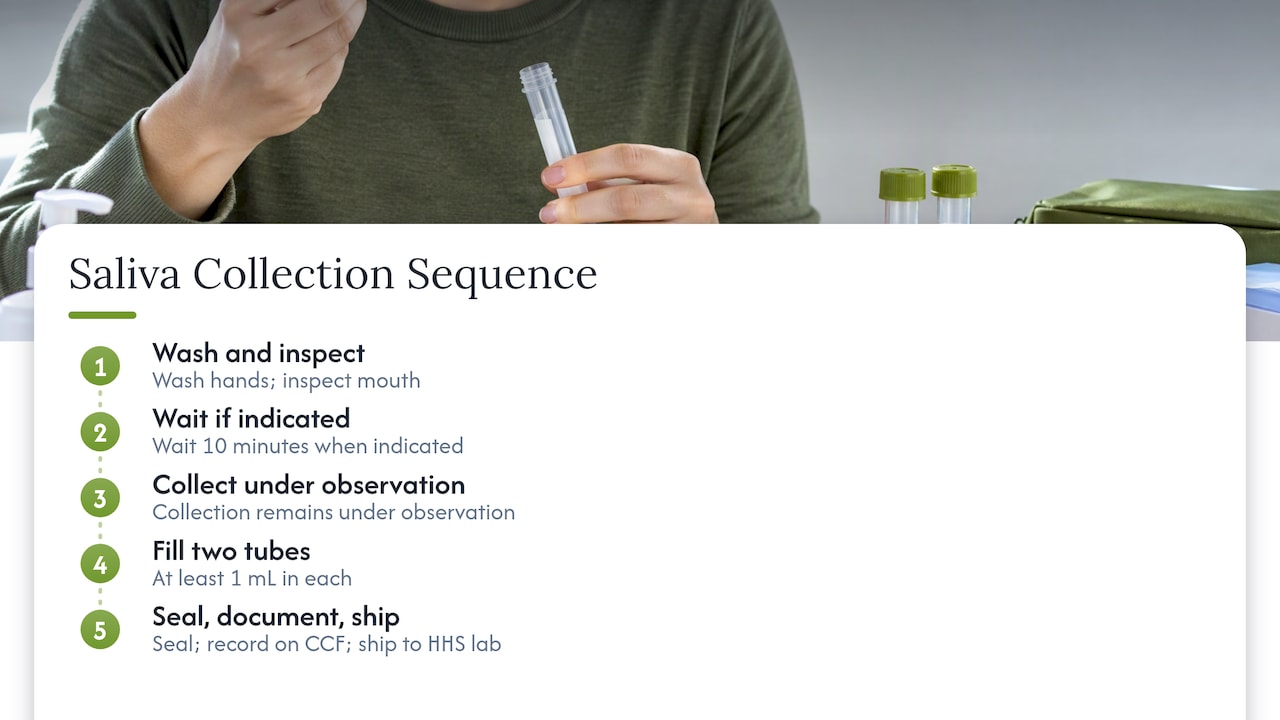
Saliva collection, step by step
The handbook describes a sequence that is consistent from site to site. The details below come from it.
1. Before you start
You wash your hands before the collection begins. The collector then inspects your oral cavity. The goal is to confirm it is free of food, candy, gum, tobacco or anything else that could interfere with the collection. If something is there, you are asked to remove it.
You should not eat, drink or smoke from this point on. That includes water, mints and chewing gum. If you are in the middle of a meal or have just had a cigarette, tell the collector rather than trying to hide it. The collector has a standard way to handle it, and concealment only complicates the record.
2. The wait period
When the collector sees something in the mouth, or thinks it is needed, a 10-minute wait follows. You stay with the collector, follow their instructions and keep your mouth free of anything new. The wait gives the mouth time to clear before the sample is taken.
3. Observed collection
The collector must keep you in visual contact throughout the collection, as the federal proposal states. You do not collect the specimen alone, and you do not step out of view.
The device is cleared by the FDA and used according to the manufacturer’s instructions. The collector walks you through where to place the pad or how to fill the vessel, and how to tell when enough fluid has been collected.
4. Splitting the sample
Federal collections require two tubes. Tube A is the primary specimen and Tube B is the split. Each holds at least 1 mL of undiluted oral fluid. The handbook explains the split is the backup: if a result is challenged, Tube B can be tested at another certified lab.
The split can be made in different ways. Under the proposed federal rule, a collector can use two separate devices, either at the same time or one after the other, or subdivide a single specimen into the two tubes.
5. Sealing, paperwork and shipping
The tubes are sealed with tamper-evident labels, and the collection is documented on the Federal Custody and Control Form (CCF). You may be asked to initial the seals. If you decline, the collector notes it on the CCF and continues the process, according to the same proposal. Declining does not stop the test, so there is little to gain by refusing and the note stays in the record.
The sealed specimen then goes to an HHS-certified laboratory for analysis. The chain of custody form travels with it, so every hand that touched it is on paper.
Oral fluid collection devices: what they look like
People searching for oral fluid collection devices usually want to know what will be put in their mouth. The handbook describes two basic designs:
| Design | How it works | What you do |
|---|---|---|
| Stick with an absorbent pad | The pad sits in the mouth until it takes up enough fluid. Some include a volume indicator that shows when the amount is enough. | Place the pad as the collector instructs and hold it until the indicator or the collector confirms the volume. |
| Collection vessel | A container receives oral fluid that you expectorate (spit). | Spit into the vessel as directed until the required volume is reached. |
Some devices include a diluent, a liquid that mixes with the fluid in the device, together with a volume indicator. This matters because the federal split requirement refers to undiluted oral fluid. The handbook tells collectors to follow the manufacturer’s instructions on pad placement and fluid volume for the exact device in use. That is why two sites can look slightly different and still follow the same rules.
Devices vary in how long they take. Some labs describe a collection as taking about five minutes, though the wait period and any retries can lengthen the visit.
If you want the bigger picture of how these tests detect substances and what the claims around “passing” actually mean, see our guide on passing a saliva mouth swab drug test.
What to do and what to avoid before and during collection
The donor’s job is simple, and most problems come from skipping a step.
Do:
- Bring valid photo ID if the site or employer requires it, and read any instructions you were sent.
- Wash your hands when asked.
- Let the collector look in your mouth and remove anything they ask you to remove.
- Follow the collector’s directions, including the wait period.
- Ask the collector to explain a step if it is unclear. They are trained to walk you through it.
- Mention any medication you take. Disclosure of prescriptions usually happens later with a medical review officer, so ask the site how to raise it.
Avoid:
- Eating, drinking, smoking or vaping before or during the collection.
- Putting gum, candy, mints or lozenges in your mouth while you wait.
- Leaving the collection area or leaving the collector’s line of sight.
- Arguing about the process at the site. If you think a step was done wrongly, say so calmly and ask that it be noted on the paperwork.
The handbook’s mouth inspection exists because foreign material can interfere with collection. Treat that as a reason to arrive with a clean, empty mouth and some patience, not as a trap.
When the sample is insufficient or invalid
Not enough fluid is a common reason a collection takes longer. The procedure is spelled out in the handbook:
- The collector discards the specimen that was insufficient or deemed invalid.
- The attempt is documented.
- A new collection begins with a new device.
- If failures repeat, the collection may be discontinued and the Designated Employer Representative (DER) is notified.
What the DER does next depends on the employer’s policy and the program. You will not be told to simply “try again forever.” A stressed or very dry mouth is one of the usual reasons for a slow collection, so slow breathing and sitting calmly while following instructions helps more than rushing. Do not drink water to speed things up unless the collector allows it, because liquids can disrupt the process and the record.
Is clarifying shampoo relevant to a saliva test?
Not to the saliva sample itself. Oral fluid is taken from your mouth. Hair products have no route into that specimen, so a shampoo question belongs with hair testing.
The confusion is understandable, since many people prepare for several test types at once. A German academic study, Manipulation of THC Hair Concentrations by Commercially Available Products, found that everyday hair-care products, including shampoos, could lower THC concentrations in hair. The authors recommend using urine analysis alongside hair abstinence controls and caution when interpreting quantitative hair results.
That is a finding about hair. It does not tell you anything about oral fluid. If a hair test is coming, start with our guides on hair dye and drug tests and hair drug test methods and products. For timing across all test types, the THC detox timeline lays out detection windows.
How workplace collection differs from medical or research saliva collection
Search results for “saliva collection” mostly show research and clinical instructions, such as collecting saliva in a tube for a hormone or protein assay. Those sheets share a pattern: wash your hands, avoid eating and drinking for a set time, rinse with water, then spit into a tube at a specific time of day. The aim is a clean, consistent sample of one marker.
A workplace drug test has a different aim. It has to produce a specimen that can stand up if someone challenges it. That changes the procedure in several ways:
| Medical or research collection | Workplace drug test collection | |
|---|---|---|
| Who collects | Usually you, at home or in a clinic | A trained collector at a site |
| Observation | Not required | Collector keeps visual contact throughout |
| Split sample | Not usual | Two tubes, A and B, in federal collections |
| Documentation | Labeling with name and time | Custody and control form, tamper-evident seals |
| Destination | A lab chosen by the study or clinic | An HHS-certified lab in federal programs |
The habits are similar in places, such as avoiding food and drink beforehand. The shared habit does not mean the sheets are interchangeable. If you are given instructions for a drug test, follow those, not a generic saliva sheet you found online.
How saliva collection compares with urine collection
Urine collection can be observed too, and the rules there are well known. If you are weighing which test you may face, our guide to supervised urine collection covers the 45 mL volume, same-sex observation and your rights. For women specifically, there is a guide on supervised drug tests for females. If your test is tied to probation, see what to expect and why to ask for GC/MS confirmation.
Some people look for a single trick product that works across every test. We would be careful with that framing. Our piece on why labs catch Quick Fix and what single-marker claims miss shows why claims about one marker rarely survive a real lab process. For a wider overview, our complete guide to drug tests puts the test types side by side.
Our perspective
We publish drug-testing guides because people go into these appointments with half-remembered rules and a lot of anxiety. In our experience, the single most useful thing a reader can do is know the procedure before arriving. When you know that the collector will inspect your mouth, that there may be a 10-minute wait, and that a short sample simply means a restart, the appointment is far less stressful.
We separate what is documented from what is claimed. The collection steps in this article come from the HHS handbook and the federal rulemaking record. Product claims and personal reports are a different category, and we treat them that way. That is the standard we hold ourselves to across every guide in this area.
Our wider work is in nursing science: research, practice and policy that depend on careful, honest evidence. We bring the same habit to testing information, and we think it serves readers best.
MIchael
Membership for nurses and students
The Council for the Advancement of Nursing Science supports nurse scientists and nursing professionals with resources, events and a job board. If you work in or study nursing, you can see what membership includes on the membership benefits page.

Individual student memberships (undergraduate, master’s and pre-doctoral) are $40 per year, and NSNA members on the discounted individual plan pay $36 per year. Other plans do not have a published price. You can join or compare plans here.
FAQ
How long does a saliva drug test collection take?
The collection itself is brief, and some labs describe it as taking about five minutes. A 10-minute wait, a slow-to-fill device or a restart after an insufficient sample can lengthen the visit. Plan for the appointment to take longer than the collection alone.
Can I eat or drink before a saliva test?
Do not eat, drink or smoke once you are at the site, and during the collection and wait. The HHS handbook has the collector check your mouth for food, candy, gum or tobacco. If you did consume something shortly before, tell the collector so they can apply the wait period.
What happens if I cannot produce enough saliva?
The collector discards the insufficient specimen, notes the attempt and starts again with a new device. If failures continue, the collection may be stopped and the employer’s designated representative is told. Stay calm, follow directions and ask the collector what to do next.
Why are there two tubes?
Federal collections split the oral fluid into Tube A and Tube B, each with at least 1 mL of undiluted fluid. Tube A is tested first. Tube B is the split, kept so a result can be re-tested if it is challenged.
Does clarifying shampoo change a saliva test?
No. Oral fluid is collected from your mouth, and shampoo applies to hair. The research on hair products and THC concerns hair samples only.
Sources
- Oral Fluid Specimen Collection Handbook for Federal Agency Workplace Drug Testing Programs (HHS/SAMHSA)
- Mandatory Guidelines for Federal Workplace Drug Testing Programs Using Oral Fluid (Federal Register)
- Manipulation of THC Hair Concentrations by Commercially Available Products (PMC)
- Oral fluid collection overview (Quest Diagnostics)
Recommended
- How to Pass a Saliva Mouth Swab Drug Test
- How to Pass a Drug Test: A Complete and Detailed Guide
- Methods to Pass a Hair Drug Test
- Supervised Drug Tests for Females – Best Guide
|
The Council for the Advancement of Nursing Science |
   |