Routine drug tests do not screen for psilocybin or its active metabolite, psilocin. Standard workplace panels, including 5-panel, 10-panel, and 12-panel tests, check for substances like THC, cocaine, amphetamines, opiates, and PCP, not mushrooms. Specialized labs can detect psilocin, but these tests are rare, costly, and only useful within a narrow window after use, so most routine employment or school screens will not catch it.
TL;DR:
- Routine drug tests do not include psilocybin or psilocin, making mushroom use undetectable in standard workplace panels.
- Detection likelihood depends on specimen type, with urine offering the best chance, but timing remains critical due to psilocin’s rapid clearance.
- Confirmation through mass spectrometry is essential if a positive result could impact employment or legal standing, as initial screenings are often limited.
- Federal regulations prevent routine screening for psilocybin, so targeted testing usually only occurs in forensic, clinical, or safety-sensitive situations.
Table of Contents
- Which tests can and can’t detect psilocybin
- How detection windows differ across urine, blood, saliva, and hair
- How labs actually test: screening versus confirmation
- Why tests miss psilocybin or return misleading results
- When is psilocybin testing actually ordered?
- Testing procedures worth understanding before a test
- What this actually means if you’re facing a test
- Where to go for deeper procedural guidance
- FAQ
- Sources
Which tests can and can’t detect psilocybin
A standard drug panel is built around a fixed list of substances, usually THC, cocaine, amphetamines/methamphetamines, opiates, and phencyclidine on a 5-panel test, with additions like benzodiazepines or barbiturates on 10 and 12-panel versions. Psilocybin and psilocin do not appear on this list, as confirmed by standard workplace panels excluding psilocybin. That means the overwhelming majority of pre-employment, random, and school drug screens will not flag mushroom use at all, regardless of how recently someone consumed them.
Specialized testing for psilocin does exist, but it has to be ordered on purpose. Labs can run targeted assays on urine, blood, saliva, or hair when there is a specific reason to look for psilocin rather than the usual suspects. These assays are built around different detection logic than a standard panel:
- Urine assays target free and conjugated psilocin shortly after use, when concentrations are highest.
- Blood and saliva assays catch a brief window right around intoxication, useful mainly in acute clinical or forensic cases.
- Hair assays look for longer-term incorporation, though psilocin binds poorly compared to drugs like cocaine or opiates.
Rapid test strips marketed for psilocin also exist commercially, but they are preliminary screening tools only. A strip result is never treated as final. Any positive from a cassette-style immunoassay has to be sent for laboratory confirmation before it carries any real weight.
How detection windows differ across urine, blood, saliva, and hair
Detection likelihood depends heavily on which specimen gets tested and how soon after use the sample is collected. Psilocin clears the body quickly, so timing matters more here than with many other substances.
- Urine offers the best shot at detection, but the window is short. Free psilocin tends to show up for roughly a day after use, though some sensitive assays can pick up low-level traces slightly longer.
- Blood and saliva have even tighter windows, often just a few hours, since psilocin’s plasma levels drop fast after the acute effects fade.
- Hair and nails can theoretically reflect use from months earlier, but low incorporation rates and the lack of validated cutoffs make hair testing for psilocin unreliable compared to its use for other drugs.
Psilocin’s plasma half-life runs from about one to several hours, and only a small percentage of an oral dose appears as free psilocin in urine, which explains why even targeted testing has such a tight practical window. Dose size, individual metabolism, and the sensitivity of the specific assay used all push these ranges up or down, so no single number applies to every case.
How labs actually test: screening versus confirmation
Laboratories that do test for psilocin rarely rely on a single method. The process typically starts with a screening step and only moves to confirmation if something flags.
- Screening (immunoassay): Fast and cheap, but most commercial immunoassays were never built with psilocin in mind, so sensitivity and specificity are limited.
- Confirmation (LC-MS/MS or GC-MS): Validated mass-spectrometry methods reach limits of detection around 1 to 5 nanograms per milliliter for screening and closer to 1 nanogram per milliliter for confirmation, and they can distinguish psilocin from structurally similar compounds like bufotenine.
- Sample prep: Psilocin degrades in aqueous specimens, so labs often add stabilizers, control storage temperature, and run hydrolysis steps to capture both free and conjugated psilocin together.
Pro Tip: If a result matters for employment, legal, or medical reasons, always ask whether a positive screen was sent for mass-spectrometry confirmation before accepting it as final.
Why tests miss psilocybin or return misleading results
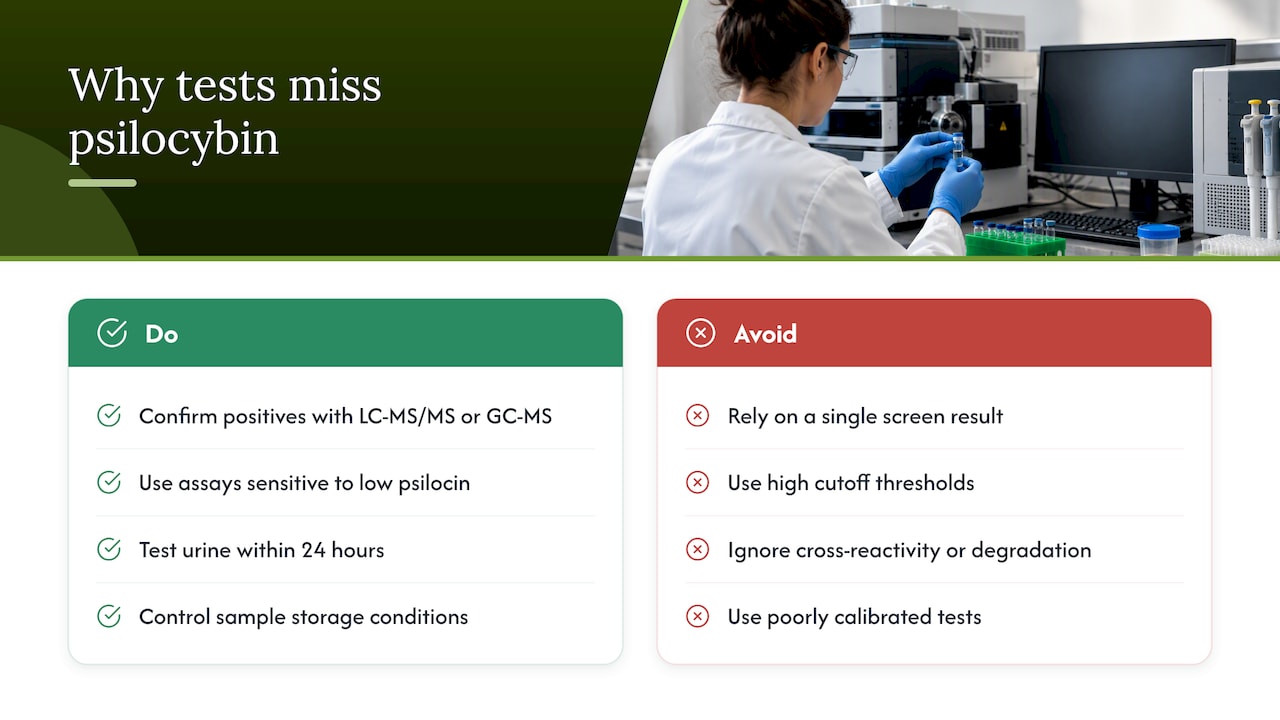
Several biological and technical factors work against reliable detection. Psilocin’s short half-life means the active window for finding it closes fast, often within a day in urine and far sooner in blood or saliva. Because only a small fraction of an oral dose ever appears as free psilocin, detection depends on using an assay sensitive enough to catch low concentrations rather than a standard cutoff built for other drugs.
Cross-reactivity with unrelated compounds, degradation during storage, and cutoff thresholds set too high can all produce false negatives, while improperly calibrated tests occasionally produce false positives. This is exactly why any positive screening result should be confirmed with LC-MS/MS or GC-MS before anyone treats it as definitive.
When is psilocybin testing actually ordered?
Routine employer and school drug screens are built around federally authorized panels, and SAMHSA’s Mandatory Guidelines for federal workplace testing do not include psilocybin or psilocin among the approved analytes. Adding a new substance to a federal panel requires advance HHS approval, which keeps psilocybin out of the vast majority of routine workplace testing.
Targeted psilocin testing tends to show up in narrower circumstances:
- Forensic cases, such as post-mortem toxicology or criminal investigations where mushroom use is specifically suspected.
- Clinical toxicology, when a patient presents with symptoms consistent with hallucinogen use.
- Probation or court-ordered testing, when a judge or officer has specific reason to screen for it.
- Safety-sensitive roles with reasonable suspicion, where an employer orders expanded testing after an incident.
Because specialized assays cost more and require extra lab steps, they are used selectively rather than built into standard screening programs.
Testing procedures worth understanding before a test
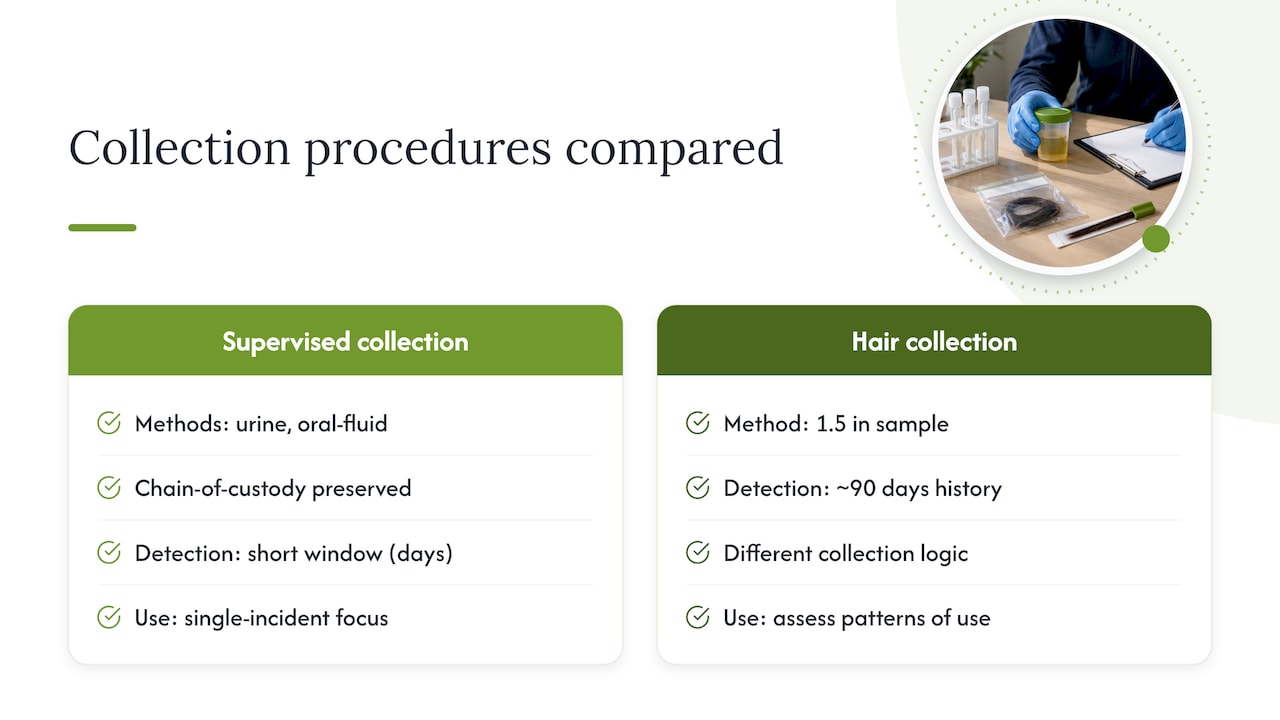
Collection procedures matter as much as the lab method itself. Supervised urine collection and oral-fluid swab procedures exist to protect chain-of-custody, meaning the sample’s handling is documented at every step so results hold up if challenged later. Our supervised collection guide walks through how that process typically works.
Hair collection follows different logic. A standard 1.5-inch sample taken close to the scalp reflects roughly the past 90 days of history, which is why labs lean on hair when a program wants to assess patterns of use rather than a single incident. For readers who want procedural detail on sample prep and what to expect, our hair testing methods guide covers the collection process step by step.
What this actually means if you’re facing a test
Most people worrying about a mushroom-related drug test are worrying about the wrong thing. Routine panels were never built to catch psilocybin, and the specialized tests that can are narrow, short-lived, and reserved for specific situations. If a result does come back positive and carries real consequences, the right move is requesting confirmatory testing and talking to a medical review officer or legal counsel rather than guessing. For procedural questions along the way, guides on this site cover the collection and testing process in detail.
— MIchael
Where to go for deeper procedural guidance
Understanding the testing landscape is one thing, but preparing for a specific test type often raises more detailed questions, and that is where our existing guides come in. We built NursingScience.org’s testing content area to walk through exactly how samples get collected and analyzed, not just what shows up on a panel.
A few guides worth bookmarking depending on what you are facing:
- Our hair drug test guide covers sample length requirements and what affects hair-testing reliability.
- Our saliva swab guide explains oral-fluid collection timing and procedure.
- Our complete drug test guide walks through specimen types and general timelines in one place.
Beyond individual guides, our membership program gives nursing professionals and students ongoing access to educational resources and updates as testing science evolves, starting at $40 per year for the student plan and $36 per year for NSNA members.
FAQ
What drugs show up on a 12-panel test?
A 12-panel test typically screens for THC, cocaine, amphetamines, opiates, PCP, benzodiazepines, barbiturates, methadone, propoxyphene, and a few additional prescription or synthetic drugs depending on the specific panel. Psilocybin and psilocin are not included in these standard panels, so a 12-panel result will not reflect mushroom use.
Can employers test for psilocybin?
Employers can technically order specialized testing for psilocin, but it falls outside the authorized analytes in federal workplace testing programs, so it is not part of routine screening. This type of testing is mostly reserved for forensic or safety-sensitive situations where there is specific cause to look for it.
What do 14 panel drug tests test for?
Expanded panel tests add substances like oxycodone, tramadol, and other synthetic opioids alongside the usual THC, cocaine, amphetamines, and opiates. Even at these expanded levels, psilocybin and psilocin remain outside the standard analyte list and require a separate, specialized test.
Will Lion’s Mane make you fail a drug test?
Lion’s Mane is a mushroom supplement, but it is not psychoactive and contains no psilocybin or psilocin, so it has no documented effect on standard drug test results. Because routine panels do not screen for psilocybin in the first place, Lion’s Mane use would not be a relevant factor even on a targeted psilocin assay.
Sources
- Drugs
- Validated high-throughput urine screening and confirmation methods for psilocin and other challenging analytes — Journal of Analytical Toxicology (2024)
- Model drug-free workplace plan — SAMHSA (March 2026)
- Clinical pharmacokinetics of psilocin after psilocybin administration: systematic review and post-hoc analysis — PubMed (2025)
Recommended
- Methods to Pass a Hair Drug Test
- Supervised Drug Tests for Females – Best Guide
- Best Detox Drinks for THC Drug Tests: A Comprehensive Guide
- How to Pass a Saliva Mouth Swab Drug Test
|
The Council for the Advancement of Nursing Science |
   |