For nurse scientists, the fastest route to research and policy leadership combines competency-based training, funded career pathways, and a longitudinal mentor team that secures protected time for scholarship. This is a different track than clinical unit management: it centers on leading research teams, translating evidence into practice, and shaping health policy. The immediate step is simple: find a structured program or assemble a mentor team and negotiate protected time before taking on new projects.
TL;DR:
- Building and leading diverse research teams, communicating research value, and managing projects through consensus are essential for nurse scientists seeking leadership roles.
- Funded pathways like fellowships and K awards provide necessary protected time and mentorship to develop independent research and leadership skills effectively.
- Mentorship models involving multiple mentors and clear expectations significantly improve research outputs and leadership growth, especially when tied to concrete milestones.
- Prioritizing skills such as grant writing, scientific communication, negotiation, and digital health literacy accelerates tangible research and policy achievements.
- Continuous education, active involvement in professional organizations, and structured leadership plans ensure sustained development and visibility in research and policy environments.
Table of Contents
- Why research leadership demands its own competency framework
- Proven development pathways: fellowships, postdocs, and NIH career awards
- Mentorship and sponsorship models that scale scientist leadership
- High-impact skills and short trainings to prioritize now
- A compact 12-month leadership development plan template
- Building emotional intelligence and communication skills
- Overcoming barriers specific to nurse scientist leadership
- How to measure whether leadership development is working
- Keeping leadership skills current through continuing education
- Publisher perspective: why this platform prioritizes nurse scientist leadership
- Put CANS membership to work on your leadership path
- Sources
- FAQ
Why research leadership demands its own competency framework
Leading a research team asks for a different skill set than supervising a clinical unit. It requires building coalitions across disciplines, making the case for why a study matters to people who control budgets, and managing projects where the deliverables are grants, manuscripts, and policy briefs rather than staffing schedules.
The AHRQ learning health system core competencies frame this directly under an “Engagement, Leadership, and Research Management” domain. Three items in that domain matter most for nurse scientists building a leadership track:
- Building and leading teams that include diverse stakeholders, from clinicians to informaticists to community partners.
- Communicating the value of research as a business case that funders and administrators can act on.
- Managing team-based projects through negotiation and consensus building rather than top-down direction.
The Future of Nursing 2020-2030 report frames leadership as a progression: leading yourself, then others, then extending influence beyond health care into policy and multisectoral work. Health equity sits inside that progression, not beside it.
Measurable leadership outcomes for nurse scientists include funded grants, author publications, invitations to serve on policy or advisory boards, and interdisciplinary collaborations. These are the metrics worth tracking from year one, not vague professional growth.
Proven development pathways: fellowships, postdocs, and NIH career awards
Structured, funded pathways beat ad hoc career planning because they build in protected time and training expectations. National Research Service Award mechanisms, including F-series individual fellowships and T32 institutional training grants, fund the early stages of research training. Career development K awards follow, typically supporting several years of mentored research time while a scientist builds an independent line of inquiry and the grantsmanship skills that go with it.
The NINR Training Pathways Working Group report recommends structural supports that many training programs still lack:
- Formal mentor and sponsor training rather than assuming senior faculty already know how to mentor.
- Longitudinal mentorship that spans a fellowship rather than ending at graduation.
- Funding models built to reduce the need for outside work during training, since fragmented time slows research output.
Program examples that put those recommendations into practice include the NURTURe Program, which prepares nurse postdoctoral fellows to lead interdisciplinary research using digital technologies and AI, with explicit training in grant writing, scientific communication, and networking to secure funding. The Betty Irene Moore Fellowship similarly concentrates on leadership, negotiation, and strategic communication, and has offered Next Steps Grants that provide significant funding to advance select fellows’ projects, according to the program’s page.
Mentorship and sponsorship models that scale scientist leadership
A single mentor rarely covers everything a developing research leader needs. The UC Davis Nurse Leader Fellows mentorship model pairs each fellow with a self-selected mentor and a program-appointed mentor, and some fellows add a third, research-focused mentor. That structure supports both project completion and the intrapersonal growth that leadership requires.
The evidence for this approach is specific. A pretest-posttest study of leadership mentoring for PhD-prepared nurses found measurable gains across Leadership Practices Inventory domains alongside increased grant submissions, publications, and conference presentations. Mentoring tied to concrete research outputs appears to build more durable leadership than coursework alone.
To put a mentor team together:
- Identify a self-selected mentor whose research or leadership style you want to emulate.
- Ask your institution or program about a formally appointed mentor with complementary expertise.
- Add a research mentor if your project needs technical guidance outside your primary mentors’ scope.
- Set explicit expectations and a meeting cadence at the outset, not after problems appear.
- Build an individual development plan with your mentor team and revisit it twice a year.
- Request protected time in writing, tied to specific deliverables your mentors help you define.
Pro Tip: Bring a one-page agenda to every mentor meeting so the conversation produces a decision, not just an update.
High-impact skills and short trainings to prioritize now
Some skills return value faster than others. For a nurse scientist building toward research or policy leadership, the short list worth prioritizing includes grant writing, scientific communication for non-specialist audiences, project management, negotiation, policy advocacy, and AI or digital health literacy, the last of which the NURTURe program treats as core to leading technology-enabled research teams.
Formats that build these skills efficiently include:
- Mentored grant-writing retreats that produce a submittable draft, not just feedback.
- Short continuing education modules on negotiation or strategic communication.
- Interdisciplinary practicums that pair nurse scientists with data scientists or policy staff.
- Certificate programs in implementation science or AI-enabled health interventions.
Track return on these investments with numbers you already generate: grants submitted, manuscripts drafted, invited talks accepted, and new cross-disciplinary collaborations started. A skill that does not move one of those numbers within a year probably is not the right priority yet.
A compact 12-month leadership development plan template
A written plan turns leadership development from an aspiration into a schedule. Structure it in quarters:
- Quarter 1: Set two research output goals (a grant submission, a manuscript) and one leadership goal (join a committee or working group). Finalize your mentor team.
- Quarter 2: Submit the grant or manuscript draft. Request protected time in writing, tied to the milestones from Quarter 1.
- Quarter 3: Pursue a policy engagement opportunity, such as a public comment period or advisory panel, and begin K award or fellowship preparation if eligible.
- Quarter 4: Review outcomes with your mentor team, submit fellowship or award applications, and set next year’s targets.
Review the plan quarterly with your mentors rather than waiting for an annual check-in. The NINR Training Pathways report ties institutional tracking of outcomes directly to better career development results, which makes the quarterly cadence more than a scheduling preference.
Building emotional intelligence and communication skills
Research leadership runs on persuasion as much as data. A nurse scientist who can read a room, defuse tension in a multidisciplinary meeting, and adjust a pitch for a funder versus a policymaker moves projects forward faster than one with a stronger dataset and weaker delivery.
Emotional intelligence in this context breaks into a few practical habits: naming your own reactions before responding in a tense meeting, checking in with collaborators individually rather than assuming silence means agreement, and asking clarifying questions before defending a position. These habits are learnable through practice, not just temperament.
Communication skill matters just as much in written form. A funding agency reviewer, a journal editor, and a state legislator each need the same finding framed differently. Nurse scientists who can produce a one-page policy brief, a grant aims page, and a plain-language summary from the same study are positioned to lead across all three audiences, which is exactly the “communicating research value” competency the AHRQ framework names directly. Short workshops on scientific storytelling or health policy writing build this skill faster than years of informal trial and error.
Overcoming barriers specific to nurse scientist leadership
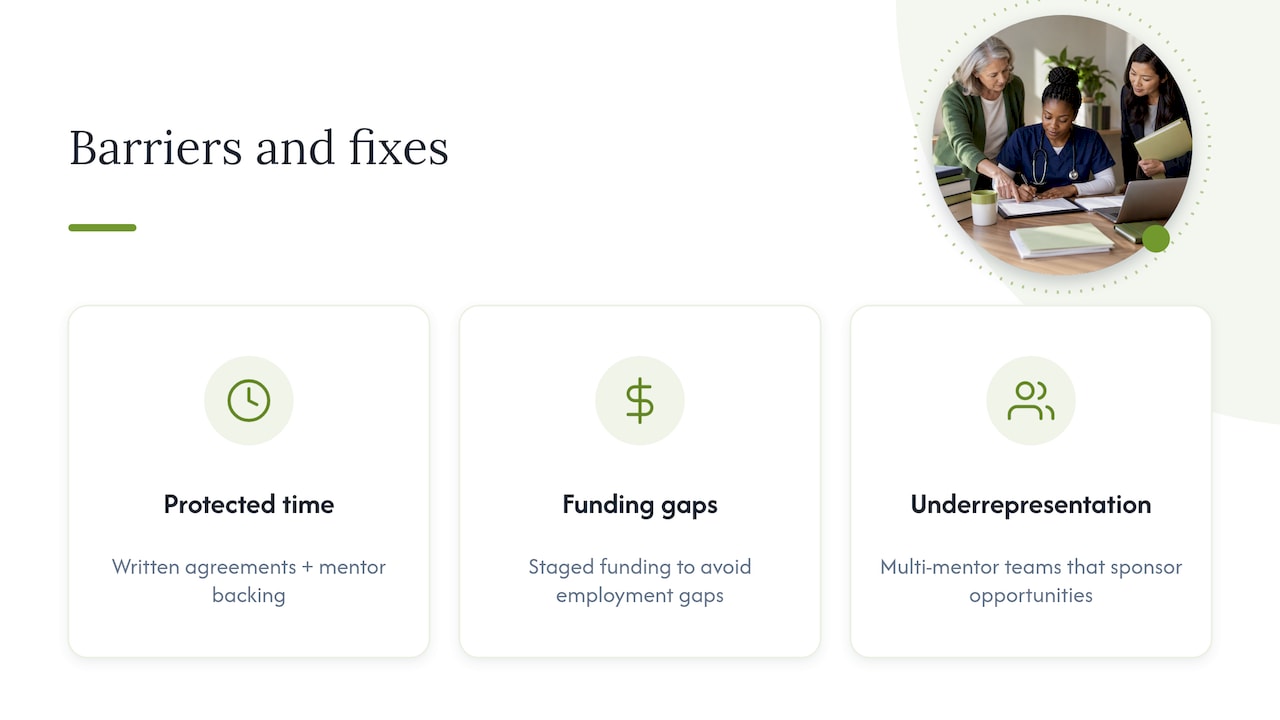
Nurse scientists face a few recurring obstacles that differ from those in clinical leadership tracks. Protected time is the most common: research requires sustained blocks of uninterrupted work, and institutions built around clinical staffing models do not always protect that time by default. Negotiating it explicitly, with a mentor’s backing, works better than hoping workload adjusts on its own.
Funding gaps between training stages create another barrier. A postdoctoral fellowship can end before a K award or first R-level grant comes through, leaving a gap that pushes some scientists toward unrelated work just to stay employed. The NINR Training Pathways report flags this directly and recommends funding models that reduce the need for outside work during training.
Underrepresentation in senior research leadership is a third barrier. The Future of Nursing 2020-2030 report points to mentoring as one lever for building a more diverse leadership pipeline, which is one reason multi-mentor models matter beyond individual skill building. None of these barriers disappear through willpower alone. They respond to structural fixes: written agreements on protected time, staged funding applications that anticipate gaps, and mentor teams that actively sponsor a nurse scientist for opportunities rather than waiting to be asked.
How to measure whether leadership development is working
Leadership development in nursing research is measurable, even though it is often treated as a soft outcome. The study on leadership mentoring for PhD-prepared nurses used the Leadership Practices Inventory 360, a validated instrument that captures leadership behaviors from the perspective of the leader and the people around them, alongside concrete research productivity: grants awarded, articles published, and conference presentations delivered.
That combination, a validated leadership instrument plus tangible research output, is a stronger evaluation model than tracking either alone. A leader whose self-reported skills improve but whose grant and publication record stays flat has not necessarily developed the capacity the training targeted. Track both sets of numbers from the start of any formal program, and revisit them at the same quarterly cadence used for the development plan itself, so shifts in leadership behavior and shifts in output stay linked rather than measured on separate timelines.
Keeping leadership skills current through continuing education
Leadership development does not end when a fellowship or K award concludes. Continuing education keeps skills current as funding priorities, policy environments, and technologies such as AI-enabled health tools shift. Short courses on grant strategy, health policy writing, or emerging research methods let a working scientist update specific skills without pausing a research program.
Professional organizations built around nursing science convene much of this ongoing learning through conferences, committee work, and structured continuing education, offering venues where a mid-career scientist can both teach and keep learning. Committee and editorial board service function as a form of continuing education too: reviewing grants or manuscripts sharpens judgment in ways that reading alone does not. Building a habit of at least one substantial continuing education activity per year, chosen to match a current gap rather than convenience, keeps a leadership skill set from going stale between major career milestones.
Publisher perspective: why this platform prioritizes nurse scientist leadership
The Council for the Advancement of Nursing Science exists to make sure nursing science has a seat at the policy table, not just a presence in journals. That mission shapes everything described above: competency frameworks mean little without venues to practice them, and funded pathways mean little without a community that tracks and celebrates the outcomes. Through continuing education, conferences, and committee work, we try to make the mentor teams and skill-building this article describes easier to find, not harder.
— MIchael
Put CANS membership to work on your leadership path
You do not have to assemble every piece of a leadership plan alone. Membership with the Council for the Advancement of Nursing Science gives you a direct line to the continuing education, conferences, and networking described throughout this guide, at rates built for where you are in your career.
The Individual (student/Undergraduate, Masters, & Pre-Doctoral) membership is $40 per year, and NSNA members qualify for a discounted $36 per year rate. Full membership details, including current benefits, are listed for those further along in their careers.
- Browse continuing education courses to fill a specific skill gap this quarter.
- Check the job board for fellowship and faculty postings relevant to your next career stage.
- Review membership benefits to see which tier fits your current role.
- Contact CANS staff if you want help connecting with mentorship or policy committees.
Join as a member when you are ready to put these resources behind your own plan.
Sources
- AHRQ learning health system core competencies
- NINR Training Pathways Working Group report
- Leadership Mentoring in Nursing Research (LMNR) study
- NURTURe Program mission and goals
FAQ
What is leadership development for nurse scientists?
It is training and mentorship aimed at building the skills to lead research teams, secure funding, and influence health policy, distinct from clinical unit management. The AHRQ core competencies frame this as an engagement, leadership, and research management domain.
Which funded pathways build research leadership skills?
NRSA mechanisms such as F and T32 awards fund early training, while career development K awards support several years of mentored, independent research. The NINR Training Pathways report recommends pairing these with mentor training and longitudinal funding.
Does mentorship actually improve leadership outcomes for nurse scientists?
A pretest-posttest study of PhD-prepared nurses found improvements in Leadership Practices Inventory scores alongside increased grants, publications, and presentations after a mentoring program, according to the LMNR study. Multi-mentor models, like the one UC Davis Nurse Leader Fellows uses, appear to support both project completion and leadership growth.
How much does CANS membership cost for students?
The Individual student membership, covering undergraduate, masters, and pre-doctoral students, costs $40 per year, and NSNA members receive a discounted rate of $36 per year, according to the membership page. Rates for other membership tiers are available on the same page.
What skills should I prioritize first in a leadership development plan?
Grant writing, scientific communication, negotiation, and policy advocacy return measurable results fastest, since they connect directly to grants submitted and manuscripts published. Programs like NURTURe add AI and digital health literacy as an increasingly necessary skill for leading technology-enabled research teams.
Recommended
|
The Council for the Advancement of Nursing Science |
   |