Yes, kratom shows up on urine tests, but only when the test is built to look for it. Standard workplace panels skip it entirely, so detection depends on buying a kratom-specific dip card, strip, or multi-panel cup with mitragynine listed as an analyte. Rapid kits give a presumptive result in minutes; a positive still needs lab confirmation by LC-MS/MS before anyone treats it as definitive.
TL;DR:
- Kratom detection in urine tests requires a specific kit that tests for mitragynine, as standard panels do not include it, and positive results need lab confirmation.
- Rapid test kits like dip cards and strips provide quick presumptive results in minutes but cannot replace confirmatory LC-MS/MS analysis for legal or occupational decisions.
- Sensitivity cutoff levels vary, with some retail dip cards detecting down to 250 ng/mL, although most are around 300 ng/mL, emphasizing the importance of validated, validated testing protocols.
- Detection windows depend on dose and usage frequency, with half-lives estimated from 12 to over 60 hours, causing variability in how long kratom remains detectable.
- For reliable results, vendors should clearly publish cutoff levels, validation status, and confirmatory workflows, avoiding any kits that lack transparent performance data or validated cutoffs.
Table of Contents
- Comparing the best kratom urine test kits on the market
- A quick profile of every kit worth knowing
- How to choose the right kratom test for your situation
- Why screening and confirmation give different answers
- Where to buy kratom test kits and how to use them
- Our take on what these tests can and cannot prove
- Read more before you buy or test
- FAQ
- Sources
Comparing the best kratom urine test kits on the market
Most buyers land in one of three categories: someone screening themselves at home, a clinic that needs a reliable single-analyte option, or a workplace program running a full panel. A few products stand out for each.
- For a fast individual screen, the Rapid Response Kratom Single Drug Test Strip gives a visual result in about five minutes.
- For clinics wanting a dedicated mitragynine assay, the Healgen Scientific Kratom Drug Test Dip Card is built for single-analyte clinical use.
- For the lowest published cutoff among retail options, the ASC Single-Panel Kratom Urine Test Dip Card lists a sensitivity around 250 ng/mL on some vendor pages, tighter than the 300 ng/mL figure common on competing dip cards.
Confirmatory testing is not built into any rapid kit. A presumptive positive from a dip card, strip, or cup has to be sent to a lab running LC-MS/MS if the result needs to hold up for an employer, a court, or a treatment program. Most of these products are sold through medical supply retailers and general online marketplaces, with availability shifting by season and vendor stock.
A quick profile of every kit worth knowing
Twelve kratom urine tests circulate in the retail and clinical supply market, and they split cleanly by format and intended buyer.
- SAFE LIFE Kratom Dip Card Test Kit: a single-panel dip card marketed on low-cutoff sensitivity, aimed at individuals who want a quick private screen.
- NarcoCheck Kratom urine Test: a rapid strip built for quick presumptive screening at home or in a small clinic, valued mainly for its single-strip simplicity.
- Rapid Response Kratom Single Drug Test Strip: a five-minute visual immunoassay, the cheapest route to a fast single result.
- Identify Health 12 Panel Kratom Drug Test Cup: bundles a kratom panel with eleven other common analytes, suited to clinics or workplaces that need broad coverage in one device.
- Healgen Scientific Kratom Drug Test Dip Card: a single-analyte card distributed mainly through clinical supply channels rather than general retail.
- W.H.P.M. MEGA ECO Drug Test Cup (with Kratom panel): a multi-panel cup sold in bulk, practical for clinics processing many samples a week.
- UScreen 19-Panel Rapid Drug Test Cup (with Kratom panel): an extended cup covering 19 analytes, built for clinics that need specialty panels alongside kratom.
- UScreen 22-Panel Rapid Drug Test Cup (with Kratom panel): the highest panel count in this group, meant for comprehensive clinical screening rather than casual home use.
- Amazewell Select Multi-Drug Urine Test Cup (with Kratom panel): marketed to employers and clinics wanting a compact multi-panel option with retail availability.
- ASC Single-Panel Kratom Urine Test Dip Card: notable for a published cutoff as low as 250 ng/mL on some vendor listings, tighter than the 300 ng/mL figure seen on many competing dip cards.
- SAFElife T-Cup Instant Drug Screen Test Cup (with Kratom panel): an instant-read cup format built for workplace screening where speed matters.
- SAFE LIFE Kratom T-Cup and related cup variants: SAFE LIFE’s broader cup lineup, useful for buyers who want to stay within one brand’s ecosystem across formats.
None of these publish a confirmatory LC-MS/MS cutoff themselves. That step always happens at a separate lab, regardless of which rapid kit flags the initial positive.
How to choose the right kratom test for your situation
Picking a kit comes down to five questions you can run through before you buy.
- What cutoff does the vendor publish, and is it stated in ng/mL rather than a vague “sensitive” claim?
- Do you need a presumptive screen only, or will the result have to hold up legally or occupationally?
- Is chain-of-custody documentation and supervised collection required for your situation?
- Do you need a single kratom panel, or a multi-panel cup that also screens for other substances?
- Can the vendor or an affiliated lab actually run confirmatory LC-MS/MS if the screen comes back positive?
Ask any vendor directly about their published cutoff value, whether the product has been validated against a CLIA-certified lab, and what their confirmatory workflow looks like if a result needs to be contested. A vendor that cannot answer those questions plainly is not one to trust with a result that matters.
Pro Tip: Treat any kit that advertises a “guaranteed” result or skips a published cutoff as a red flag, not a shortcut.
A missing cutoff, a vague sensitivity claim, or no stated path to confirmatory testing are the clearest signs a kit is built for casual reassurance rather than a result you can stand behind.
Why screening and confirmation give different answers
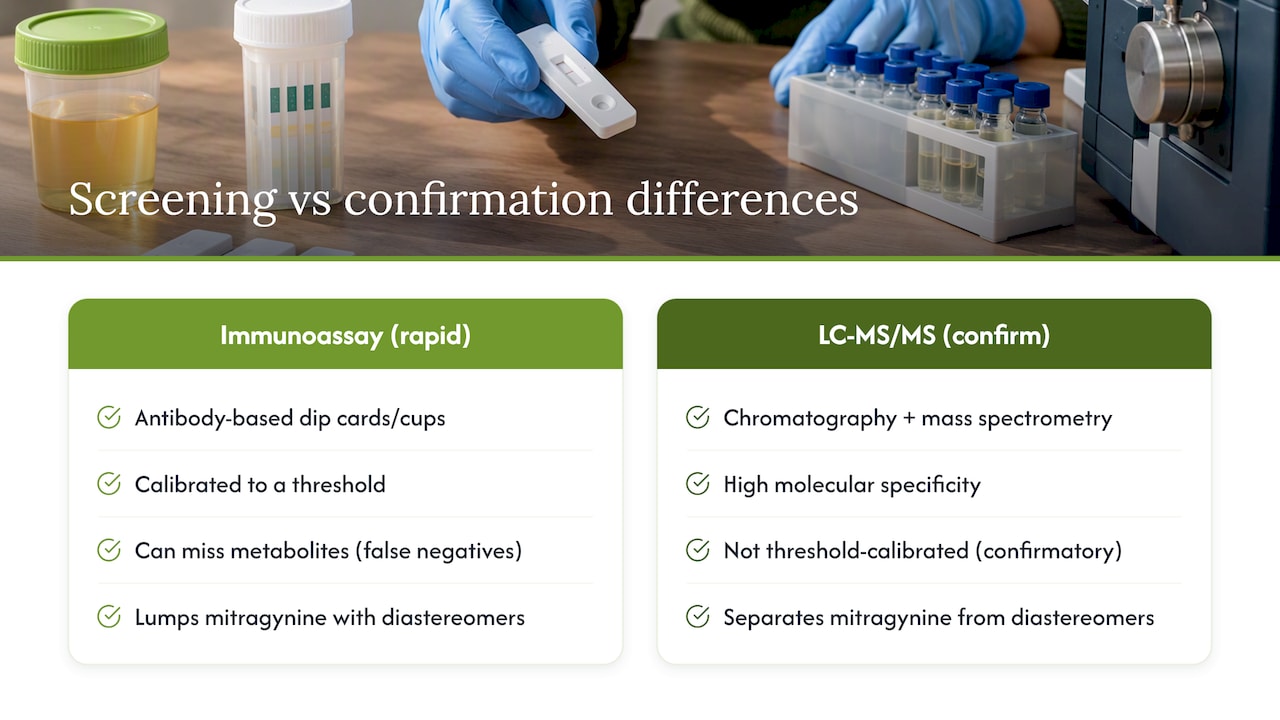
Rapid dip cards and cups work on immunoassay chemistry: an antibody reacts to mitragynine or a related compound and produces a visual line. That reaction is fast and cheap, but it is calibrated to a threshold, not to the exact molecule. Peer-reviewed analysis notes that presumptive immunoassays can produce false negatives when they are not calibrated for mitragynine’s metabolites, and that confirmatory testing resolves those gaps by separating the compound from its diastereomers.
Confirmatory labs run LC-MS/MS, which separates mitragynine from closely related diastereomers like speciociliatine and speciogynine instead of lumping them together the way a rapid card does.
Mitragynine’s terminal half-life has been estimated at roughly 12 to more than 60 hours depending on dose and individual metabolism, which is why detection windows vary so widely between occasional and frequent users. Dose, frequency of use, and assay sensitivity all shift how long a positive stays detectable.
Where to buy kratom test kits and how to use them
Dip cards and strips are sold as single units or in boxes of 25 and 100, mostly through medical supply retailers and general online marketplaces; cup-style multi-panel tests follow the same pack logic but at a higher per-unit price because of the added analytes.
- Choose a dip card or strip for a quick, private screen with no chain-of-custody requirement.
- Choose a multi-panel cup when a workplace or clinic needs several analytes screened at once.
- Store kits at room temperature and check the expiration date before use, since reagents degrade over time.
- Retailers like Moja-lekarna’s rapid test section stock general rapid self-test equipment alongside kratom-specific options.
Our take on what these tests can and cannot prove
A rapid kit is a screening tool, not a verdict. Federal workplace panels still do not list kratom biomarkers as routine analytes, so anyone relying on a drug test for a legal or occupational decision needs a validated lab method and supervised collection, not a dip card bought online. Treat a positive from any of these kits as a starting point that belongs in a confirmatory lab, never as the final word.
— MIchael
Read more before you buy or test
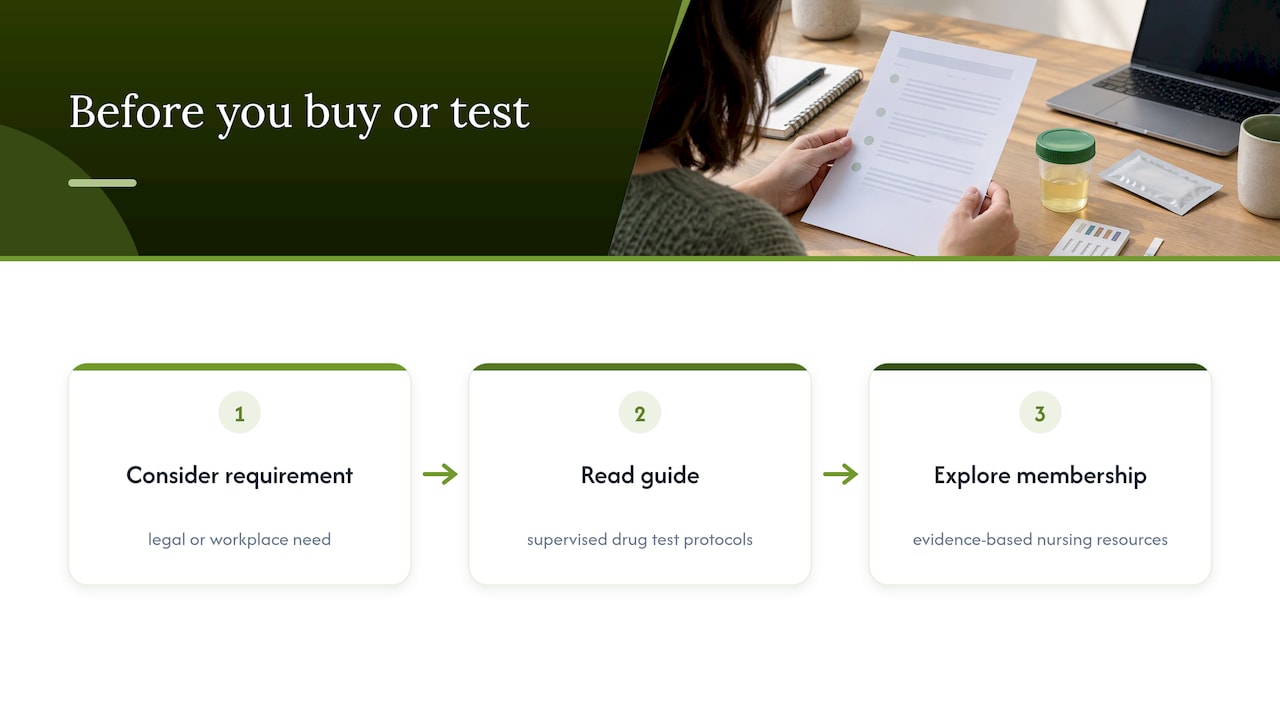
Membership with NursingScience.org gives you access to deeper guides on collection procedures and test interpretation, including our breakdown of supervised drug test protocols. 
If you are weighing a kratom screen against a legal or workplace requirement, read that guide first, then explore membership options built for nursing professionals who want evidence-based resources on testing practice.
FAQ
Will kratom give you a false positive?
A kratom-specific immunoassay can misfire if it is not properly calibrated for mitragynine’s metabolites, producing an inaccurate screen in either direction. Confirmatory LC-MS/MS testing resolves this by separating mitragynine from its diastereomers before reporting a result.
What shows up on a 12-panel drug test?
A standard 12-panel urine test screens for common drug classes like opiates, amphetamines, and cannabinoids, and it does not include kratom unless the product specifically lists a kratom panel. The Identify Health 12 Panel Kratom Drug Test Cup is built with that panel included, which is not the case for a generic 12-panel device.
Do they test for kratom in drug court?
Federal workplace testing guidelines do not currently authorize kratom biomarkers as part of standard urine panels, so routine drug court testing typically will not catch it unless a specific request is made. When kratom detection matters for a legal proceeding, the testing program has to order a validated biomarker test with a confirmatory lab workflow.
How long does kratom stay in your system?
Detection time depends heavily on dose and frequency, since mitragynine’s half-life estimates range from about 12 to more than 60 hours across individuals. Someone using kratom occasionally will clear it faster than a regular, higher-dose user.
Sources
- Drug testing for mitragynine and kratom: Analytical challenges and medico-legal considerations
- Pharmacokinetic studies on mitragynine (Mitragyna speciosa)
- Mandatory Guidelines for Federal Workplace Drug Testing Programs—Authorized Testing Panels
Recommended
- Methods to Pass a Hair Drug Test
- Best Detox Drinks for THC Drug Tests: A Comprehensive Guide
- How to Pass a Drug Test: A Complete and Detailed Guide
- How to Pass a Saliva Mouth Swab Drug Test
|
The Council for the Advancement of Nursing Science |
   |