Yes, edibles show up on drug tests. A standard urine test looks for THC metabolites, and it cannot tell whether they came from a gummy, a vape or a joint. How long they stay detectable depends on the sample type, how often you use, your body and the cutoff the lab applies. For urine, published ranges run from about one day to 30 days, and hair can reach back about 90 days.
This guide explains what each test looks for, what the federal numbers mean, why edibles can feel unpredictable, and how to read the claims you will see online.
TL;DR
- Edibles are detected like any other cannabis product: tests look for THC or its metabolites, not for the form you used.
- Reported detection windows are roughly 2 to 12 hours in blood, up to 24 to 48 hours in oral fluid, 1 to 30 days in urine and up to 90 days in hair.
- Frequency of use is the biggest driver of the urine window. Hydration, body fat and the time since your last dose also matter.
- Federal urine testing uses a 50 ng/mL screen and a 15 ng/mL confirmation. Your employer’s program may use different rules.
- Nobody can promise a result from a calendar alone. Treat any “safe after X days” claim as an estimate.
Table of Contents
- Do edibles show up on a drug test?
- Detection windows by test type
- Federal cutoffs: what “positive” means
- Why edibles can feel different
- What the online “X days” answers get wrong
- Preparing for a test: a practical checklist
- Our perspective
- Get more from Nursingscience
- FAQ
- Sources
Do edibles show up on a drug test?
They do. Drug tests are built around the compound, not the delivery method. After you eat THC, your liver converts it into metabolites, and the main one measured in urine is THC-COOH. The American College of Medical Toxicology explains that a positive urine THC-metabolite result indirectly indicates THC has been present in the body. The same position statement makes clear that these urine tests do not identify the route or source of exposure.
In practice that means three things:
- A lab cannot say “this was a gummy.” It reports a concentration above or below a cutoff.
- “Legal edible” or “low-dose edible” does not change the question. A product bought in a state where cannabis is legal can still produce a positive workplace result.
- A negative result depends on how much the screen is set to detect, not on whether you used.
For a deeper look at what the metabolite means and what it does not, see our guide on how THC metabolites show exposure, not current impairment.
Detection windows by test type
Different specimens capture different slices of time. The ranges below are general guidelines. Verywell Health’s 2026 overview of edibles gives them as follows, and stresses that individual metabolism changes them.
| Test | Typical reported window after edibles | What it reflects |
|---|---|---|
| Blood | About 2 to 12 hours | Very recent use |
| Oral fluid (saliva) | Up to 24 to 48 hours | Recent use |
| Urine | 1 to 30 days | Use over days to weeks, depending on pattern |
| Hair | Up to 90 days | Longer-term exposure |
The wide urine range is the part readers find frustrating, and it is real. One person who ate a single gummy at a party and a person who eats gummies nightly sit at opposite ends of it. Our page on how long weed stays in urine breaks the range down by use pattern, and the THC detox timeline puts the specimens side by side.
Urine
Urine is the most common test for pre-employment screening and for many random programs. Because THC-COOH is stored and released slowly, it lingers. The ACMT notes that in chronic heavy users the metabolite may be detectable for a month or longer after the last use. For an occasional user, the window is much shorter, which is why you see “3 to 7 days” quoted so often on ranking pages. Those are common figures, not guarantees.
Saliva
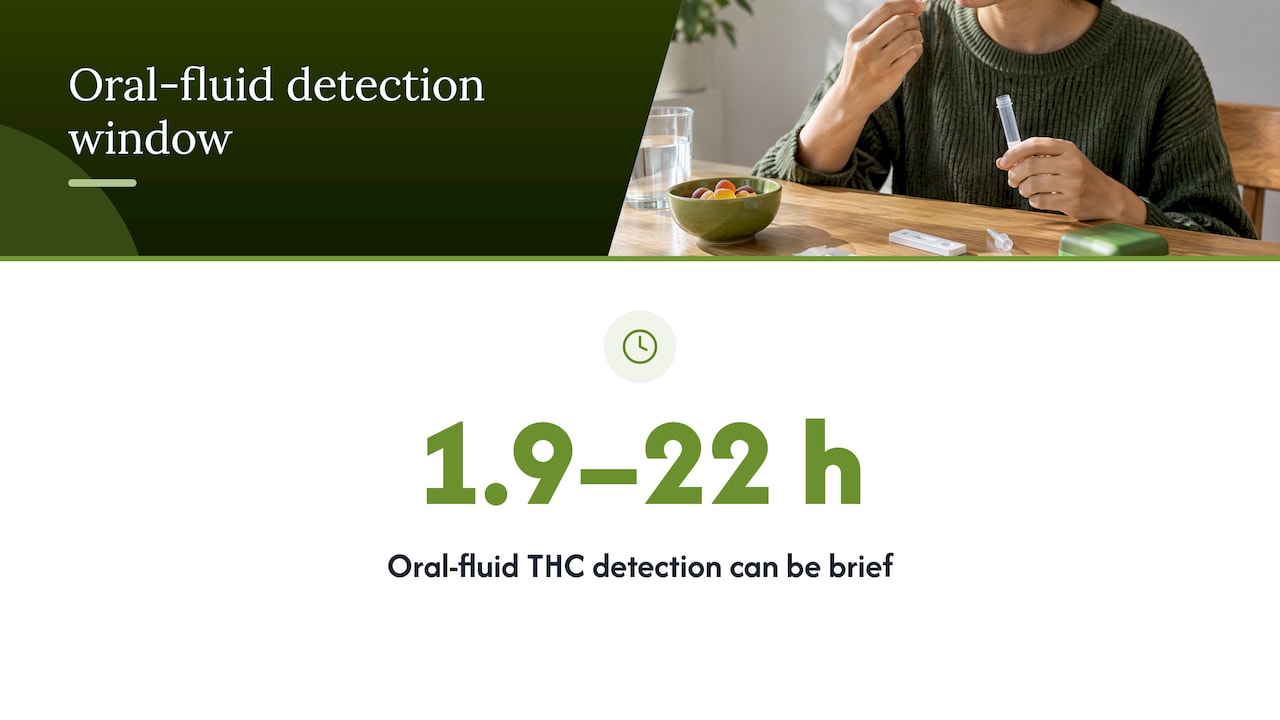
Oral fluid tests are used in some workplace programs and roadside settings because collection is quick and observed. A study of oral cannabis found that THC in oral fluid was detectable for between 1.9 and 22 hours. The same study suggested oral-fluid THC after eating cannabis likely reflects residue in the mouth, not THC circulating in the body. That is one reason a saliva swab can turn positive soon after eating an edible and then clear relatively quickly.
Saliva testing is also a global question, since countries set their own rules for drivers. For a look at cannabis detection for drivers in France, that page covers how detection across different samples is approached there. For U.S. readers, the federal workplace numbers below are the ones that matter.
Blood
Blood tests are rare in routine employment screening. THC is generally present in blood for only a short time, about 2 to 12 hours according to the Verywell Health overview above. Researchers also use the ratio of THC to its metabolites in blood to estimate the timeline of consumption. Blood is more often used after an accident or in a medical or legal setting than in a job screen.
Hair
Hair tests look back furthest. Metabolites become trapped in the hair shaft, so the sample is a record of exposure over time, not of recent impairment. A review in the analytical chemistry literature notes that hair testing is resistant to typical adulteration methods for exactly that reason. A single edible months ago is unlikely to be the main story in a hair result, but repeated use is more likely to register. If a hair test is on your calendar, our guides on hair dye and drug tests and methods people try for a hair test explain what is documented and what is only claimed.
Federal cutoffs: what “positive” means
A drug test is not a yes-or-no detector of any trace. Labs compare a concentration to a cutoff. Under the U.S. Department of Transportation rules, which many employers copy, the numbers are:
- Urine screen: 50 ng/mL for marijuana metabolites, with a confirmation cutoff of 15 ng/mL.
- Oral fluid: 4 ng/mL for the initial THC screen and 2 ng/mL for confirmation.
The ACMT adds that in federal workplace testing, a urine THC-COOH concentration above 15 ng/mL by chromatography or spectroscopy constitutes a positive. The screen is usually an immunoassay, and a confirmation by a more specific method follows when the screen is non-negative. That second step is why a presumptive result is not the end of the process.
Not every employer follows the federal model. Private employers can pick different cutoffs, different panels and different specimen types, which is why the question “how long do I have” has no single answer. Our explainer on how specimen, cutoffs and program rules change detection times goes through those variables.

Why edibles can feel different
People often say edibles “hit later and last longer.” That experience is real, but the research we can cite supports a narrower point for testing purposes: the test measures what is in the sample, and the route does not change which metabolite the lab looks for. What changes your window is the total amount of THC exposure and how often it happens.
The ACMT lists the factors that affect detectability: the extent and duration of THC exposure, time since last exposure, hydration status and individual factors such as adiposity. Here is how each plays out with edibles.
Dose and frequency
Edibles are easy to take in larger, longer-lasting doses. A 20 mg gummy is a much larger THC exposure than a single puff for many people, and a pattern of daily use builds up metabolite stores. If you use several days a week, expect a longer window than the occasional-user numbers suggest.
Time since last use
The clock starts at your last dose, not at the day you bought the product. Metabolite levels fall gradually, and what matters is when your sample is collected relative to the cutoff.
Body composition
THC is fat-soluble, which is why body fat is on the ACMT list. We cover the mechanism in our guide on how THC stores in fat and ways people try to flush it faster.
Hydration and sample dilution
Hydration changes urine concentration. Labs routinely check creatinine and other validity markers, so a very dilute sample may be flagged and you may be asked to retest. Drinking large amounts of water right before collection is not a reliable plan.
Other products
Products labeled CBD can carry trace THC. If you use them, read what actually triggers a positive on a CBD and THC test before your screen.
What the online “X days” answers get wrong
The top results for this search mostly give tidy numbers: up to 3 days for occasional users, 5 to 7 for moderate users, longer for chronic users. Those are reasonable rules of thumb, and they match the lower end of the 1 to 30 day urine range. The trouble starts when a number is treated as a promise.
- They assume the same cutoff. A 50 ng/mL screen and a lower in-house cutoff can give different results for the same sample.
- They assume the same specimen. Three days may be fine for urine and irrelevant for hair.
- They average very different people. The range comes from people who use once and people who use daily.
- Reddit timelines are anecdotes. Someone dropping from 50 to 20 ng/mL in a certain number of days says little about your body.
Home tests have their own limits. The FDA states that home-use drug tests are presumptive and need laboratory confirmation. A home strip that reads negative tells you about that strip at that cutoff, not about the lab’s result.
Preparing for a test: a practical checklist
No product or routine can be promised to change a result, and we do not claim otherwise. What you can do is prepare with accurate information.
- Find out which specimen. Ask HR or the testing site whether it is urine, oral fluid or hair. The window for each is very different.
- Ask what the notice period is. Pre-employment tests often give a day or two. Random tests may give none.
- Stop using as early as you can. The most dependable factor in any timeline is time since last use.
- Think about your use pattern honestly. Daily use over months points toward the long end of the urine range.
- Bring a list of your medications and products. If a result is questioned, labs and medical review officers consider legitimate prescriptions and explanations.
- Read the product claims critically. Detox drinks, shampoos and kits are marketed with confident language. Look for what the maker documents, what is only reported by users, and whether the claim applies to your specimen. Our guide to a tested hair-test approach and products separates those categories.
- Retest on your own terms only as a rough check. A presumptive home test can inform your timeline, but it will not match a lab.
Our perspective
Readers come to us a few days before a test, often anxious, and the first thing we owe them is accuracy. The honest answer on edibles is that the test does not care about the form, and that the window is set mostly by how much and how often you use. We would rather give you the specimen, the cutoff and the realistic range than a slogan.
That is also why we publish detailed guides on each sample type and on the products people ask about. When you understand what a urine screen, a saliva swab or a hair test is measuring, you can judge a claim for yourself and plan around your own situation. Our work as a nursing science community is to make clinical and laboratory information readable for the people who need it, and testing is no exception.
If you take one thing away: plan around your specimen type and use pattern, give yourself as much time as you can, and use our guides to compare the methods and products you are weighing.
MIchael
Get more from Nursingscience
Our drug-testing guides are written for readers preparing for a screen, and the wider site is a home for nurse scientists, educators and students. If you work in or study nursing, membership gives you access to resources, events and a professional network. Student membership (undergraduate, master’s and pre-doctoral) is listed at 40 USD per year, and the NSNA member rate is 36 USD per year. See the options on our membership page.
Employers and organizations can also reach our community through job postings and eNewsletter placements, described on our advertiser information page.
FAQ
How long can edibles be detected in your system?
It depends on the sample. Reported ranges are about 2 to 12 hours in blood, up to 24 to 48 hours in oral fluid, 1 to 30 days in urine and up to 90 days in hair. Your own pattern of use and metabolism move you within those ranges.
Can a drug test tell I used an edible and not smoked?
No. Urine THC-metabolite tests do not identify the route or source of exposure, according to the ACMT position statement. The lab reports a concentration relative to a cutoff, nothing about the product form.
What is the federal cutoff for THC in a urine test?
Under DOT rules the urine screen is 50 ng/mL for marijuana metabolites, and the confirmation cutoff is 15 ng/mL. Oral fluid uses 4 ng/mL for the screen and 2 ng/mL for confirmation. Private employers may set their own limits.
Will one edible cause a positive result?
It can, especially if your sample is collected within a few days and the cutoff is low. For an occasional user the urine window is usually shorter than for a daily user, but nobody can promise a result for one person. Time since last use matters most.
Is a home drug test accurate enough to trust?
Treat it as a rough check. The FDA describes home-use tests as presumptive, meaning a laboratory needs to confirm the result. A negative strip does not guarantee a negative lab result.
Sources
- ACMT Position Statement: Interpretation of Urine Cannabinoid Tests
- How Long Do Marijuana Edibles Stay In Your System? (Verywell Health)
- Pharmacokinetic Profile of Oral Cannabis in Humans
- Analysis of Cannabinoids in Biological Specimens: An Update
- DOT 49 CFR Part 40 Section 40.85
- DOT 49 CFR Part 40 Section 40.91
- Drugs of Abuse Home Use Test (FDA)
- Cannabis au volant : comment fonctionne la détection en France
Recommended
- THC Metabolites: Tests Show Exposure, Not Current Impairment
- Cannabis (THC): How It Stores in Fat and Ways to Flush It Faster
- Hours to 90 Days: THC Detox Timeline and 2026 Federal Cutoffs
- Exercise Before a Drug Test: What Actually Happens to THC
|
The Council for the Advancement of Nursing Science |
   |