Apple cider vinegar (ACV) does not help you pass a drug test. No scientific evidence shows that drinking it clears THC from your body, and adding it to a urine sample is the kind of manipulation labs are built to catch. Below is what ACV does and does not do for urine, hair and saliva tests, what a lab checks on every urine specimen, and what to do if you have a test coming up.
TL;DR
- There is no evidence that drinking vinegar helps the body clear THC quickly, and no evidence it changes a drug-test result.
- Urine tests look for THC metabolites stored in body fat, not for something a vinegar drink can wash out.
- Putting ACV in a urine sample lowers its pH, and labs check pH, creatinine, specific gravity and temperature on every specimen.
- A hair test measures drug incorporated into the hair shaft over months, so a drink does not reach it.
- Concentrated ACV can burn the mouth, throat and esophagus, and mixing vinegar with bleach releases toxic gas.
Table of Contents
- Why people try ACV before a drug test
- What a urine drug test actually detects
- Drinking ACV: what it does and does not do
- Adding ACV to the sample: the part labs expect
- Dilution: the cousin of the ACV myth
- ACV and hair tests
- Health risks of using ACV as a “detox”
- What actually shapes your result
- Perspective
- Planning for a test without gambling on a myth
- Join Nursingscience
- FAQ
- Sources
Why people try ACV before a drug test
The idea spreads through forums and “home remedy” lists: vinegar is acidic, it is sold as a “detox” ingredient, so it must scrub something out of the body. Some posts claim it works like a cleanser for urine. Others say it lowers the pH of your sample so the test cannot read the drug.
The appeal is easy to understand. It is cheap, it is in most kitchens, and it feels safer than a mystery product. But a claim passed from one forum to the next is not evidence. When researchers and clinicians look at it, the answer is consistent: there is no scientific evidence that apple cider vinegar can clean the system and help someone pass a drug test.
To see why, you need to know what a test actually measures.
What a urine drug test actually detects
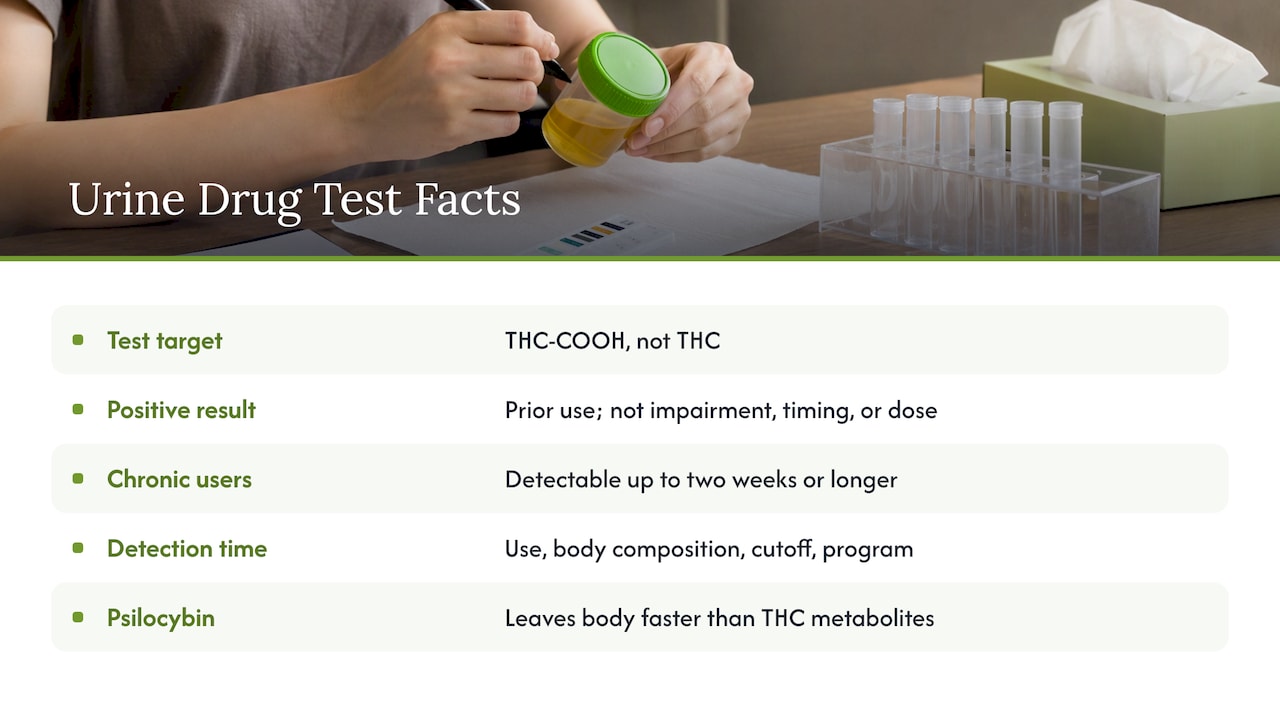
Most workplace tests are urine tests. For cannabis, they do not look for THC itself. They look for THC-COOH, a metabolite your body makes after processing delta-9-THC. The CDC’s advisory on urine testing for marijuana notes that a positive result indicates only the likelihood of prior use and cannot establish impairment, the timing of exposure or the dose. The American College of Medical Toxicology makes the same point: a urine THC-metabolite result shows prior exposure, not clinical impairment. Our guide to THC metabolites and what tests show goes deeper on that distinction.
THC is fat-soluble. It builds up in body fat and is released slowly, which is why the same CDC advisory says metabolites can be detectable for up to two weeks or longer in chronic users. That slow release is the core problem for any quick fix. A drink you swallow an hour before a test does not empty fat stores. It passes through your stomach, enters your blood or leaves your gut, and your kidneys keep producing urine that carries whatever metabolites are still circulating.
How long that takes depends on how often you use, your body composition, the cutoff the lab applies and the kind of program you are in. Our pages on how long weed stays in urine and on how specimen, cutoffs and program rules change detection times lay out those variables.
The same logic holds for other substances, each with its own window. Psilocybin, for example, leaves the body much faster than THC metabolites, which you can see in this overview of psilocybin detection windows and likelihood. The point is that detection time comes from the substance and the test, not from anything in a kitchen cabinet.
Drinking ACV: what it does and does not do
Here is what drinking vinegar can realistically do: add a little fluid, taste sour, and possibly irritate your stomach or throat. Here is what it cannot do: speed up the removal of THC metabolites from fat. There is no evidence that drinking vinegar helps the body quickly cleanse itself of THC.
People sometimes answer that urine pH changes after you drink something acidic. Your body keeps blood pH tightly regulated, and a tablespoon of vinegar in a glass of water is not going to rewrite your kidney chemistry in a way a lab would call a clean sample. And even if some change did occur, it would not remove the metabolite from the specimen. It would only make the specimen look unusual.
Adding ACV to the sample: the part labs expect
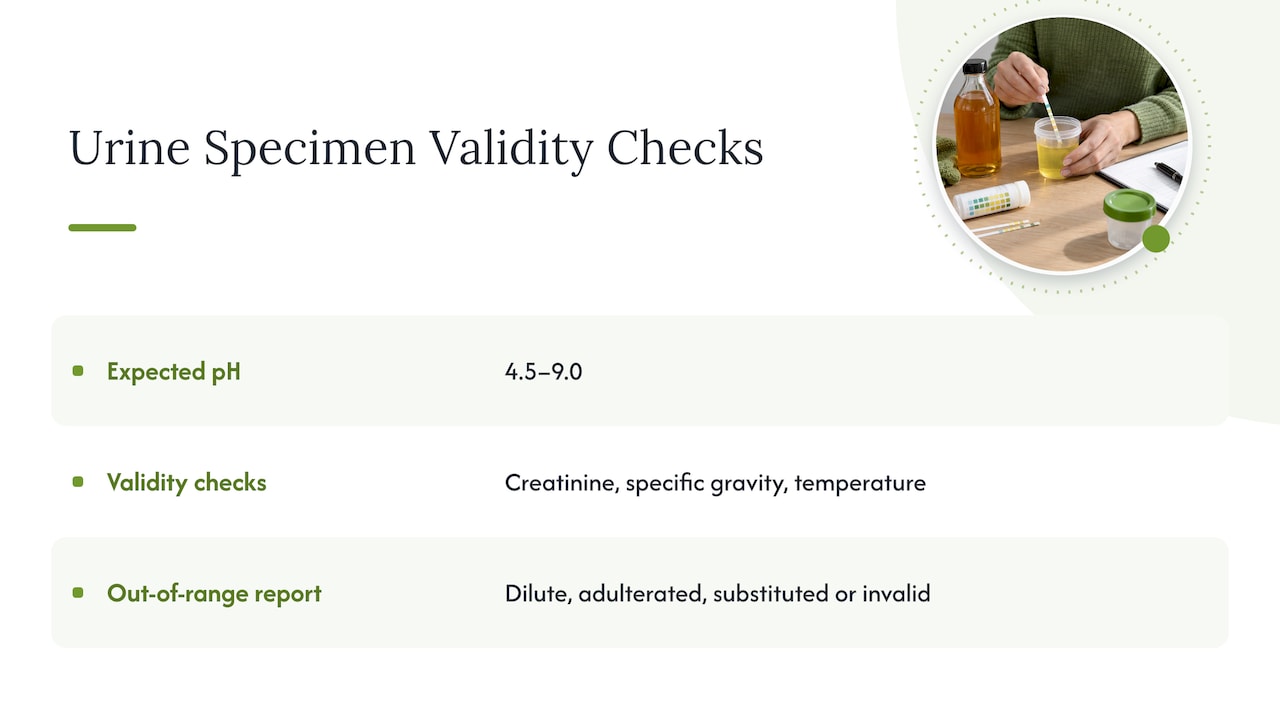
The second version of the myth is to put vinegar into the urine cup itself. Adding ACV to urine can lower its pH and, in principle, interfere with some test results. But labs know this trick. Labs can detect artificially lowered pH, and every urine specimen goes through validity checks.
SAMHSA’s National Laboratory Certification Program lists a normal urine pH range of 4.5 to 9.0. Validity testing also covers creatinine, specific gravity and temperature, and these checks exist to catch dilution, substitution and adulteration. A specimen outside the expected ranges is not read as “negative.” It is reported as dilute, adulterated, substituted or invalid, and that triggers its own process.
Research on household products points the same way. A study of adulterants and ingested compounds found that most household adulterants, except eyedrops, can be detected by routine specimen integrity tests, and that some can mask results only when drug concentrations are moderate. In plain terms: where an additive works at all, it tends to leave a fingerprint.
On the high-pH side, SAMHSA’s advisory board minutes describe a 2006 study showing that pH between 9.0 and 9.5 could reduce recovery of certain metabolites, but that this does not help someone pass because it triggers invalidity protocols. The lesson holds on the acidic side too: an out-of-range sample draws attention.
What happens after a flagged sample
A flagged specimen rarely ends the matter. Depending on the program, an employer may order a recollection, sometimes directly observed. Our guide to supervised urine collection covers what that involves, and the overview of urine collection procedures walks through the workplace and clinical steps. The collection site also checks the sample’s warmth, which we explain in urine drug test temperature for donors.
An adulterated or invalid result can also look worse to a reviewer than an honest positive. It signals an attempt to manipulate the test, and that is a different conversation from a medical or off-duty-use one.
Dilution: the cousin of the ACV myth
Many ACV recipes tell you to drink a lot of water with the vinegar. That is really a dilution strategy, and it has its own track record. SAMHSA’s 2024 Medical Review Officer case studies note that drinking large volumes of water to dilute a sample can produce a Negative and Dilute finding, which may lead an employer to order a second, sometimes directly observed, collection. Medical Review Officers treat dilute specimens as possible signs of manipulation, often calling for a prompt retest.
So the combination of vinegar and gallons of water does not add up to a loophole. It adds up to a sample that looks odd. If your result came back dilute and you are wondering what the numbers mean, see dilute urine drug tests: 20 mg/dL, 1.003 and what to do next.
ACV and hair tests
Hair testing works on a different principle. Drug compounds enter the hair as it grows and stay in the shaft, so a standard sample reflects a much longer period than urine. Nothing you drink moves backward into hair that has already grown, which is why “drinking vinegar before a hair test” has no mechanism behind it.
What research does show is that things applied to the hair can change readings. A 2022 peer-reviewed study found that commercial hair care products, including shampoos and hair tonics, could reduce THC concentrations in hair samples to non-detectable levels. That is a finding about specific products in a controlled setting, not about vinegar, and the authors drew a cautious conclusion: they recommend complementing hair-based abstinence controls with urine analysis. In other words, testing programs are already adapting to this.
If hair testing is your concern, these guides cover what is documented and what is only claimed:
- Detox shampoos
- Hair dye and drug tests
- Bleached hair and drug test readings
- Methods to pass a hair drug test
Saliva tests work on a short recent-use window and have their own collection rules, covered in our guide to saliva swab drug tests.
Health risks of using ACV as a “detox”
Vinegar feels harmless because it is food. In concentrated form it is not. Poison Control states that vinegar is acidic and can cause chemical burns to the skin, and throat and esophageal injury if consumed in concentrated form. The same page warns that mixing vinegar with chlorine bleach releases toxic chlorine gas, which matters if you are tempted to combine household products in the name of cleansing.
A few practical safety points:
- Never drink undiluted vinegar, and do not take large amounts in an attempt to force a result.
- Never mix vinegar with bleach or other cleaners.
- Do not put vinegar or any other additive in a specimen cup. Beyond the testing consequences, it is the sort of act that can cost you a job offer.
- If you have swallowed concentrated vinegar or have throat pain, trouble swallowing or vomiting afterward, call Poison Control at 1-800-222-1222 or seek emergency care.
- If you take medication for diabetes, kidney problems or acid reflux, or have a history of esophageal problems, talk to your doctor or pharmacist before using vinegar in any regular or large amount.
What actually shapes your result
If ACV is not the lever, what is? Several things decide whether a cannabis test comes back positive:
- How often you use. Chronic use means more stored THC and a longer tail of metabolites.
- The cutoff. Lab cutoffs vary by program, and federal cutoffs are different from some private ones.
- The test type. Urine, hair, saliva and blood each have a different window.
- Time since last use. This is the one factor you control, and it is the reason a realistic timeline matters more than any drink.
- Sample validity. A dilute or out-of-range sample creates a retest, not a pass.
Our THC detox timeline breaks this down from hours to 90 days. For the biology of why THC lingers, read about how THC stores in fat and ways to flush it faster. If you use CBD products, see what actually triggers a positive on a THC test.
Other home remedies get the same scrutiny
Vinegar is one of a family of kitchen-cabinet ideas. Baking soda is another, and it carries its own problems, outlined in baking soda and drug tests. Single-marker products that claim to beat a test also tend to fall short, as explained in why labs catch Quick Fix and Upass, and fake samples face their own detection, covered in how labs catch synthetic urine.
If you are comparing commercial options, read our guide to detox drinks for THC tests and the page on Certo and drug tests. Those pages separate documented testing facts from product marketing, and they say plainly what a drink can and cannot do. For a full overview, start with our complete guide to passing a drug test.
Perspective
We read a lot of drug-testing claims, and the ACV one is a good example of how a myth survives. It sounds scientific, because vinegar is acidic and urine has a pH. It is cheap and easy. And enough people post that it worked, without anyone knowing what their result would have been otherwise.
What we try to do at Nursingscience is hold every claim to the same question: what is the mechanism, and who has checked it? For ACV, the mechanism is missing. The checks that exist, from poison control authorities to lab validity standards, point away from it.
Our approach is to give you the testing process in full. Know the test type, the window, the collection rules and the validity checks, and you can plan around real facts. A reader who understands why a dilute sample triggers a recollection makes a better decision than one following a recipe from a comment thread.
If you want to keep learning, we publish guides across hair, urine and saliva testing, and the site is built to link each question to the guide that answers it in depth.
MIchael
Planning for a test without gambling on a myth
A sensible plan starts with finding out which test you are facing. Ask the employer or the collection site which specimen they use and whether the program is federal or private. Then work out your own timeline honestly: how long since your last use and how often you used.
If the test is soon and you may be positive, the honest options are limited, and none of them is a drink from the pantry. Consider whether a short delay or rescheduling is possible through the employer’s normal process. If you hold a medical cannabis card or take any prescribed medication that could affect results, tell the Medical Review Officer during the verification step. That is what the MRO role exists for, and it is a far stronger position than a flagged sample.
If you want to understand what you are walking into, our guide to supervised urine collection explains your rights and the procedure, so nothing at the site surprises you.
Join Nursingscience
Nursingscience.org is a community for nurse scientists and nursing professionals, with resources, conferences and collaboration around research, practice, innovation and health policy. If you work in nursing or are studying for it, membership is how you take part. Student memberships (undergraduate, master’s and pre-doctoral) are $40 per year, and NSNA members pay $36 per year. Regular, discounted and institutional plans are also offered, and you can see all options on the membership page.

Employers and organizations can also reach our community through job postings and eBlasts. Details are on the advertiser information page.
FAQ
Does apple cider vinegar help you pass a drug test?
No. There is no scientific evidence that apple cider vinegar can clean your system or change a drug-test result. THC metabolites are stored in body fat and released slowly, so a drink does not remove them. Time since last use matters far more.
Can apple cider vinegar affect THC in a urine test?
Drinking it has no documented effect on THC metabolites. Adding it to a sample can lower pH, but labs check pH and can detect an artificially lowered value. A specimen that fails validity checks leads to a recollection or a reported invalid result, not a clean negative.
Does vinegar work on a hair drug test?
There is no mechanism for a vinegar drink to alter hair that has already grown. Studies of hair treatments look at topical products such as shampoos and tonics, not ingested vinegar, and even those findings come from lab settings. Programs are also adding urine analysis alongside hair testing.
Is it safe to drink vinegar before a drug test?
Diluted vinegar in food is generally fine for most people, but concentrated vinegar can burn the throat and esophagus, and it should never be mixed with bleach. Drinking it will not help your result, so there is no reason to take risks. If you have reflux, kidney problems or diabetes, ask your doctor first.
What happens if my sample looks diluted or altered?
A dilute result can lead an employer to order a second, sometimes directly observed, collection. An altered or out-of-range sample is flagged by validity testing. Our guide to dilute urine drug tests explains the numbers and next steps.
Sources
- Does Vinegar Really ‘Clean’ Your System in 24 Hours?
- Urine Testing for Detection of Marijuana: An Advisory (CDC)
- ACMT Position Statement: Interpretation of Urine for THC Metabolites
- Use of Urine Biomarkers in Validity Testing (SAMHSA)
- The Effects of Adulterants and Selected Ingested Compounds on Drug Testing
- Drug Testing Advisory Board Meeting Minutes (SAMHSA)
- 2024 Medical Review Officer Case Studies, Urine (SAMHSA)
- Manipulation of THC Hair Concentrations by Commercially Available Products
- No, vinegar is not always safe (Poison Control)
Recommended
- Methods to Pass a Hair Drug Test
- Best Detox Drinks for THC Drug Tests: A Comprehensive Guide
- 1,000 to 8,000 mg Niacin Won’t Beat a Urine Drug Test, CDC Says
- Hours to 90 Days: THC Detox Timeline and 2026 Federal Cutoffs
|
The Council for the Advancement of Nursing Science |
   |