Drinking a lot of water before a urine drug test can lower the concentration of drugs in your sample. It also lowers creatinine and specific gravity, and those are the two numbers a lab uses to label a sample “dilute.” A dilute result is reported on its own line. It is not a pass, and depending on who ordered the test, it can lead to a recollection. This guide covers the lab cutoffs, how fast dilution happens, what creatine does to the numbers, and what the rules say happens next.
TL;DR
- Under the federal workplace rules, a lab calls a sample dilute when creatinine is at least 2 but under 20 mg/dL and specific gravity is above 1.0010 but below 1.0030.
- Heavy fluid intake can push drug levels below the cutoff. The lab still sees the dilution and reports it.
- Creatine supplements can raise urine creatinine, but one controlled study treated that as sample adulteration, not a safe shortcut.
- A “negative-dilute” can trigger an immediate recollection. A positive that is also dilute is treated as a verified positive.
- Medications, coffee, tea and kidney problems can also produce thin urine, so a dilute flag alone does not prove intent.
Table of Contents
- What a dilute urine specimen is
- The cutoffs labs use
- How dilution lowers drug levels
- How fast urine becomes dilute
- Creatine, creatinine and the drug test question
- Other reasons urine can be dilute
- What happens after a dilute result
- What dilution cannot do for THC testing
- Perspective
- Support for the work behind these guides
- FAQ
- Sources
What a dilute urine specimen is
Urine is mostly water, plus waste products the kidneys clear. A dilute specimen has more water than usual, so everything dissolved in it, including drug metabolites, is weaker and harder to detect. That is why people search for dilution as a way around a screen, and why labs built checks to catch it.
The lab does not guess by looking at color. It measures two things:
- Creatinine, a waste product from normal muscle activity that the body releases at a fairly steady rate.
- Specific gravity, a measure of how dense the urine is compared with water.
If both are low, the sample looks like it came from someone who flushed their system. For a deeper walk through the numbers, see our guide on dilute urine drug tests, 20 mg/dL and 1.003.
The cutoffs labs use
For federally regulated testing, the rule is written down. Under 49 CFR 40.88, a laboratory classifies a primary specimen as dilute when creatinine is at least 2 mg/dL but less than 20 mg/dL, and specific gravity is greater than 1.0010 but less than 1.0030 on a single aliquot.
| Measure | Dilute range (federal workplace rule) |
|---|---|
| Creatinine | At least 2 mg/dL and under 20 mg/dL |
| Specific gravity | Above 1.0010 and below 1.0030 |
The 20 mg/dL line shows up elsewhere too. The Nuclear Regulatory Commission’s rule for its testing programs, 10 CFR 26.137, requires a creatinine validity screen with a 20 mg/dL cutoff and quality controls around that value, so labs check their instruments against it constantly.
A few practical points follow from this:
- The thresholds are about the sample, not about any drug. A sample can be dilute and still contain a drug.
- Non-federal employers, clinics and insurers may use their own wording or cutoffs. The federal numbers are the best-documented reference, but your employer’s policy is the one that governs your test.
- Very low values (under 2 mg/dL creatinine) fall into different categories than “dilute,” because they suggest the sample may not be human urine at all. Our piece on how labs catch fake samples covers that side.
How dilution lowers drug levels
The mechanism is simple physiology. When you take in a lot of water, the body suppresses antidiuretic hormone. The kidneys then reabsorb less water, and urine volume goes up. Researchers describing this in a 1998 study of fluid ingestion noted that forced water intake can produce large volumes of highly dilute urine.
That study is the one most often cited on this topic. Its authors concluded that by the time subjects had consumed 2 quarts of any fluid, they were generally producing false-negative results for marijuana and cocaine. They also found that all of the dilution effect tracked with water intake. Herbal “flush” products and diuretic medications added nothing obvious on top of the water.
Two details from that work matter for anyone trying to understand the risk:
- Subjects drinking one gallon of water in four 1-quart portions over 4 hours produced dilute specimens (creatinine under 20 mg/dL, specific gravity under 1.003) after an average of about 1.5 hours.
- Urine values recovered to pretreatment levels over roughly 8 to 10 hours.
So dilution is real, but it is temporary and it leaves a visible footprint in the very measurements the lab reports.
How fast urine becomes dilute
Timing depends on how much you drink, how quickly, and how hydrated you already were. Water can be absorbed within minutes, and Healthline reports it peaks around 20 minutes after drinking. The kidneys begin filtering surplus water roughly 15 to 30 minutes after a drink, according to one health-tech explainer.
The lowest creatinine usually comes a bit later. In a 2018 controlled study, volunteers drank water within 15 minutes and the 2-hour urine void showed these mean minimum creatinine levels:
| Water consumed in 15 minutes | Mean minimum creatinine at 2 hours |
|---|---|
| 0.5 L | 60.4 mg/dL |
| 1.0 L | 15.8 mg/dL |
| 1.5 L | 10.9 mg/dL |
The same study found that 50% of volunteers with a BMI under 20 and 20% of those with a BMI over 20 fell below the 20 mg/dL line. Body size, muscle mass and baseline hydration all change where you land, which is why no single “safe amount of water” exists.
There is also a daily rhythm. A 2013 study in Nutrition Today found that morning and night samples are more concentrated than afternoon samples, in both low and high drinkers. That is one reason collection sites often prefer a first-morning or well-timed sample, and why a normal glass of water at breakfast is a different thing from a flood.
Creatine, creatinine and the drug test question
This is the most searched side of the topic, so here is the plain version.
Creatine is a supplement many gym-goers take. The body converts it to creatinine, and creatinine is one of the numbers labs use to spot dilution. So the logic people follow is: dilute the urine, then add creatine to bring creatinine back above 20 mg/dL.
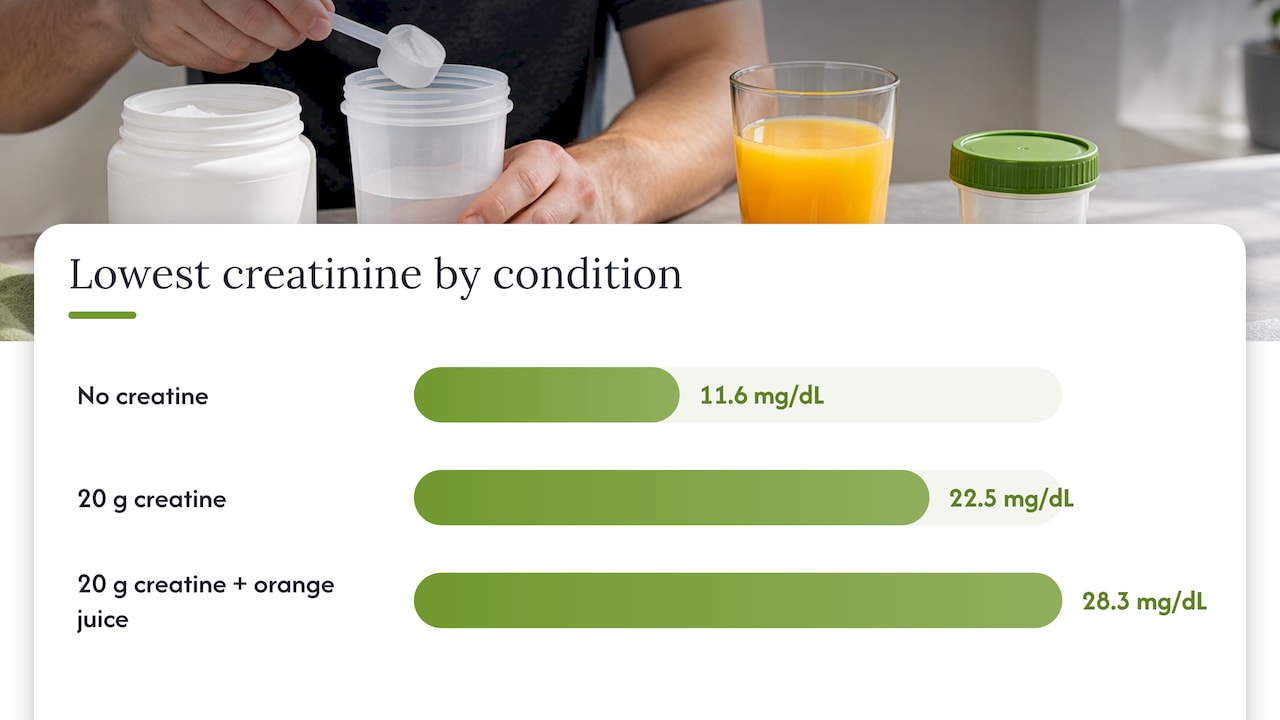
The evidence is narrower than the forum version suggests. A 2022 study by Franz, Skopp and Musshoff measured urine after volunteers drank 1.3 L of water and 0.2 L of orange juice. The lowest creatinine arrived about 2 hours after intake:
| Condition | Mean lowest creatinine |
|---|---|
| No creatine | 11.6 mg/dL |
| 20 g creatine | 22.5 mg/dL |
| 20 g creatine mixed with orange juice | 28.3 mg/dL |
So creatine did raise the creatinine reading above the dilution line. The authors’ conclusion, though, was that creatine supplementation during drug testing would cause negative results through matrix adulteration. In other words, they describe it as interfering with the sample, not as ordinary supplement use. That has consequences:
- Taking creatine as part of a normal training routine is one thing. Loading 20 g right before a collection to alter a result is what the study describes as manipulation.
- Labs look at more than one parameter. Our article on why single-marker claims fail explains how a fix aimed at one number can leave others out of line.
- If a result looks inconsistent, the sample can be sent for further review. Employers and medical review officers (MROs) do not need proof of intent to act on a problem with the specimen.
If you take creatine daily for training, say so to the MRO if one contacts you. A documented routine explains an unusual creatinine value far better than silence.
Other reasons urine can be dilute
Not every dilute sample is deliberate. Healthline lists diuretic medications, coffee or tea, and kidney problems as possible causes. Low body weight and normal heavy hydration, such as a hot day or a long workout, can do it too. The 2018 study above shows that people with a lower BMI dropped under the creatinine line more often.
The American Academy of Family Physicians notes in its urine drug test guide that urine drug concentrations depend on how fast a person metabolizes and eliminates a drug as well as hydration status. It also says an unexpected negative should be confirmed with further testing to tell a false negative from a true one. A pharmacy-focused review in US Pharmacist adds that dilution, timing and amount ingested can all push a result below the lab threshold, and that surprising immunoassay results should be confirmed by GC-MS or HPLC.
If you take a prescribed diuretic or have a kidney condition, tell the collection site or the MRO before the test, and ask your prescriber about timing and fluids. Do not change a prescribed medication or your fluid limits on your own to prepare for a screen.
What happens after a dilute result
What follows depends on the program. Here is what the federal transportation rules say, since they are the most detailed public reference.
Negative-dilute. Under 49 CFR 40.197, when creatinine is between 2 and 5 mg/dL, the MRO directs a recollection and it must happen immediately. When creatinine is above 5 mg/dL, the employer may retest under its own policy, and the recollection is not observed unless there is another basis for it.
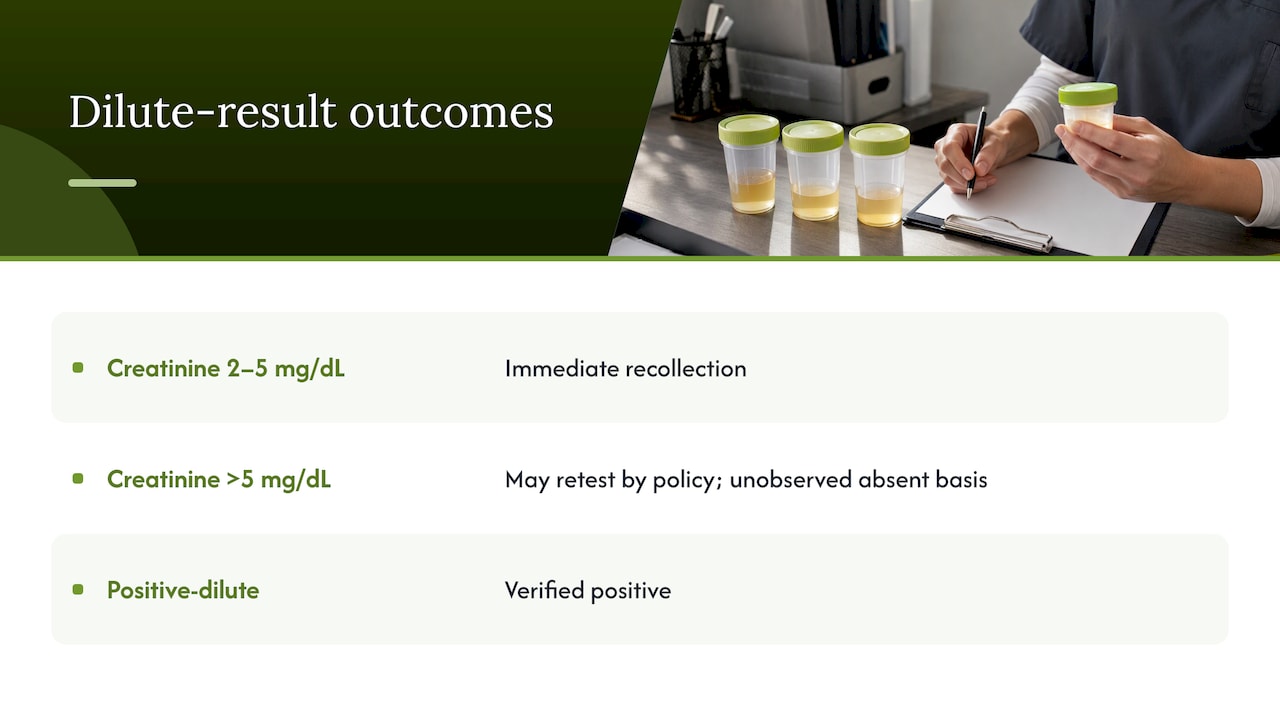
Positive-dilute. The same section says an employer treats a positive test that is also dilute as a verified positive. Dilution does not cancel a positive. It just means the drug was present even at a weakened concentration.
That last point is the practical one. People assume a diluted sample is a safe fallback. The rule works the other way: a dilute flag adds a second reason for scrutiny and, in many programs, a second collection.
Pre-employment screens at non-regulated companies often follow a similar logic, though policies differ: some accept a dilute negative, some require a retest, some treat it as a refusal. Read the policy you signed, and see our guide to U.S. preemployment drug tests and applicant rights for how the process generally runs. Other substances raise their own questions at screening time, as in this look at nicotine pouches and drug tests.
What dilution cannot do for THC testing
THC metabolites can linger for days or weeks in regular users, so people looking for a quick fix often turn to water. The trouble is that dilution works against itself. It lowers the numbers for a few hours, flags the sample, and may trigger a recollection after the water effect has worn off, when your concentration is back to normal.
If your concern is how long THC stays detectable, the better starting point is timing. Our guides on how long weed stays in urine and the THC detox timeline lay out the windows by frequency of use. For a broader view of the methods people talk about and what is documented about each, read our complete guide to drug testing. Two products people ask about specifically are covered in the niacin article and the Certo article.
Perspective
We read a lot of questions from people who are about to be tested, and the pattern is consistent: they hear that one number, usually creatinine, decides everything, so they try to fix that number. A urine drug test is a chain of checks. Collection, temperature, creatinine, specific gravity and the drug assay all say something about the sample.
What we try to do at NursingScience.org is separate what is written in testing rules and studies from what is repeated in product claims and personal stories. The studies on water loading and creatine are clear about what they measured, and the rules are clear about what happens after a dilute result. When you know those two things, you can plan around the actual process instead of a rumor.
Our practical view: the best preparation is accurate information, honest disclosure of medications and supplements to the MRO, and enough time before the test. We keep our guides linked together so you can move from the lab cutoffs to detection windows to your employer’s policy without starting over.
MIchael
Support for the work behind these guides
NursingScience.org is run by a professional community of nurse scientists and nursing professionals, and the educational content you read here sits alongside that mission. If you work in or study nursing, membership gives you access to resources, events and community. The student membership (undergraduate, master’s and pre-doctoral) is listed at $40 per year, and the NSNA member rate is $36 per year.

See the options on the membership page, or visit the NursingScience.org home page for more guides.
FAQ
How long after drinking water is urine diluted?
The kidneys begin filtering surplus water about 15 to 30 minutes after you drink, and the lowest creatinine in a controlled study appeared around 2 hours after intake. In the 1998 study, dilute samples showed up after roughly 1.5 hours of repeated drinking. The effect fades over several hours as your hydration returns to normal.
Does creatine help a drug test?
Creatine can raise urine creatinine. In a 2022 study, 20 g of creatine lifted the mean lowest creatinine from 11.6 to 22.5 mg/dL after heavy fluid intake. The authors described this as matrix adulteration, though, and labs check specific gravity as well, so it is not a reliable or risk-free approach.
What creatinine level counts as a dilute urine drug test?
Under the federal workplace rule, a dilute specimen has creatinine of at least 2 mg/dL but under 20 mg/dL, and specific gravity above 1.0010 but below 1.0030. Other programs can set their own limits, so check the policy for your test.
What happens if my sample comes back dilute?
In federal transportation testing, a negative-dilute with creatinine of 2 to 5 mg/dL requires an immediate recollection. Above 5 mg/dL, the employer’s policy decides whether to retest. A positive that is also dilute is treated as a verified positive.
Can medications cause a dilute or false-negative result?
Yes. Diuretics, heavy coffee or tea, and kidney problems can all produce thin urine. Medical sources also note that unexpected negatives should be confirmed with laboratory methods such as GC-MS. Tell the MRO or your prescriber about any medication you take.
Sources
- Diluted Urine in Drug Tests: How to Ensure Accuracy (Healthline)
- 49 CFR 40.88, criteria laboratories use to establish a dilute specimen (eCFR)
- 10 CFR 26.137, quality assurance and quality control (Cornell LII)
- In Vivo Adulteration: Excess Fluid Ingestion Causes False-Negative Results (PubMed)
- How Long Does It Take to Digest Water and Make Its Way Out? (Healthline)
- Pee a Lot After Drinking Water? (My Flow Check)
- Creatinine excretion in consecutive urine samples after water ingestion (PubMed)
- Short-term Physiological Effects of Increased Water Intake (Nutrition Today)
- The effect of creatine ingestion on urinary creatinine (PubMed)
- Urine Drug Tests: Ordering and Interpretation (AAFP)
- Urine Drug Screening: Minimizing False-Positives and False-Negatives (US Pharmacist)
- DOT Rule 49 CFR Part 40 Section 40.197 (US Department of Transportation)
Recommended
- Dilute Urine Drug Tests: 20 mg/dL, 1.003, and What to Do Next
- Why Labs Catch Quick Fix vs Upass: 3 Reasons Single Marker Claims Fail
- Synthetic Urine Detection: How Labs Catch Fake Samples
- U.S. Probation Drug Test: What to Expect and Ask for GC/MS Confirmation
|
The Council for the Advancement of Nursing Science |
   |