Urine adulteration checks are a set of specimen validity tests that confirm a sample is real, undiluted human urine before anyone looks at drug results. Collectors inspect the sample at the site. Labs then measure creatinine, specific gravity and pH, and test for oxidizing chemicals such as bleach and for agents such as glutaraldehyde. A sample that fails is reported as adulterated, substituted, dilute or invalid, and each label sets off its own review.
This guide walks through those checks in the order a sample meets them. It explains what each one measures and what the result means for the person who gave the sample.
TL;DR
- Adulteration checks start at the collection site (color, temperature, foreign objects, foaming) and continue in the lab (creatinine, specific gravity, pH, oxidants).
- Bleach and other oxidizing adulterants can be screened with an oxidant test and confirmed with a specific quantitative method. Glutaraldehyde is a known adulterant that labs test for.
- Synthetic urine is detectable because it lacks the natural concentrations of human urine constituents.
- An adulterated or substituted result goes to a Medical Review Officer (MRO) and is handled like a positive. In DOT-regulated testing it can lead to a second, directly observed collection.
- Dilute and invalid results are not the same as adulterated ones, and each has its own next step.
Table of Contents
- Where adulteration checks begin: the collection site
- The three kinds of tampering
- The core lab checks at a glance
- What pH tells a lab
- Bleach and other oxidizing adulterants
- Glutaraldehyde test strips: what they are and what they show
- Synthetic and substituted urine
- Adulterated, dilute, invalid: three different results
- What happens after an abnormal validity result
- Preparing for a test without creating a validity problem
- Join the Council for the Advancement of Nursing Science
- FAQ
- Sources
Where adulteration checks begin: the collection site
Most people think of adulteration testing as a lab process, but the first checks happen in the restroom or collection area. According to a professional overview of specimen validity testing, collection-site inspection covers the color of the specimen, foreign objects, foaming and specimen temperature.
Each of these is a cheap, fast signal:
- Temperature. Fresh urine is warm. A specimen that is far too cool or too hot suggests it did not come straight from the body.
- Color and clarity. Unusual colors, cloudiness or visible particles prompt a closer look.
- Foaming. Soap-like foam that does not settle can indicate that something was added.
- Foreign objects. Anything floating in the cup is noted on the paperwork.
These observations do not decide a result alone. They tell the collector whether to flag the sample, and in some programs they can trigger a recollection. If you want to know how supervised collection works in practice, our guide to how labs catch fake samples covers the procedural side.
The three kinds of tampering
The same specimen validity overview groups tampering, which it calls subversion, into three types:
- Adulteration: a substance is added to the sample to interfere with the test or to chemically degrade drugs or their metabolites.
- Substitution: the sample is not the donor’s urine at all, or is not urine.
- Dilution: the sample has been watered down, in the cup or through the donor’s own fluid intake.
The same source lists examples of adulterants: nitrites, chromium (VI), halogens and glutaraldehyde. Each works differently, which is why labs use more than one test instead of a single marker. That idea comes up again in our breakdown of why single-marker claims fail.
The core lab checks at a glance
Under federal guidance, specimen validity testing means evaluating whether a sample is consistent with normal human urine. The SAMHSA Medical Review Officer Guidance Manual identifies creatinine, pH, specific gravity and oxidizing adulterants as common checks in U.S. testing.
| Check | What it measures | What an abnormal result can point to |
|---|---|---|
| Creatinine | A waste product of normal muscle metabolism, present in human urine at fairly predictable concentrations | Dilution (low), or a sample that is not human urine |
| Specific gravity | How concentrated the urine is compared with water | Dilution (low), or substitution when read alongside creatinine |
| pH | Acidity or alkalinity | Adulteration with strong acids or bases |
| Oxidant test | Presence of oxidizing chemicals such as bleach, nitrites or chromium (VI) | Adulteration meant to destroy drug metabolites |
| Specific adulterant tests | Particular agents, for example glutaraldehyde | Interference with the immunoassay reagents |
Creatinine and specific gravity work as a pair. One of the top-ranking technical pages notes that specific gravity is often used as a secondary marker to confirm a problem when creatinine suggests a dilute sample. If you want the numbers and the next steps for a dilute result, see our guide to dilute urine drug tests.
What pH tells a lab
People searching for what causes an abnormal pH on a urine screen usually want to know if a high or low number automatically means tampering. Not quite. According to the specimen validity overview:
- A urine pH below 4 or at 11 and above is classified as adulterated.
- A pH from 4 to 4.5, or from 9 to 11, is classified as invalid.
The same source adds that pH can also be affected by disease, microbial growth, and the time and temperature at which a specimen is stored. That is why an invalid pH is not treated as proof of tampering. The lab reports it, and the review process decides what comes next. In ordinary life, normal urine falls in a middle band, so extreme values stand out quickly.
Bleach and other oxidizing adulterants
A frequent question is whether a urine test can detect bleach. It can. The specimen validity overview states that bleach (hypochlorite) is an oxidizing adulterant that can be screened with an initial oxidant test and confirmed with a specific quantitative test. Confirmation of oxidant adulteration needs specific, quantitative methods such as multi-wavelength spectroscopy or ion chromatography.
Two points are worth understanding:
- Screening and confirmation are separate steps. The first test flags a possible oxidant. A more specific method then measures it, so a flag alone does not become the final result.
- Detection of the oxidant is not the same as detection of the drug. A 2016 review in the academic literature notes that oxidizing adulterants can destroy drug metabolites so that no technology can find them. It adds that validity testing does not reveal which drugs were hidden, and that researchers are working on markers for the oxidation products. In other words, the lab may not know what was in the sample, but it knows the sample was altered, and that alone is reportable.
The practical takeaway: the question labs ask is not only whether a drug is present. They also ask whether the sample is what it claims to be.
Glutaraldehyde test strips: what they are and what they show
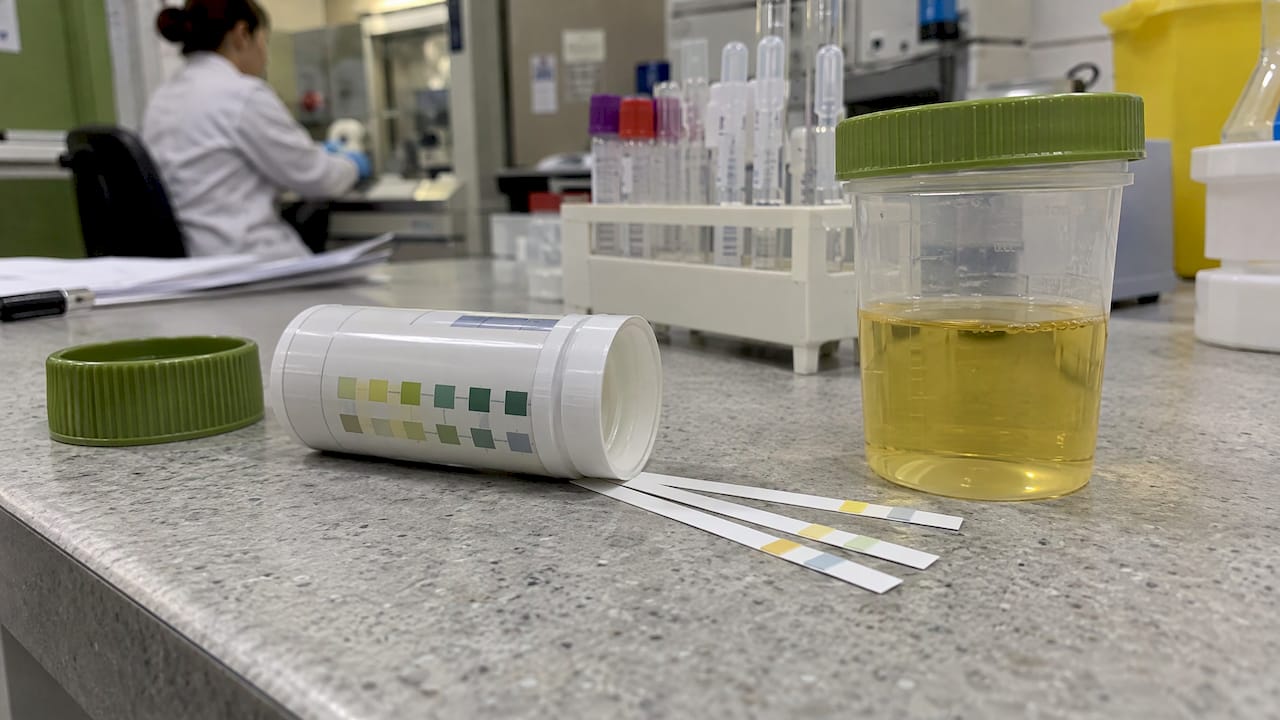
Glutaraldehyde is a chemical used to sterilize hospital equipment. The specimen validity overview explains that it can act as an adulterant by interfering with immunoassay reagents, which may cause false-negative drug results. Because of that, it is one of the agents specifically named in validity testing.
Test strips for glutaraldehyde, and multi-parameter adulteration strips more broadly, are sold for in vitro use. They are fast, one-step tools meant to check whether a specimen looks diluted or adulterated. They are mainly used by employers, treatment programs and collection sites to screen sample integrity on the spot. A few things to keep in mind when you read about them:
- A strip is a screening tool. A lab applies its own validated procedures and confirmation methods to a sample that is actually reported.
- Strips check for particular things. A strip panel that covers creatinine, pH, oxidants and a handful of adulterants says nothing about agents it was not built to detect.
- Strip results at a collection site are not the same as a certified lab’s finding.
The broader point is that glutaraldehyde does not hide in a lab setting. It is a known target, and the people running the test are looking for it.
Synthetic and substituted urine
Substitution is where a different liquid replaces the donor’s urine. Is synthetic urine detectable? Yes. The SAMHSA MRO manual explains that federal guidelines authorize testing for biomarkers. Synthetic urine lacks the natural concentrations of constituents found in human urine, such as creatinine and specific gravity, and other endogenous substances, so a lab can identify it as not consistent with normal human urine.
Temperature and visual inspection catch many fakes before the sample leaves the site. Directly observed collection removes the opportunity altogether. Our guide to synthetic urine detection goes deeper on what labs look for, and our page on probation drug testing explains how supervised programs ask for GC/MS confirmation.
Adulterated, dilute, invalid: three different results
These terms get mixed up constantly, and the differences matter. The SAMHSA manual describes them this way:
- Adulterated: the laboratory confirmed a foreign substance, or an abnormal concentration of a normal constituent.
- Dilute: creatinine and specific gravity are low but still within physiological ranges.
- Invalid: the specimen produced abnormal findings that prevent accurate analysis.
A dilute result is the mildest of the three and often has an ordinary explanation, such as heavy fluid intake. An invalid result means the lab could not produce a reliable answer. An adulterated result means the lab found something that should not be there. Each triggers a specific review protocol, including a possible interview with the MRO or a recollection.
What happens after an abnormal validity result
Laboratories report adulterated, substituted or invalid results to the MRO, who applies the same verification procedures used for a confirmed positive, according to the specimen validity overview. Three rules shape what follows in federally regulated testing:
- The MRO talks to the donor. The donor can offer an explanation.
- The burden of proof sits with the donor. Per the SAMHSA manual, an employee must provide a legitimate medical explanation showing that the substance or value occurred through physiological means.
- Denial without an acceptable explanation leads to a recollection. Under DOT rule 49 CFR 40.159, if the employee cannot give an acceptable explanation and denies adulterating the specimen, the MRO must cancel the test and require an immediate second collection under direct observation.
Non-DOT workplace programs set their own policies, so the exact consequences depend on the employer’s written drug-testing policy. If you hold a safety-sensitive job or a commercial license, the DOT rules above are the ones that apply to you, and your designated employer representative is the person to ask about procedure.
Our perspective
Most readers who land on a page like this are about to be tested and want to know what is realistic. We think the most useful thing a drug-testing resource can do is explain the process accurately, so that decisions rest on how testing actually works.
Specimen validity testing is a layered system. A collector checks the sample, a lab measures several independent parameters, and an MRO reviews anything unusual. A product claim built around one marker, or a personal story from a forum, rarely accounts for all of those layers. That is why we separate documented testing practice from marketing and anecdote in every guide we publish.
Our approach is to anchor each article to a specific reader question, cite federal guidance and published research, and connect you to the next guide that answers the follow-up. If you are weighing your options before a screening, read about detection windows and cutoffs first. They tell you far more about your situation than any single claim about a product.
MIchael
Preparing for a test without creating a validity problem
If you are heading to a screening, the checks above suggest some safe, practical habits:
- Follow the collector’s instructions. Leave bags and extra items as directed, and do not bring anything into the collection area that you were asked to leave outside.
- Drink fluids normally. Very heavy intake just before a test can produce a dilute result, which may mean a recollection. Our guide to dilute urine results explains the thresholds.
- Tell the collector and the MRO about prescriptions and medical conditions. Conditions and medications can affect values such as pH, and the MRO is the person who weighs a medical explanation.
- Skip additives and unverified supplements. Substances placed in a sample are exactly what validity checks look for. High-dose vitamins also do not change how a test works, as shown in our niacin and drug test guide.
- Learn your detection window. For cannabis, the time since last use, frequency of use and the program’s cutoff matter most. See how long weed stays in urine and the THC detox timeline and federal cutoffs for the details. For a broader look at the variables, read how specimen, cutoffs and program rules change drug detection times, or start with our complete guide to drug tests.
Join the Council for the Advancement of Nursing Science
NursingScience.org is run for nurse scientists and nursing professionals who want to advance research, practice, innovation and health policy. Membership gives you access to the resources, conferences and collaborative opportunities that the community offers. Student membership (undergraduate, master’s and pre-doctoral) is 40 USD per year, and the NSNA member rate is 36 USD per year. Regular, discounted and institutional plans are listed on the membership page, where you can see the membership options and the full list of benefits.

If you recruit nurses or researchers, our job board also accepts postings through the advertiser information page.
FAQ
Can a urine drug test detect bleach?
Yes. Bleach (hypochlorite) is an oxidizing adulterant, and labs can screen for oxidants and then confirm the finding with a specific quantitative method. Oxidants can destroy drug metabolites, but the oxidant itself is still detectable, so the sample can be reported as adulterated.
What are the three types of adulteration?
The usual grouping is adulteration (adding a substance), substitution (replacing the sample with another liquid, such as synthetic urine) and dilution (watering the sample down). Labs use creatinine, specific gravity, pH and oxidant tests to identify each one.
What do glutaraldehyde test strips detect?
They are designed to indicate the presence of glutaraldehyde, a sterilizing chemical that can interfere with immunoassay reagents and cause false negatives. Multi-parameter strips may also check creatinine, pH and oxidants. They are screening tools, not a replacement for a certified lab’s analysis.
Is a dilute result the same as an adulterated one?
No. A dilute result means creatinine and specific gravity are low but within physiological ranges, which often follows heavy fluid intake. An adulterated result means the lab confirmed a foreign substance or an abnormal concentration. The next steps differ, and the MRO reviews both.
What happens if my sample is reported as adulterated?
The lab reports it to the MRO, who handles it like a confirmed positive and gives you a chance to explain. In DOT-regulated testing, a denial without an acceptable medical explanation leads to cancellation and an immediate second collection under direct observation.
Sources
- Medical Review Officer Guidance Manual for Federal Workplace Drug Testing Programs (SAMHSA, 2024)
- Adulterants in Urine Drug Testing (PubMed, 2016)
- DOT Rule 49 CFR Part 40 Section 40.159 (U.S. Department of Transportation)
Recommended
- Dilute Urine Drug Tests: 20 mg/dL, 1.003, and What to Do Next
- Synthetic Urine Detection: How Labs Catch Fake Samples
- Why Labs Catch Quick Fix vs Upass: 3 Reasons Single Marker Claims Fail
- Baking Soda and Drug Tests: What It Does and the Risks
|
The Council for the Advancement of Nursing Science |
   |